Talk To Our Expert, Get A Solution in 20 minutes
Share your LED screen needs. Our experts will provide solutions and a quick response.

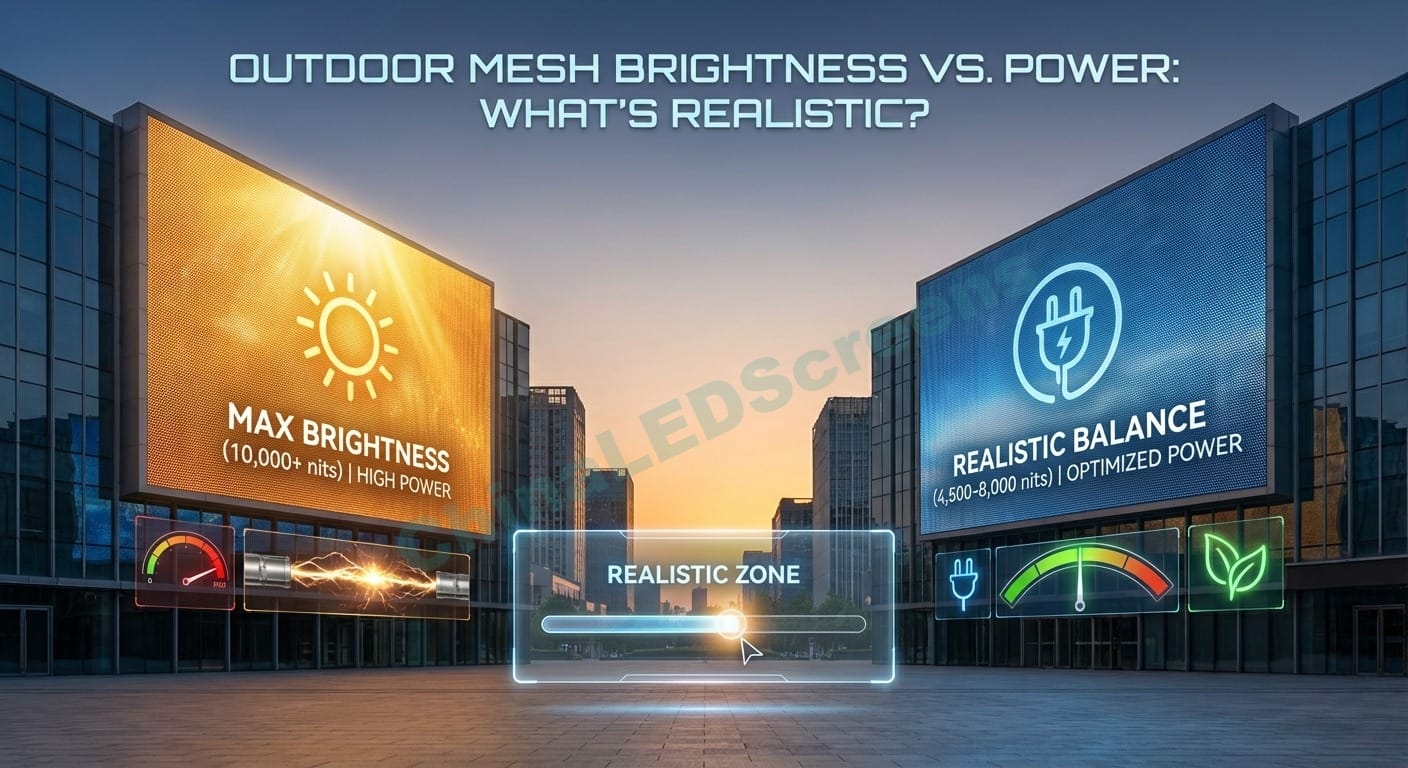
If you have compared quotations from different LED display suppliers, you have probably seen the same pattern again and again: one supplier promises very high brightness, another claims very low power consumption, and a third says their screen can deliver both while still keeping high transparency and a lightweight structure.
From a real engineering and project perspective, this is where many buyers get confused.
The truth is simple: in outdoor mesh LED displays, brightness and power are always linked. You can absolutely achieve a bright outdoor mesh screen. You can also design a mesh display with lower power consumption. You can even keep good transparency and strong wind resistance. But getting all of these advantages at the highest level, all at the same time, is rarely realistic.
That is why this topic matters so much for buyers, consultants, integrators, and project owners. If you understand what is realistic, you can compare quotations much more accurately, avoid misleading specs, and choose a solution that will actually perform well on site for many years.
In this article, I will explain this topic the way a real LED display engineer would discuss it with a serious client: clearly, honestly, and from a practical project point of view.

For most outdoor mesh LED display projects, the realistic brightness and power range usually looks like this:
So if someone tells you that their outdoor mesh screen is ultra-transparent, ultra-lightweight, extremely bright, and consumes unusually low power, you should not reject it immediately, but you should definitely ask deeper questions.
Because in real projects, there is no free lunch.
One of the biggest problems in the LED display market is that many buyers compare specification sheets without comparing the conditions behind those numbers.
For example:
On paper, all of these numbers can look excellent. But in real outdoor operation, the screen still has to deal with direct sunlight, high ambient temperature, wind load, dust, rain, content playback, and long-term reliability.
That is why professional buyers should never evaluate brightness alone and never evaluate power consumption alone.
The right way is to look at the entire engineering balance.
A mesh LED display is not the same as a standard outdoor fixed LED screen.
With a traditional fixed outdoor LED screen, you usually have a more solid display surface, more LED density, and more emissive area. That makes it easier to push brightness higher.
With an outdoor mesh LED display, the goal is often different. In many projects, the screen must also provide:
These are major advantages, and that is exactly why mesh and grille LED solutions are so popular for landmark buildings, media façades, glass curtain walls, and large-scale architectural applications.
But these advantages also introduce tradeoffs.
The more open the screen structure becomes, the less light-emitting area you have per square meter. That means brightness becomes harder to increase without changing other factors such as LED package, current, heat dissipation, power design, or pixel pitch.
So from the beginning, it is important to understand this:
Brightness, transparency, power consumption, and structural design are all connected.
If you push one parameter too far, another parameter usually has to compensate.
Let us look at this from a practical engineering point of view.
This brightness range is already workable for many outdoor transparent and mesh LED applications, especially where the display is not exposed to the harshest direct sunlight all day long.
For example, this can be suitable for:
Many buyers underestimate this range because they focus only on the highest number in the market. But in reality, a well-designed 4,500 to 5,000 nit screen can still perform very well if the project conditions are suitable.
This is one of the most practical ranges for mainstream outdoor mesh LED projects.
Why?
Because this range often gives a strong balance between:
For many commercial projects, this is the sweet spot.
If a client asks me for a practical outdoor mesh solution for a building façade, this is usually where I begin the discussion unless the site has unusually strong sunlight exposure or unusually long viewing distance.
This range is more serious.
It is usually more appropriate for:
At this level, brightness is clearly stronger, but the supplier also needs to manage thermal performance, power design, and long-term stability more carefully.
Yes, this range is possible.
But this is where I always advise buyers to stay rational.
A very high-brightness outdoor mesh or grille screen can be the right choice for some projects, especially for landmark towers, urban media façades, or strong-sun environments. However, it usually means the design is becoming more specialized.
At this level, the supplier must get many details right:
So the question is not whether 10,000 nits is real. It can be real.
The real question is whether your project actually needs it, and what compromises come with it.
This is one of the most important things many non-technical buyers miss.
In an outdoor mesh display, transparency means open area. Open area is good for wind passage, appearance, and façade friendliness. But it also means less LED coverage per square meter.
That creates a natural engineering challenge.
If the display surface has less LED coverage, then to achieve high brightness, the remaining LEDs need to work harder or the optical and electrical design needs to be improved.
That can lead to higher:
So when a supplier offers a screen with very high transparency and very high brightness, do not just focus on the headline numbers.
Instead, ask:
This is how real professionals compare solutions.
Brightness and power cannot be separated from pixel pitch.
A coarser pitch outdoor mesh screen usually has:
A finer pitch outdoor mesh screen usually has:
This is why there is no universal “best” spec.
For a tower seen from 100 or 200 meters away, a coarser pitch may be far more sensible than a finer pitch. For a retail façade with shorter viewing distance, the project may need a different balance.
In LED display engineering, brightness is never an isolated number. It is always part of the overall visual and structural logic of the project.
This is another area where buyers often get misled.
Peak power is the highest possible power draw under the most demanding conditions. It is important for:
Peak power is very important in engineering design, but it does not mean the screen will consume that power all day.
Average power is usually more useful when discussing daily operation cost. But average power depends heavily on:
This is why average power numbers can vary a lot between different projects, even when the same display model is used.
For example, if your content uses a lot of dark background and the screen is dimmed intelligently at night, actual daily average power may stay quite reasonable.
But if the content is bright, high-APL, and the screen is operated aggressively for long hours, average power will be much higher.
So when reviewing quotations, do not ask only for average power.
Ask for both:
That will tell you much more.
For many modern outdoor mesh LED displays, a realistic operating expectation is:
Of course, some projects may fall outside this range depending on pitch, transparency, brightness target, and system design.
But if a quotation claims unusually low average power together with unusually high brightness, I strongly recommend asking the supplier how that figure was measured.
A good supplier should be able to explain clearly:
If the supplier cannot explain the number clearly, the number should not be trusted too easily.
This is something many project owners overlook.
The same LED screen can show completely different power behavior depending on content.
For example:
That means power consumption is not only a product issue. It is also a content-management issue.
In real projects, a smart content strategy can help save meaningful operating cost over time.
So when designing an outdoor media façade, the best discussion is not only about hardware. It should also include content and operating logic.
That is how experienced suppliers and serious clients work together.
If an outdoor mesh LED display is installed on a building façade, tower, or urban structure, it should not run at full daytime brightness all the time.
A professional outdoor system should include automatic brightness adjustment based on ambient light.
This matters for several reasons:
In simple words, maximum brightness is a capability, not a permanent operating mode.
A good outdoor mesh system should be bright enough during the day and intelligently dimmed at night.
If a supplier talks only about maximum nits but says nothing about dimming logic or brightness control, that is not a complete professional answer.
In LED displays, brightness creates heat.
More current and more output usually mean more thermal pressure. In outdoor applications, this is even more critical because the screen is already working in high ambient temperature, sunlight exposure, and challenging weather conditions.
So when discussing brightness and power, I always look at the following together:
A screen may look excellent in a short demo, but the real test is whether it can maintain stable brightness and stable operation after long outdoor use.
That is the difference between a quotation-oriented product and a real project-oriented product.
Outdoor mesh LED is often chosen because it reduces wind load and keeps the façade lighter than a conventional solid LED wall.
That is a major engineering advantage, especially for:
But again, if a project pushes for higher brightness, the structural conversation may also become more demanding.
For example, the project may need:
That is why experienced façade LED suppliers do not evaluate brightness separately from structure.
A strong outdoor mesh project is always a combination of optical, electrical, and mechanical engineering.
If you want to compare quotations professionally, here are the questions I recommend asking every supplier.
Not theoretical maximum. Not a brochure headline. Ask for the actual supplied configuration.
This is extremely important. Numbers without matching test conditions are not very meaningful.
Make sure the transparency matches the real product design, not just marketing wording.
A good supplier should explain why the proposed pitch matches your viewing distance and content goal.
This is a basic requirement for serious outdoor projects.
Ask about thermal behavior, power supply layout, and long-term outdoor stability.
If the screen is installed on a façade, service access becomes very important.
A serious supplier should be able to discuss this honestly.
These questions quickly reveal whether the supplier truly understands outdoor façade LED engineering or is only trying to win by quoting attractive numbers.
From my professional perspective, for many outdoor mesh LED applications, the most practical range is often:
This range is often where you get the best overall balance of:
For more demanding landmark or high-exposure projects, the target can absolutely move higher. But the decision should be made for real technical reasons, not just because a larger nit number looks better in a sales presentation.
A lot of buyers assume higher brightness is always better.
That is not always true.
If the project does not actually need extreme brightness, over-specifying the screen may create unnecessary disadvantages:
A professional LED solution is not the one with the highest possible number.
It is the one that is correctly matched to the project.
That is true in outdoor mesh displays just as it is true in any serious engineering product.
If I answer the question directly and honestly, I would say this:
Outdoor mesh LED displays can absolutely be bright and energy efficient, but there is always a realistic engineering balance behind the final result.
For most projects, 4,500 to 6,500 nits is already a very practical outdoor brightness range. For stronger-sun or landmark applications, 6,500 to 8,000 nits is realistic. 8,000 to 10,000 nits can also be achieved, but usually with more specialized design choices and more attention to power, heat, structure, and cost.
In terms of power, many modern outdoor mesh systems realistically fall around 160 to 280 W/m² average and 460 to 800 W/m² peak, depending on brightness target, pitch, content, and dimming strategy.
So when evaluating quotations, the best approach is not to ask, “Who has the biggest brightness number?”
The better question is:
Which solution gives the best real balance of brightness, power, transparency, structure, reliability, and long-term operating value for this specific project?
That is the question real professionals ask.
And when you ask that question, you usually make a much better buying decision.
To learn more about façade LED and transparent display solutions, you can also explore these resources from ChinaLEDScreens: