Talk To Our Expert, Get A Solution in 20 minutes
Share your LED screen needs. Our experts will provide solutions and a quick response.

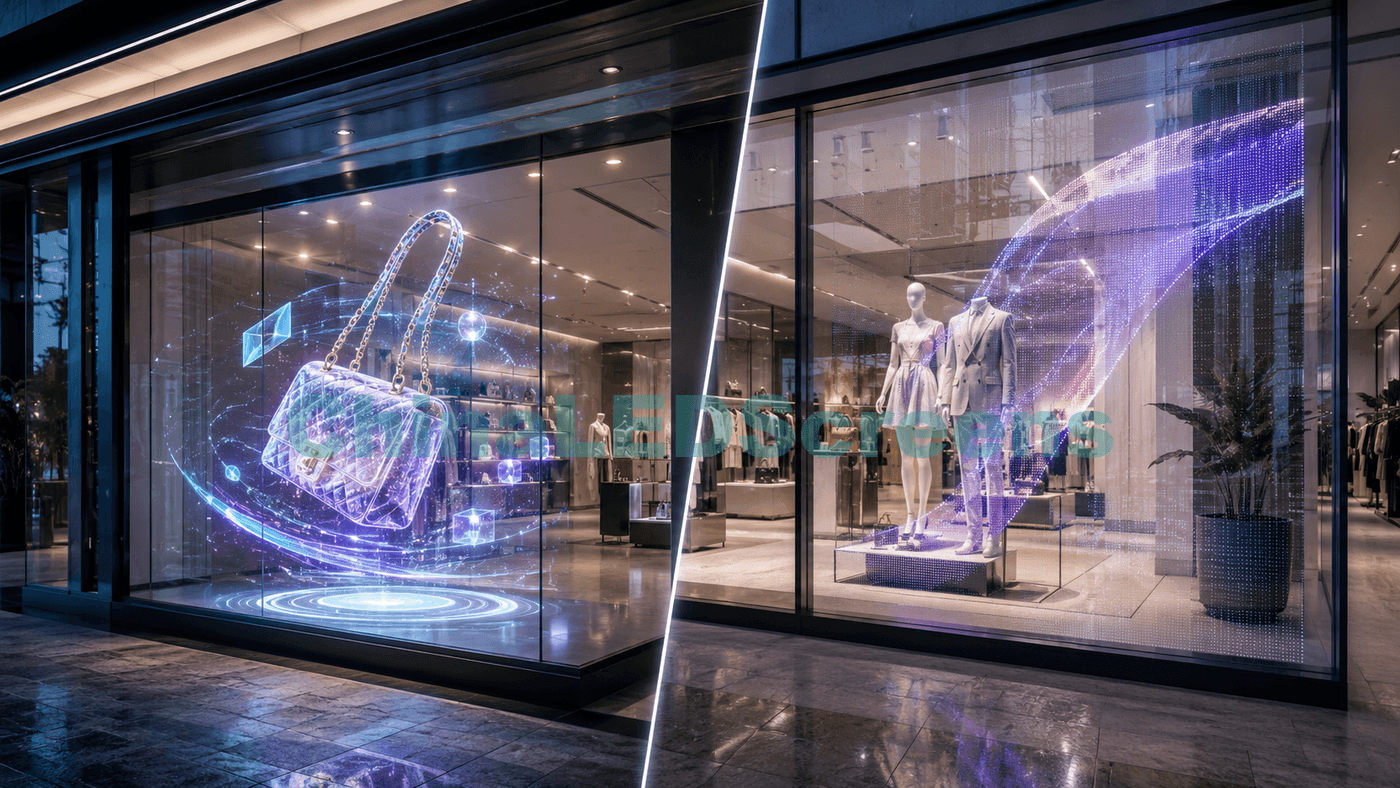
When a retail brand plans to install a digital display on a glass storefront, one of the most common questions we receive is:
“Should we choose a holographic LED display or transparent LED film?”
At first glance, both technologies appear similar. Both allow customers to see digital content on glass surfaces while maintaining transparency.
However, from an LED engineering perspective, they solve different problems.
A transparent LED film screen is mainly designed for glass integration, transparency, and minimal architectural impact.
A holographic LED display is designed for visual impact, immersive experience, and premium brand storytelling.
The right choice depends on the purpose of the project.
A shopping mall window promoting daily discounts may require a different solution compared with a luxury flagship store creating a memorable customer experience.
As a professional transparent LED display solution provider, ChinaLEDScreens evaluates these projects based on real factors such as:
If you need a simple recommendation:
| Project Requirement | Recommended Solution |
|---|---|
| Maximum transparency | Transparent LED Film |
| Existing glass window | Transparent LED Film |
| Ultra-thin installation | Transparent LED Film |
| Luxury flagship store | Holographic LED |
| Museum or exhibition | Holographic LED |
| Strong visual impact | Holographic LED |
| Large glass facade | Depends on engineering requirements |
The decision should not be based only on product specifications.
The most successful projects start by understanding the purpose of the display.
A holographic LED retail window uses transparent LED technology combined with creative content design to create a floating visual experience.
The goal is not simply to display an advertisement.
The goal is to make customers stop, look, and interact.
For example, a traditional display may show:
A holographic LED window can create:
This is a common misunderstanding.
Commercial holographic LED displays are usually not true optical holograms.
Instead, they create holographic-like effects through:
In practical retail projects, the hardware and content must work together.
A high-quality transparent LED display with poor content will not create a strong visual experience.
For a deeper explanation of the technology, see our holographic LED screen guide.
Transparent LED film is an ultra-thin LED display solution designed specifically for glass surfaces.
Unlike traditional LED cabinets, transparent LED film can be installed directly onto existing glass.
Typical applications include:
The main idea behind LED film is:
Add digital content without changing the original glass appearance.
Many retail brands do not want to block their storefront.
The glass window serves two purposes:
Transparent LED film allows both functions to coexist.
Advantages include:
Learn more about this technology in our transparent LED film screen guide.
| Category | Holographic LED | Transparent LED Film |
|---|---|---|
| Main purpose | Immersive experience | Digital window advertising |
| Visual effect | Floating 3D effect | Transparent video display |
| Transparency | High | Very high |
| Installation | Customized structure | Glass attachment |
| Content requirement | High | Medium |
| Brand impact | Very strong | Strong |
| Cost level | Higher | Medium |
| Best users | Premium brands | Retail chains |
The strongest advantage of holographic LED is emotional impact.
In luxury retail, customers are not only buying products.
They are buying:
A holographic LED window can transform a normal storefront into a digital experience zone.
Transparent LED film focuses more on elegance and integration.
It works especially well when:
For example:
A fashion store may want customers to see mannequins behind the glass while promotional content plays on the surface.
In this situation, transparent LED film is often the better choice.
Retail windows are one of the most challenging environments for LED displays.
The reason:
Glass creates reflections.
Outdoor sunlight reduces contrast.
A screen that looks excellent indoors may perform poorly when installed behind a storefront window.
Important factors include:
A professional evaluation should consider the real installation environment instead of only comparing catalog parameters.
For technical evaluation, customers should review:
transparent LED display technology and quality.
The biggest advantage is simplicity.
Typical installation:
Glass surface preparation
↓
LED film attachment
↓
Power and signal connection
↓
Testing and calibration
Benefits:
However, maintenance planning is important.
Because the film is attached directly to glass, replacement procedures must be considered before installation.
Holographic LED installations are usually more customized.
They may require:
The advantage is flexibility.
Designers can create more dramatic visual experiences.
Recommended:
Holographic LED Display
Why?
Luxury brands usually focus on:
A floating digital product presentation can create stronger customer attraction.
Recommended:
Transparent LED Film
Why?
Shopping malls usually need:
LED film provides digital advertising while maintaining transparency.
The choice depends on the objective.
For:
→ Holographic LED is attractive.
For:
→ Transparent LED film may be more practical.
Recommended:
Holographic LED
Museums value:
The technology helps combine physical objects with digital information.
Main factors:
Additional factors:
Generally:
| Solution | Investment |
|---|---|
| Traditional LED window display | Lower |
| Transparent LED Film | Medium |
| Holographic LED | Higher |
The most expensive solution is not always the best solution.
The correct technology should match the business objective.
A higher transparency rate does not automatically mean better performance.
A retail window facing direct sunlight may require:
Holographic LED depends heavily on content.
A normal advertising video may not create a holographic effect.
The content should be designed specifically for transparent displays.
Before installation, consider:
Choose transparent LED film when:
Choose holographic LED when:
For architectural glass applications, LED glass technology is another option worth evaluating. More details can be found in our LED glass screen guide.
Retail is changing.
A storefront is no longer only a place to display products.
It is becoming:
Transparent LED technologies will continue developing toward:
Not always.
Holographic LED is better for immersive experiences, while transparent LED film is better for transparency and architectural integration.
Yes.
This is one of its biggest advantages.
Usually holographic LED because luxury brands often prioritize customer experience and visual impact.
Transparent LED film is generally more affordable than customized holographic LED installations.
Yes, but brightness and contrast must be selected according to the actual environment.
Holographic LED windows and transparent LED film are both advanced solutions for modern retail environments, but they serve different purposes.
Transparent LED film is the practical choice when the priority is:
Holographic LED is the premium choice when the priority is:
The best solution is not determined by technology alone.
It depends on the project environment, customer journey, content strategy, and long-term business goals.
For a professional evaluation, review complete transparent LED display solutions and select the technology that matches your actual retail objective.