Talk To Our Expert, Get A Solution in 20 minutes
Share your LED screen needs. Our experts will provide solutions and a quick response.

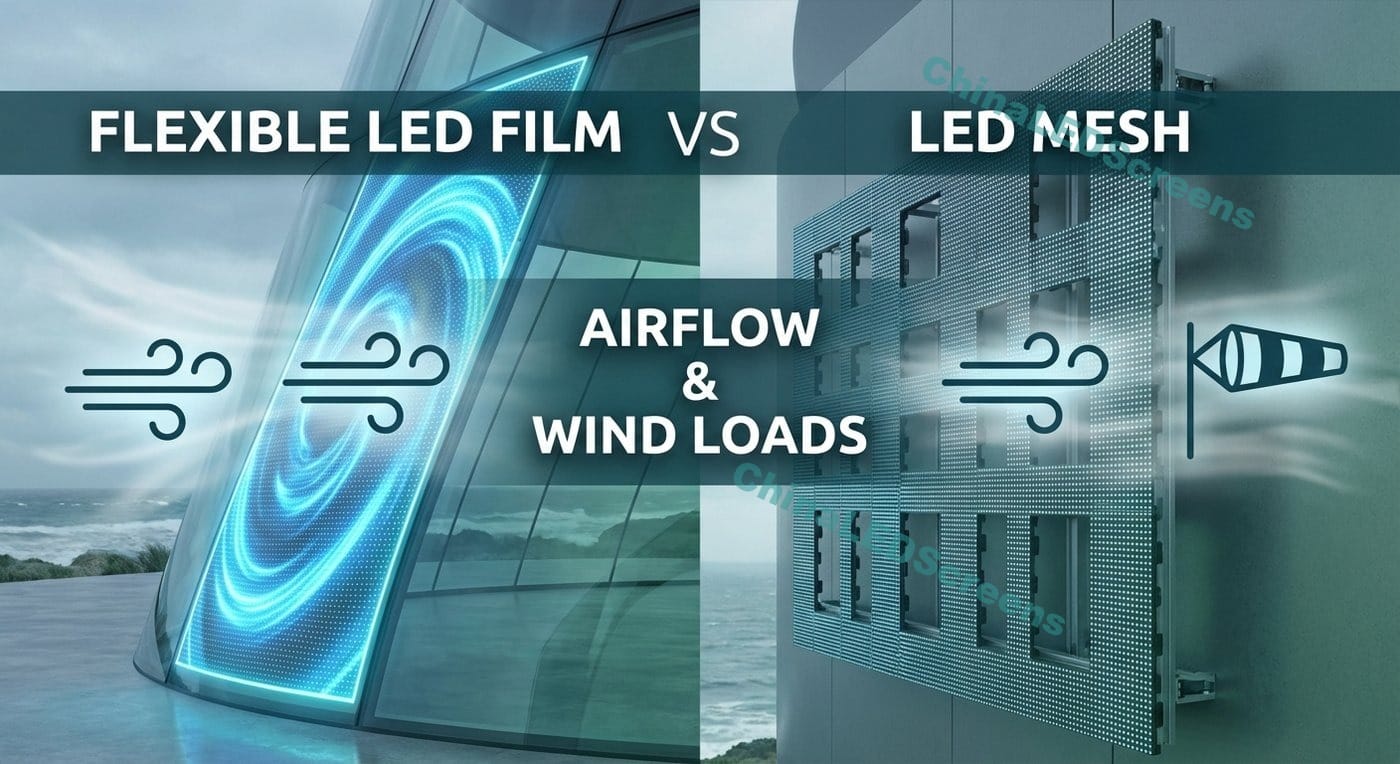
When you put pixels on a façade, you’re not just buying a display—you’re adding an aerodynamic surface to a building. In calm indoor spaces, that’s a minor detail. But on a windy exterior corner, a high-rise elevation, or a coastal site, that “detail” becomes the difference between a clean permit package and a painful redesign.
This guide gives you a practical, engineering-first way to choose flexible LED film vs LED mesh specifically through the lens of airflow, wind pressure, vibration risk, and structural cost—without drowning you in code math.
Along the way, I’ll also point you to the most relevant technical primers on ChinaLEDScreens: the homepage for solution navigation, plus deep guides on film, mesh, and grille-style systems. (Internal links are selected from your provided keyword–URL mapping.)
If you remember only one thing:
If you want to explore overall categories first, start here: ChinaLEDScreens homepage.
Wind design is not only about “how strong the wind gets.” It’s also about:
A key concept for porous displays is porosity / open area ratio (the percentage of area that allows air to pass). Porosity is commonly defined as open area divided by total area. In the real world: higher porosity generally means less sail effect, but it does not automatically guarantee safety—because cable tension, flutter, and connection fatigue can dominate.
Flexible LED film (especially adhesive film) is a beautiful tool for glass-based media surfaces: thin, clean edges, high transparency, and a “digital glass” look.
If you’re new to this category, these two are your best foundations:
Film itself is not “porous.” In wind terms, film behaves closer to a solid sheet—which means the wind force can rise quickly with wind speed.
A useful baseline physics relationship for velocity pressure is: [ q = 0.5\rho v^2 ] This form is widely used in wind action calculations (including Eurocode-style approaches), with worked examples often using (\rho \approx 1.25\ \mathrm{kg/m^3}).
(This is a baseline only; codes apply exposure, gust, pressure coefficients, and zoning.)
| Wind speed v (m/s) | Baseline q (Pa) = 0.5·1.25·v² |
|---|---|
| 20 | 250 |
| 30 | 563 |
| 40 | 1000 |
| 50 | 1563 |
What this means for film projects: If the film is exposed to strong winds, the question becomes less “can the LEDs survive” and more “can the adhesion + edge detailing + substrate safely transmit the load without peeling, creeping, or damaging the glazing assembly?”
Bottom line: Film is fantastic—just don’t force it into conditions where the project behaves like an outdoor sail.
If you’re considering a film system engineered for transparency and performance, see: Transparent flexible LED film screen (COB).
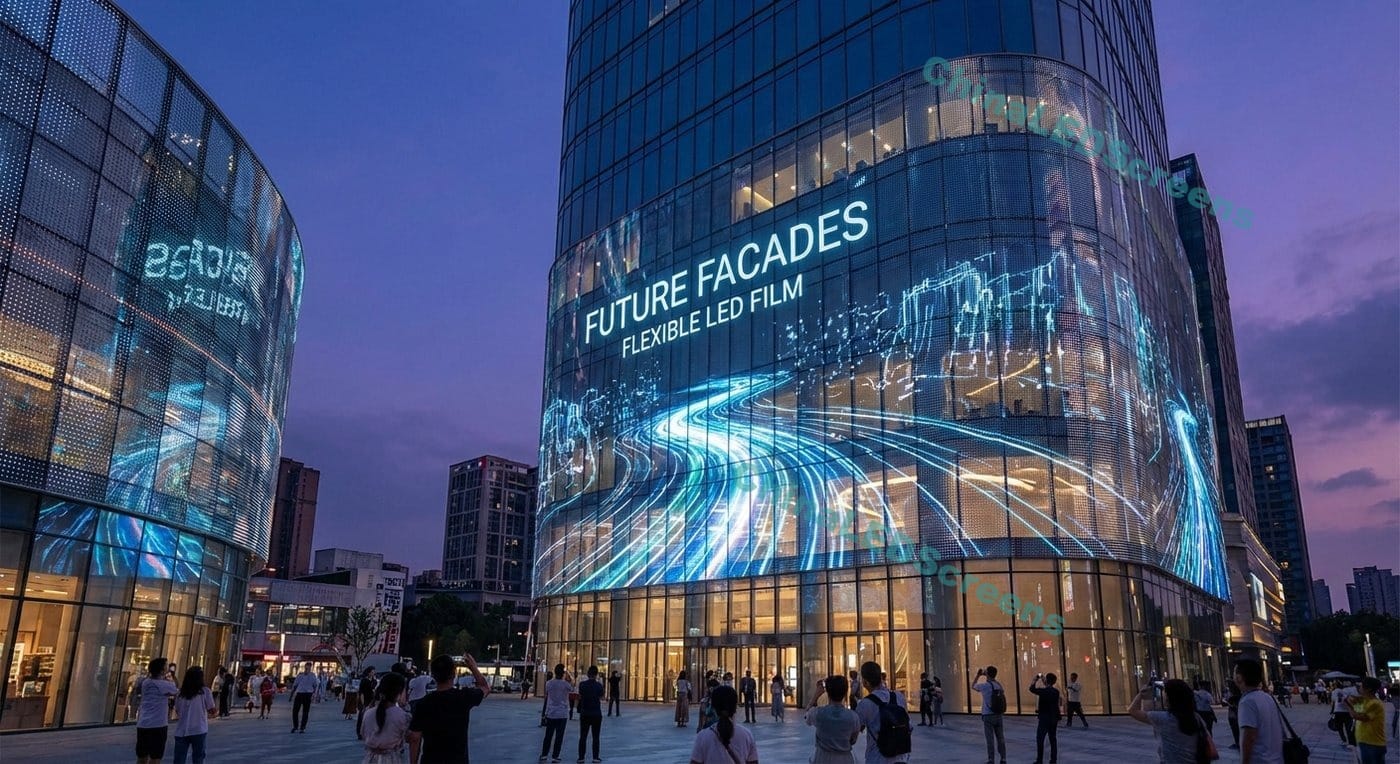
LED mesh (mesh curtain, flexible mesh) is designed to let wind pass through. That often reduces structural demand and makes permitting easier—when the system is engineered correctly.
Start with the category deep dive:
Research on porous façade skins shows wind loads can be filtered by porous layers, and the effect depends on porosity and cavity gap distance—sometimes reducing loads, sometimes shifting where loads concentrate.
A separate body of work (using perforated sign panels as an analogy) reports that drag tends to reduce with higher porosity, with one study describing up to ~0.85× drag coefficient at 30% porosity in that specific configuration.
Translation into façade projects: Mesh can reduce pressure forces—but it can also introduce dynamic problems:
If you need a rugged outdoor reference point: Outdoor mesh LED display screen (waterproof).
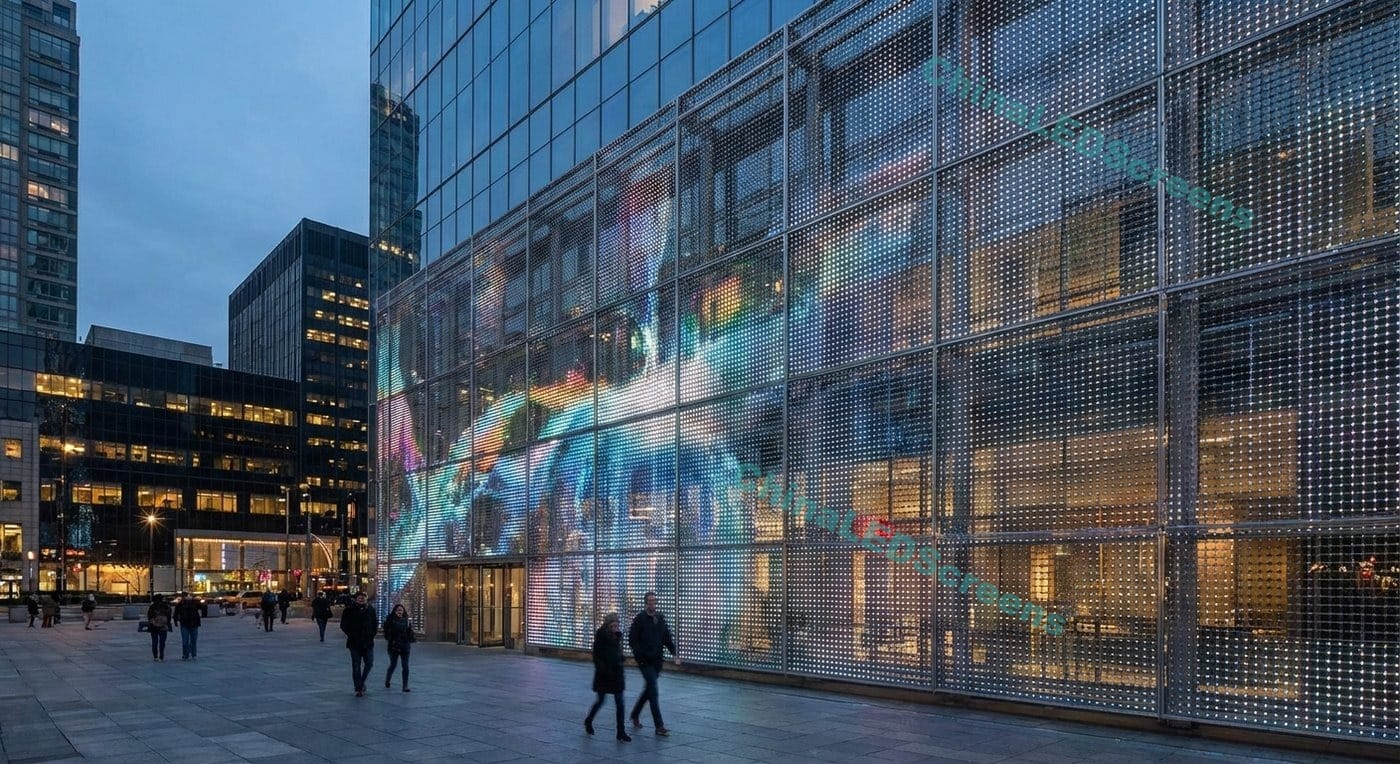
In many façade projects, the real decision isn’t only film vs mesh—it’s “Do we need a more structural, wind-practical porous system?”
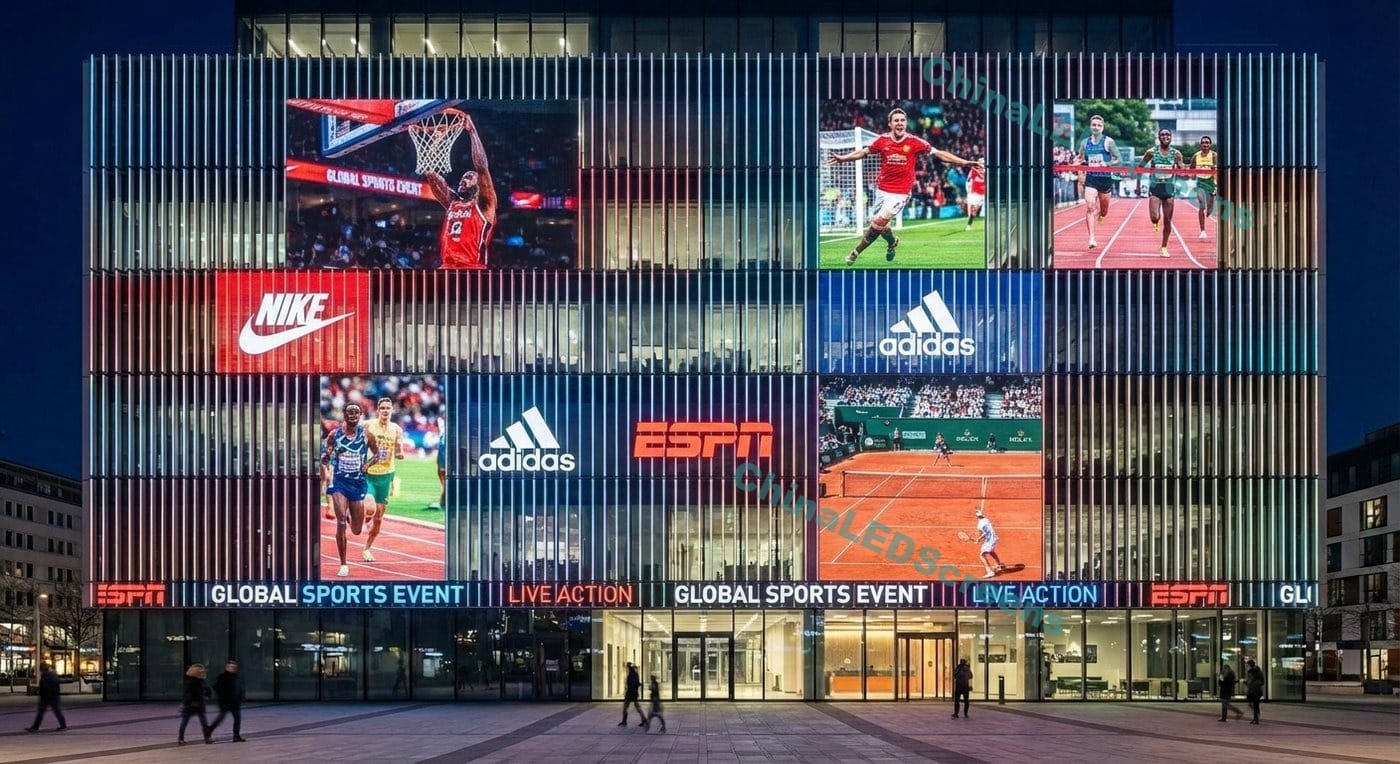
That’s where grille (louver/strip) systems often win: higher openness than solid panels, more rigid than soft mesh, and predictable load paths.
Use this for design and engineering framing:
Grille systems typically make sense when:
| Criterion | Flexible LED film | LED mesh curtain | LED grille / louver |
|---|---|---|---|
| Airflow / porosity | Low (near-solid) | High (porous) | Medium–high (porous) |
| Wind load behavior | Sail-like if exposed | Reduced sail effect, but dynamic risks | Reduced sail effect + rigid load path |
| Structural demand | Higher if wind-exposed | Often lower, depends on span/tension | Often moderate, predictable framing |
| Main engineering risk | Adhesion/edge peel + substrate pressure | Flutter, vibration, fatigue of connections | Frame/anchor detailing + thermal movement |
| Best placement | Indoors / behind glazing / sheltered | Outdoor wind-exposed façades | Outdoor façades needing rigidity |
| Visual look | “Digital glass,” seamless | “Floating pixels,” transparent at distance | Linear/louver aesthetic |
You don’t need to run full code calcs to make good early decisions—but you do need a process.
If your exposure is “High,” default to mesh or grille unless a structural engineer explicitly supports film.
In the US, many engineers use ASCE-style forms where velocity pressure is expressed with coefficients such as (0.00256) and factors like exposure and directionality. In Europe, EN 1991-1-4 style approaches commonly use (q = 0.5\rho v^2) and then apply coefficients.
Why this matters for you as a buyer: your vendor should not just say “wind resistant.” They should tell you:
Regardless of product type, request:
Practical starting points:
Start here:
A façade display budget is never only “screen cost per m².” Wind exposure changes:
That’s why wind-exposed projects often end up cheaper overall with mesh/grille, even if the LED hardware price looks higher at first glance.
Mesh often reduces the sail effect because air passes through, but the final behavior depends on porosity, spacing, detailing, and whether the system flutters or resonates. Research on porous skins shows porosity and cavity conditions can significantly change wind pressure patterns.
Because standards don’t cover every atypical porous geometry cleanly, and pressure behavior can depend on solidity ratio and shape; some work notes the need for experimental measurements for atypical porous materials.
Sometimes—but only when the installation is effectively sheltered (behind glazing, recessed, protected from direct pressure cycling). If it’s truly wind-exposed, you are designing a sail plus adhesion system, which is rarely the smartest risk profile.
To navigate your solution families quickly, start from the homepage, then go deeper into the film/mesh/grille guides linked above.