Talk To Our Expert, Get A Solution in 20 minutes
Share your LED screen needs. Our experts will provide solutions and a quick response.

Introduction: The Three Coordinates of Industry Value
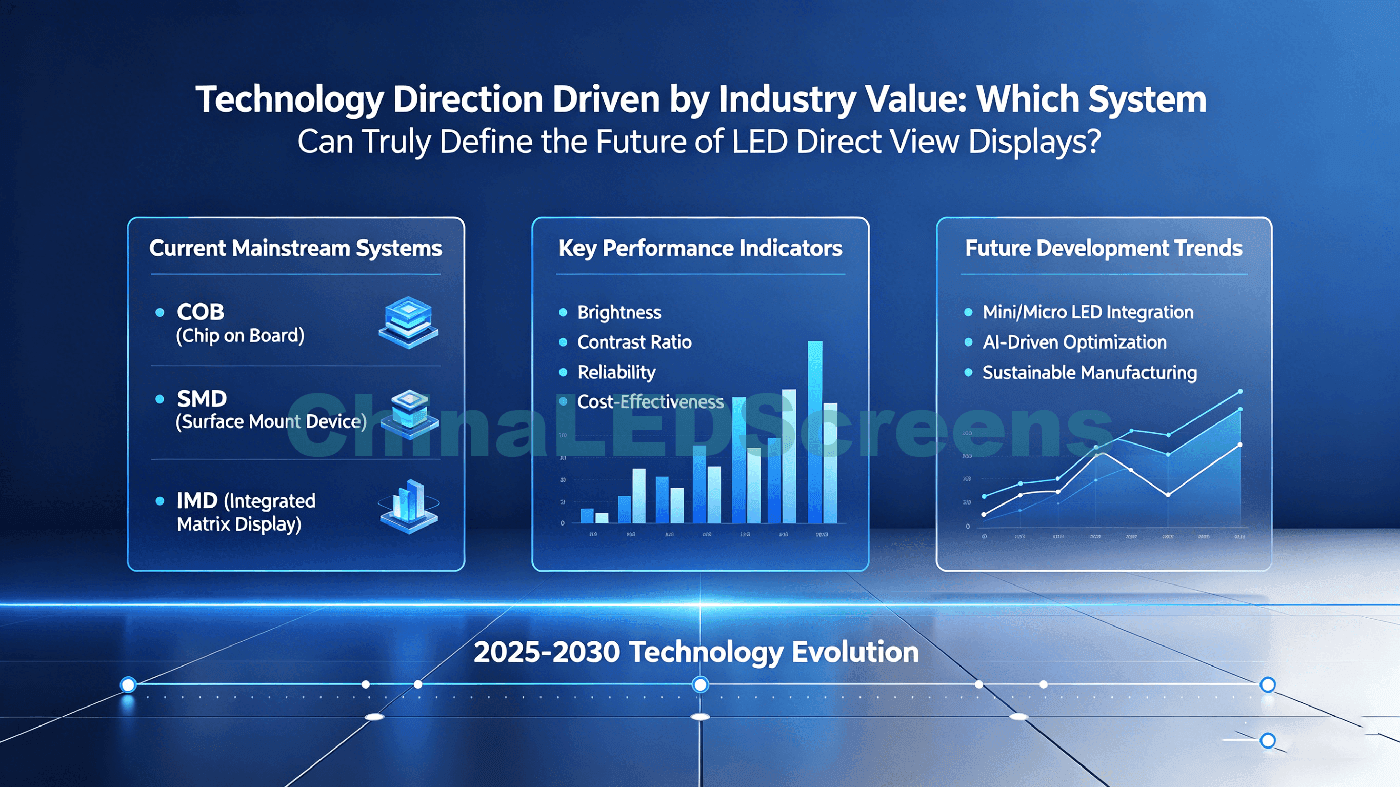
After more than 30 years of development, the LED direct view display industry has formed a clear consensus on its core value direction—continuous evolution across three key dimensions:
These three dimensions are interrelated and mutually constrained. Only a system-level technology that can simultaneously drive positive progress in all three represents the true future of LED direct view display technology.
Technologies that optimize only one dimension while compromising others are, ultimately, transitional solutions rather than long-term directions.
Based on the Evolution Model of LED Direct View Packaging Technology, this article provides an in-depth analysis of the value alignment of two major technology systems and reveals why the YangYi (BPIPack) system is the only path that truly aligns with industry value.
To answer the question, “What kind of system can truly align with industry value?”, we must first understand the underlying logic behind these three dimensions.
Front-side failure modes in LED display panels can be divided into two categories:
Chip technology can only address internal failures, but it cannot eliminate external failures.
Therefore, the improvement of reliability fundamentally depends on how effectively a packaging system eliminates external failures.
The more external failures a system can eliminate, the higher its reliability ceiling.
When pixel pitch shrinks from P2.5 to P0.9, the number of interconnection nodes per unit area increases nearly eightfold. When pixel pitch goes below P0.4, the physical size of traditional discrete devices can no longer accommodate the required density.
Therefore, the improvement of pixel density fundamentally depends on the packaging system’s ability to support high-density interconnections.
The higher the interconnect density a system can support, the smaller the achievable pixel pitch.
Cost reduction must not come at the expense of reliability; otherwise, “low cost” becomes “high maintenance cost.”
True cost optimization means ensuring that every bit of chip potential is fully utilized, rather than wasted in inefficient system architecture.
Therefore, cost reduction fundamentally depends on the “chip value realization efficiency” of the packaging system.
The higher the value realization efficiency, the lower the true cost.
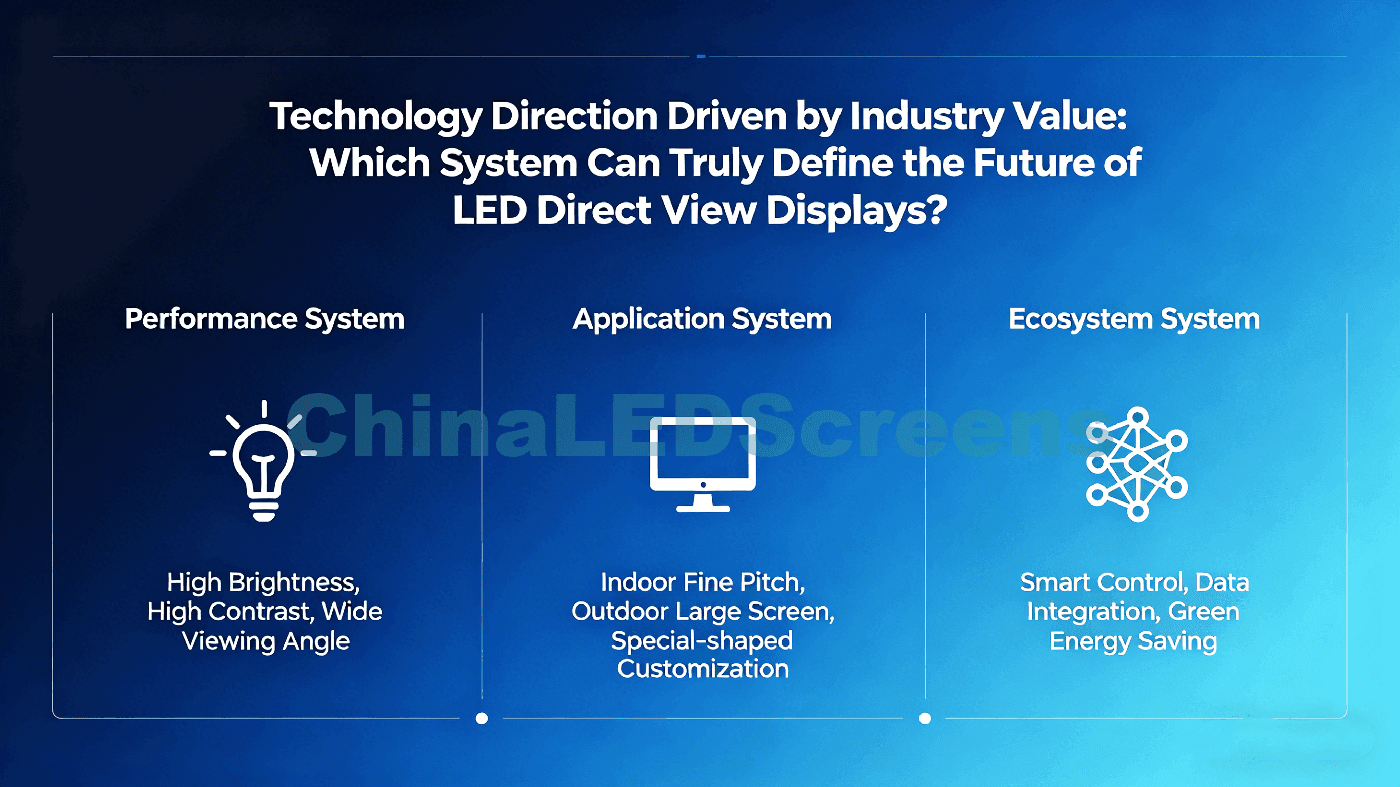
The BSP system is based on discrete devices and follows a two-stage assembly process: Chip → Device → Panel, retaining bracket and pin structures.
Representative technologies include:
Within the BSP system, even when high-performance flip-chip LEDs are used, only internal failures can be improved.
External failure sources—such as solder defects, thermal fatigue, and oxidation caused by brackets and pins—remain unresolved.
More than 90% of external failure risks still exist.
Therefore, the reliability ceiling of the BSP system is locked at the 10⁴ PPM level, which cannot be fundamentally broken.
The physical size of discrete devices determines the minimum achievable pixel pitch.
Even with MIP technology that miniaturizes devices, there still exists a secondary soldering interface between the device and the substrate.
The practical pixel density limit of the BSP system lies around P0.7–P0.9. Below P0.4, device size becomes physically unmanageable.
The chip value realization efficiency in the BSP system is only 5%–10%, meaning over 90% of chip potential is wasted.
As pixel density increases, costs rise exponentially due to:
The BSP system has physical ceilings across all three dimensions.
It can approach these limits indefinitely (device-based MIP represents this “extreme optimization”), but it cannot break through them.
It is a system that adapts to existing value, not one that creates new value.
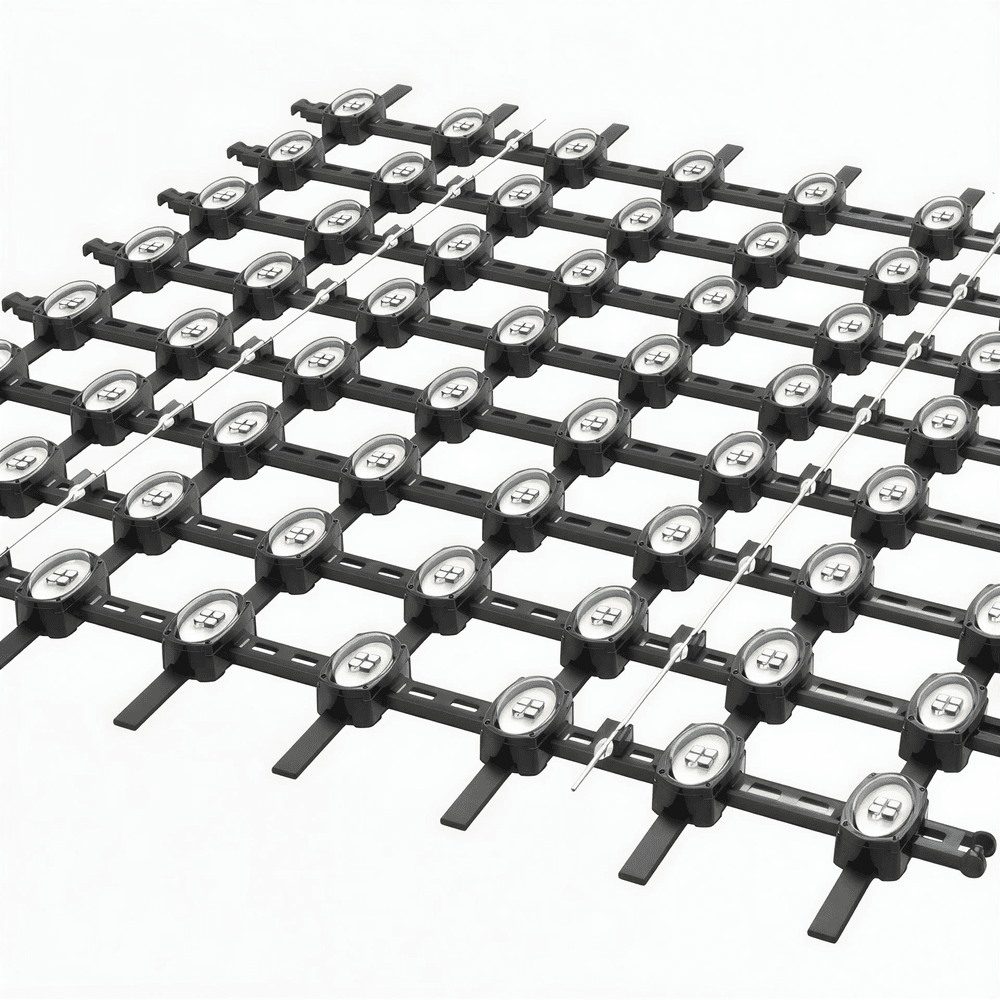
The BPIPack system removes brackets and pins at the structural level and adopts a direct integration approach, eliminating external failure paths at the source.
Representative technologies include:
By removing brackets and pins at the structural level, external failure paths are eliminated from the source.
More than 90% of external failures can be eliminated.
Reliability potential increases from the 10⁴ PPM level to the 10⁶ PPM level, evolving toward system-level reliability.
Chips are directly integrated onto the substrate, without reserving space for device packaging.
Interconnect density is determined by substrate process capability, not device size.
Pixel pitch can break through P0.4, evolving toward P0.1 and below. At the COCIP stage, chip-level 3D stacking becomes achievable.
Chip value realization efficiency reaches 70%–90%, maximizing chip performance utilization.
As pixel density increases, cost grows linearly rather than exponentially.
The BPIPack system has no physical ceiling across the three dimensions—only engineering timelines for realization.
It is a system that adapts to incremental value creation, where each technological iteration opens new industry value space.
To compare cost differences more intuitively, we introduce the concept of chip value realization efficiency.
Chip value realization efficiency refers to the proportion of a chip’s theoretical performance that is ultimately realized in the display panel under a specific packaging system.
Assume an RGB chip set (R+G+B) is priced at 20 RMB per 1K sets:
With the same cost of 20 RMB:
In other words:
👉 The real cost of BPIPack is one-tenth of BSP
For a project requiring 1 million RGB pixels:
BSP Solution
BPIPack Solution (50% higher chip price)
Although chip cost is higher, BPIPack delivers 14× more actual display performance.
👉 Users never buy chips—they buy realized display performance.
BSP system
BPIPack system

Across all mature industries, a consistent rule applies:
Technologies that simultaneously improve:
will replace those that optimize only one dimension.
Examples:
The LED display industry is now at the same turning point: from the discrete device era (BSP) to the integrated panel era (BPIPack).
Do not over-invest in directions where ceilings are already visible.
Device-based MIP can serve as a short-term supplement, but long-term strategy must focus on BPIPack.
Re-evaluate companies based on:
Ask a fundamental question:
Are you buying chips—or display performance?
There is an urgent need for unified frameworks such as: “LED Direct View Packaging System Classification and Evaluation Guidelines.”
In the BSP system, reliability, pixel density, and cost form an impossible triangle.
In the BPIPack system, they form a positive cycle, where each technological advancement simultaneously improves all three.
This is the underlying logic of industry value—and the fundamental reason why BPIPack represents the future of LED direct view display technology.
The LED display industry is transitioning from scale-driven growth to high-quality development.
It is hoped that industry participants can adopt the perspective of value realization, cut through conceptual noise, and make long-term strategic decisions aligned with technological evolution.
(This article is based on the core concepts of “LED Direct View Packaging Technology Evolution Model” and “On Chip Value Realization Efficiency,” Written by CEO Mr.Zhi Jun Hu , Ms. Qing Liang (Mother of COB packing tech in LED industry)