Talk To Our Expert, Get A Solution in 20 minutes
Share your LED screen needs. Our experts will provide solutions and a quick response.

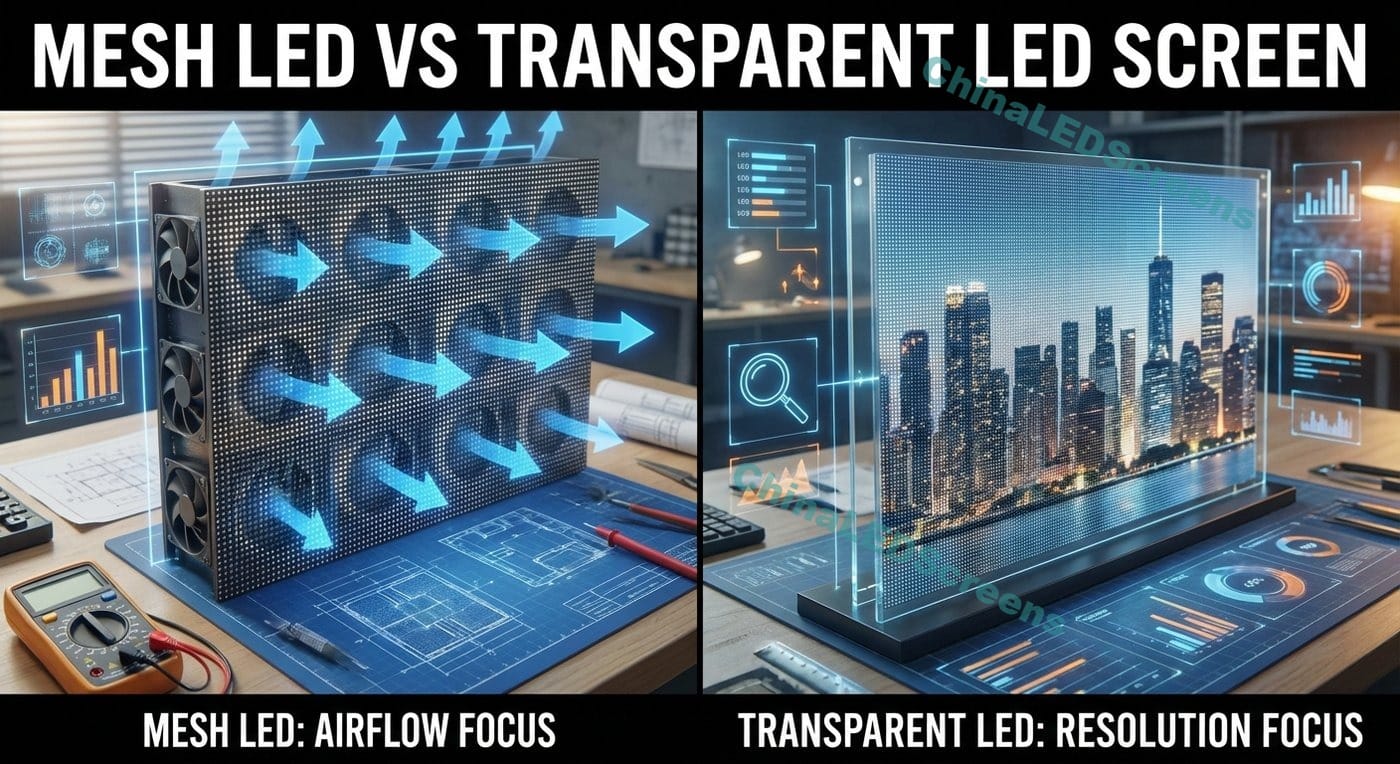
When a façade project gets serious—real wind loads, real structure reviews, real permitting—display choice becomes an engineering decision first and a “screen decision” second.
That’s why the “mesh LED vs transparent LED” question keeps coming up. Both are “see-through” families, but they solve problems differently:
This guide is written the way I’d explain it to an architect, integrator, or project manager who needs a clear choice—with a copy-paste RFQ checklist at the end.
For reference product families and project support, start at ChinaLEDScreens.
A simple way to think about it:
This doesn’t mean mesh can’t look good, or transparent LED can’t be engineered for outdoors. It means their default “design center” is different.
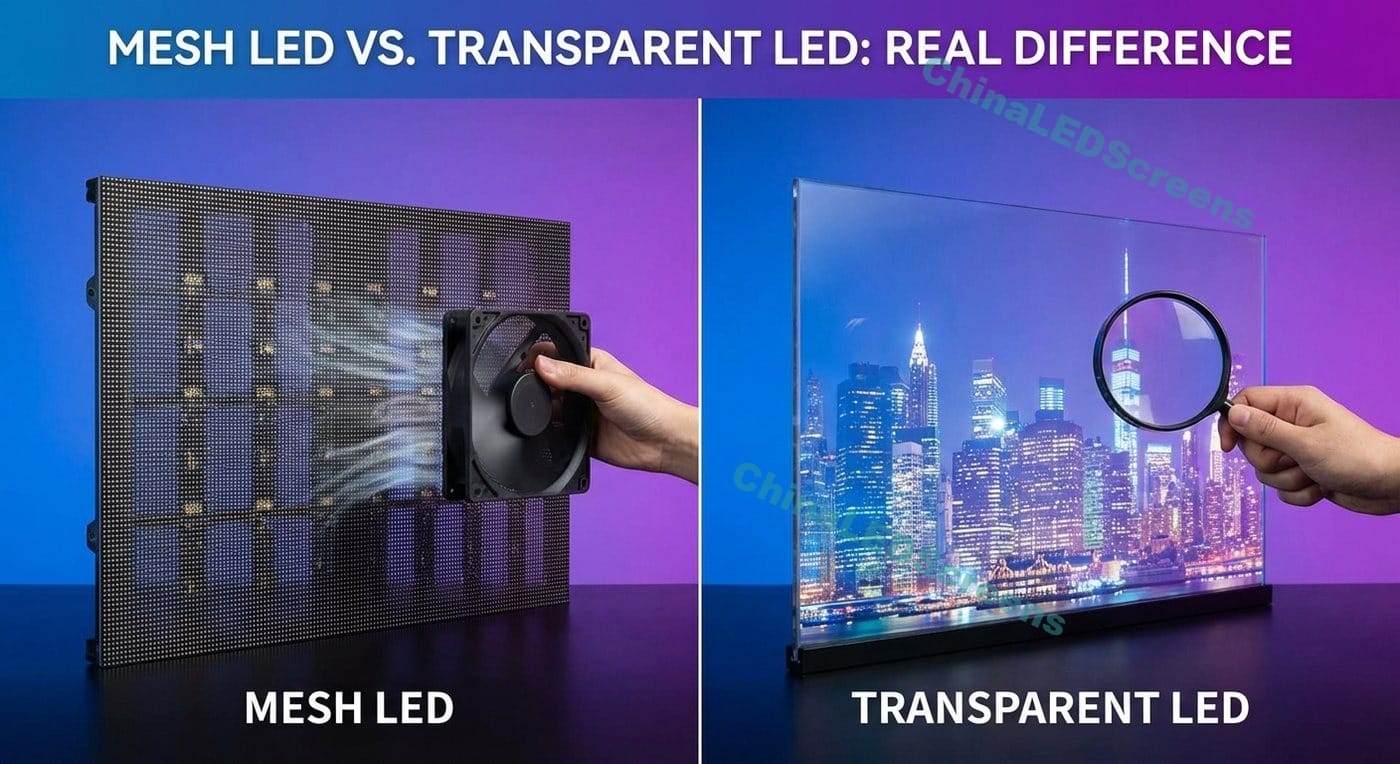
If you want a quick overview of mesh family options, see Mesh LED Displays. For a transparent LED technology walkthrough, see Transparent LED Display Guide.
On large façades, the real pain isn’t “can we show video?”—it’s:
Mesh is positioned specifically for wind-permeable media façades where low wind load is a practical advantage.
If the project wants even more rigidity and predictable framing than a curtain-style mesh, grille often becomes the alternative because it’s presented as a more structured architectural system.
Explore grille fundamentals here: LED Grille Screen Guide.
Transparent LED is typically chosen when the stakeholder expectation is:
Transparent LED is explained as thin LED strips with space between them—smart structural design rather than “magic transparent pixels.”
For pixel pitch decisios, it’s also useful to remember: pitch is not only resolution; it’s visibility vs impact, and it interacts with transparency and brightness strate
Here’s the practical split:
Engineers don’t only care about wind “pressure.” They care about:
Mesh is repeatedly positioned as wind-permeable and low wind load oriented for large façades. aim significant wind-load reduction (example: “up to 60%”) based on their open structure.
Practical takeaway: if the project is tall, exposed, or has strict structural constraints, you should not treat “see-through” as a marketing term—treat it as an engineering variable and demand a real structural plan.
On real buildings, cost is often driven by:
Architecture-focused pages often frame mesh as a solution that helps keep loads and wind resistance in check for towers and podiums—exactly because large scale punishes heavy, sail-like systems.
Outdoor façade systems must be treated like infrastructure, not stage rentals.
At minimum, confirm:
Outdoor mesh product pages explicitly list outdoor-rated positioning (including IP65/66 options and high brightness ranges), which is the kind of baseline language you want in a real RFQ.
If your project is strongly outdoor and wind-exposed, start spec framing here: Outdoor Waterproof Mesh LED Display Screen.
Even if the screen looks good, operators will judge it by:
This is where “system architecture” matters: not just the LED surface, but the full chain of power distribution, signal topology, and maintenance workflow.
Rule of thumb: A façade system is only as good as its maintenance plan. If the building can’t service it safely, the project will struggle long-term regardless of display choice.
For traditional LED walls, people use a quick field shortcut (and you’ll still hear it on façade calls):
comfortable viewing distance (m) ≈ pixel pitch (mm)
But transparent systems behave differently because the viewer sees both emissive points and daylight/background behind the system. So pitch becomes tied to visibility vs impact and the transparency/brightness strategy, not just “resolution.”
Practical takeaway: if the client expects crisp text close to glass, you can’t choose pitch the way you’d choose a billboard. You must choose it the way you’d choose a window display—with a content plan.
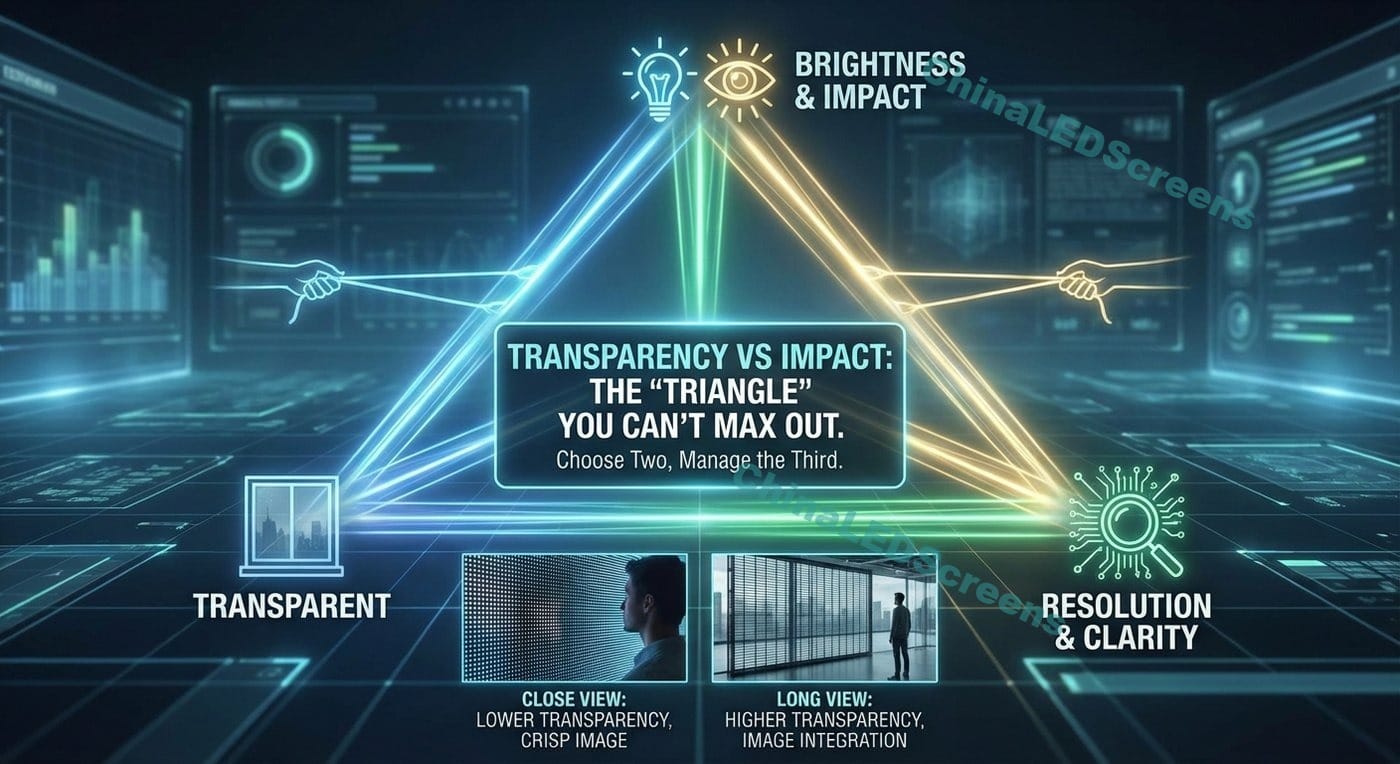
Most teams try to maximize all three:
In practice, you usually choose two and manage the third.
A transparency guidance page frames the tradeoff clearly: if you want the screen to read crisply from closer distances, you typically accept lower transparency (denser structure); if viewing distance is long, you can push higher transparency because the eye integrates the image.
Daylight isn’t only about “more nits.” It’s also about:
Outdoor mesh pages referencing high-brightness options (e.g., 6,500–10,000 nits) are useful anchors for what “daylight capable” means in product positioning.
Below is the practical selection view I ting.
| Best fit scenario | Choose | Why |
|---|---|---|
| Large-scale façades, towers, stadium exteriors, rooftops | Mesh LED | Wind-permeable media façade positioning; designed for long-distance impact and large scale. |
| Retail windows, atriums, daily storefront installations | Transparent LED | Built for glass-first visibility: content on glass without fully blocking daylight or views. |
| When you want porous airflow benefits but with more rigid architectural framing | LED Grille | Framed as a structured architectural system; open structure can reduce wind resistance. |
Want a deeper mesh selection walkthrough? Use the buying/engineering guide: Mesh LED Displays: Flexible Mesh Curtain Display Guide.
| Dimension | Mesh LED | Transparent LED |
|---|---|---|
| Airflow / porosity | High airflow; helps reduce wind resistance in many façade designs. | Lower airflow than mesh (more “filled” structure), so wind can matter more depending on design. |
| Wind-load strategy | Often favored where permeability and load reduction are priorities. | Can still work outdoors, but needs disciplined structural + wind planning. |
| Resolution / crispness | Typically chosen for long-distance impact; close-up text isn’t the main goal. | Often chosen when you want “window video” with stronger perceived density. |
| Daylight + inside visibility | Strong “see-through” feel at distance; great for large-scale façades. | Designed specifically to keep glass feeling like glass while showing content. |
| Question | Why grille can be the answer |
|---|---|
| Need more rigidity + predictable framing than curtain-style mesh | Grille is positioned as a more structured architectural system. |
| Wind-load reduction is a major goal | Grille designs can significantly reduce wind resistance (example: “up to 60%” on a grille series page). |
| Spec area | What to lock in | Why it matters |
|---|---|---|
| Weather protection | Target IP rating (e.g., IP65/66 options shown on outdoor mesh product pages). | Defines real-world survivability and maintenance burden. |
| Brightness range | Confirm your day/night operation range; outdoor mesh pages reference 6,500–10,000 nits as an option. | “Too low” fails in daylight; “too high” can waste power and stress thermal design. |
| Pitch band | Architecture pages reference pitch choices in wide bands (e.g., 10–50 mm) for city-scale legibility planning. | Keeps spec realistic for viewing distance and project budget. |
If you want clean comparisons across suppliers, don’t ask “price per sqm” first. Ask for an engineered quotation.
Copy/paste this into your RFQ email:
When stakeholders need confidence, show them executed work—especially projects that match your façade type and constraints.
Use Projects & Case Studies to align expectations around what’s realistic for mesh façades and transparent installations.
Yes, in many façade designs, mesh is used where permeability, scale, and wind behavior are key priorities. It’s commonly positioned for large media façades with controlled loads and service planning. But if the project’s core goal is “premium window video” and close-up text, transparent LED is often the more natural starting point.
If you want the airflow benefits of an open structure but prefer a more rigid, engineered architectural framing apprtioned as that structured alternative and may offer strong wind-load advantages.
Use the transparency vs resolution rule: closer crisp readability usually needs denser structure (lower transparency), while long viewing distances allow higher transparency because the eye blends light points.