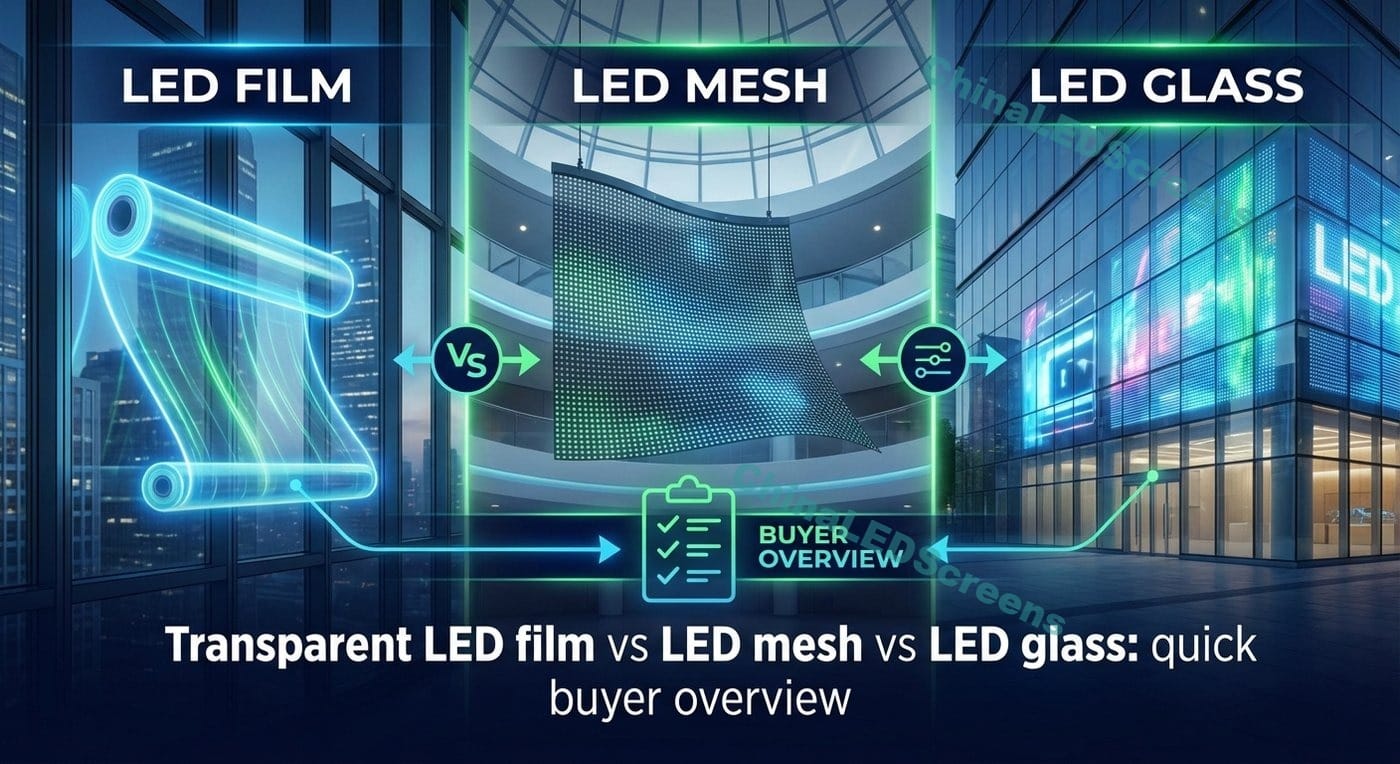
Transparent LED Film vs LED Mesh vs LED Glass: Quick Buyer Overview
Transparent LED Film vs LED Mesh vs LED Glass: Quick Buyer Overview
If you’re comparing transparent LED film, LED mesh, and LED glass, you’re not shopping for “a screen.” You’re choosing a building integration method.
A good choice looks effortless: daylight stays, views stay, the façade stays safe, and content looks intentional. A wrong choice feels like a retrofit: visible cabling, bulky boxes, hard-to-service dead pixels, or worse—structural and approval headaches.
This guide is written as a fast buyer overview you can forward to your architect, façade consultant, GC, and AV team.
Table of Contents
Quick answer: which one should you buy?
The 30-second decision tree
Use these questions in order:
Is the display going on a high-rise exterior where wind load and structure are sensitive?
Yes → start with LED mesh.
No → go to #2.
Do you need the display to be part of the glass (premium, long-life, “architectural finish”)?
Yes → LED glass (laminated media glass concept).
No → go to #3.
Do you need the simplest retrofit for existing glass with minimal construction work?
Yes → transparent LED film (often the fastest retrofit path).
No → if you’re doing new façade work anyway, re-check LED glass vs mesh based on performance + service access.
“Best for” shortlist
Choose transparent LED film when…
You need a retrofit on existing windows with minimal façade rework.
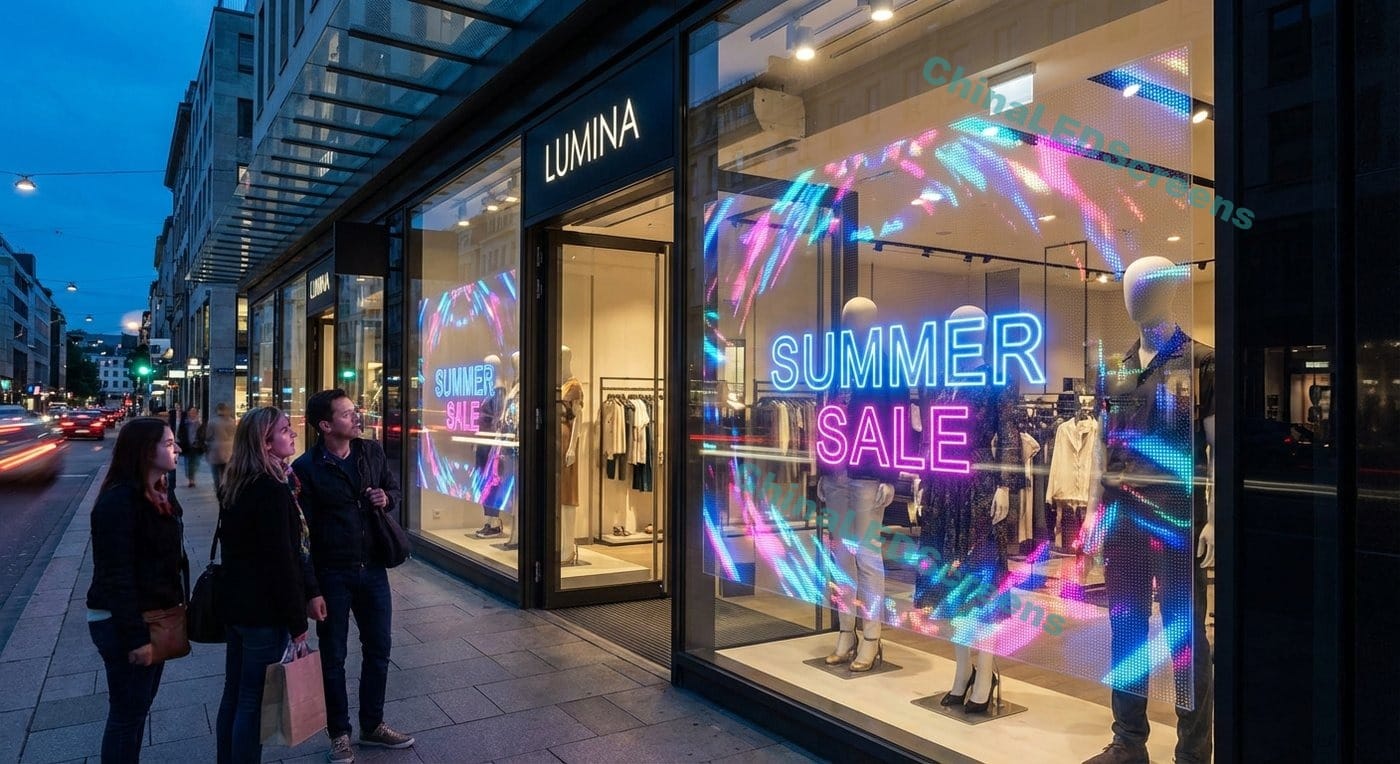
You want close-view retail storytelling (shop windows, mall atriums).
You need fast installation and the ability to rework or relocate.
Choose LED mesh when…
It’s an exterior media façade and wind/weight are major constraints.
Your content is more graphics + motion + brand patterns than tiny text.
You need large coverage with less structural penalty than solid cabinets.
Choose LED glass when…
This is a signature architectural feature and you want the cleanest integration.
You control the façade scope (new build / major renovation).
You want a premium finish and are ready for glass engineering coordination.
If you want to see all product families at a glance, start at the ChinaLEDScreens homepage and product families overview.
Transparent LED film is a thin LED carrier layer designed to sit on or near glass. In many projects it’s used as a window media layer: content floats on the glazing while you keep visibility.
In practice, “LED film” splits into two buyer-relevant subtypes:
**Adhesive / self-adheietail windows and curved glazing where invasive mounting is undesirable. (If you’re in this bucket, the selection checklist matters more than brand claims: adhesives, surface prep, thermal path, cable exits.)
Non-adhesive or mechanically fixed film-style panels: used where you want more robust mounting and serviceability.
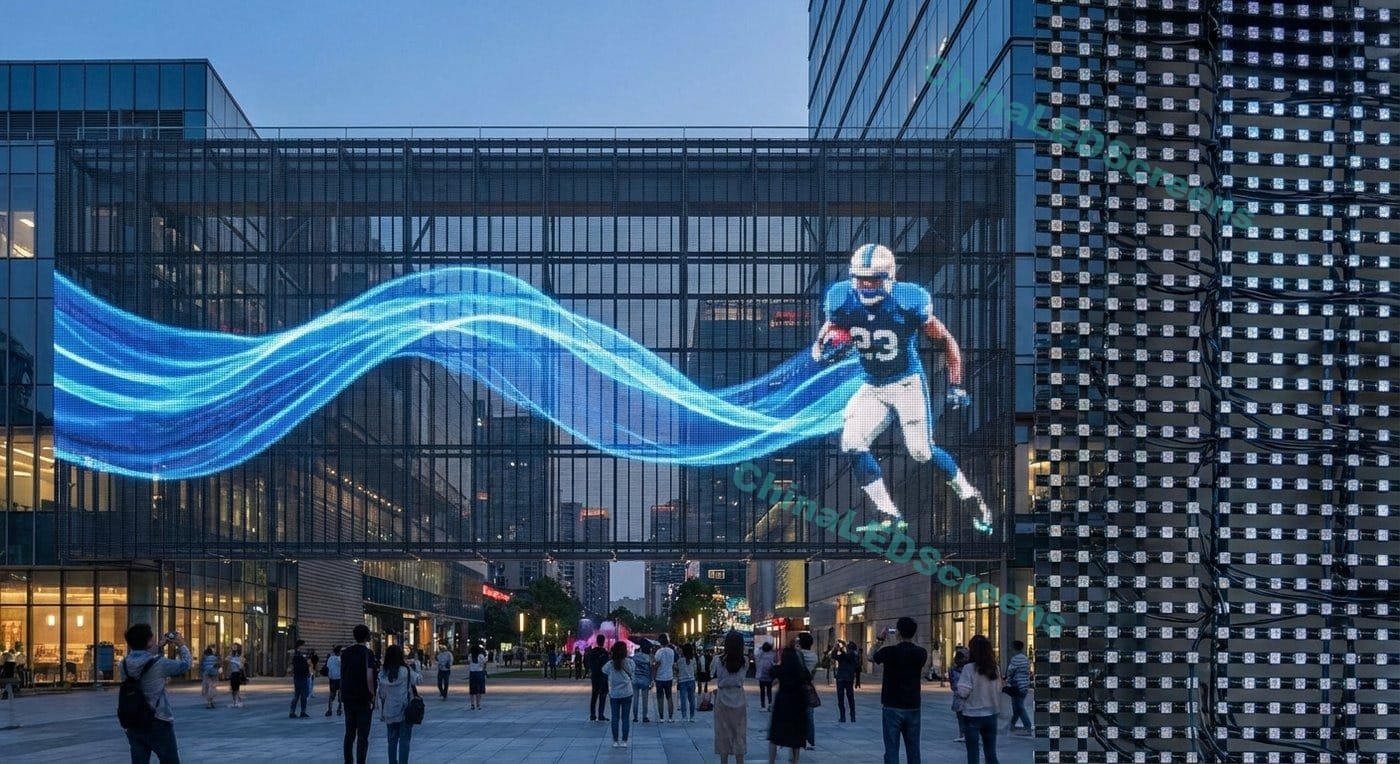
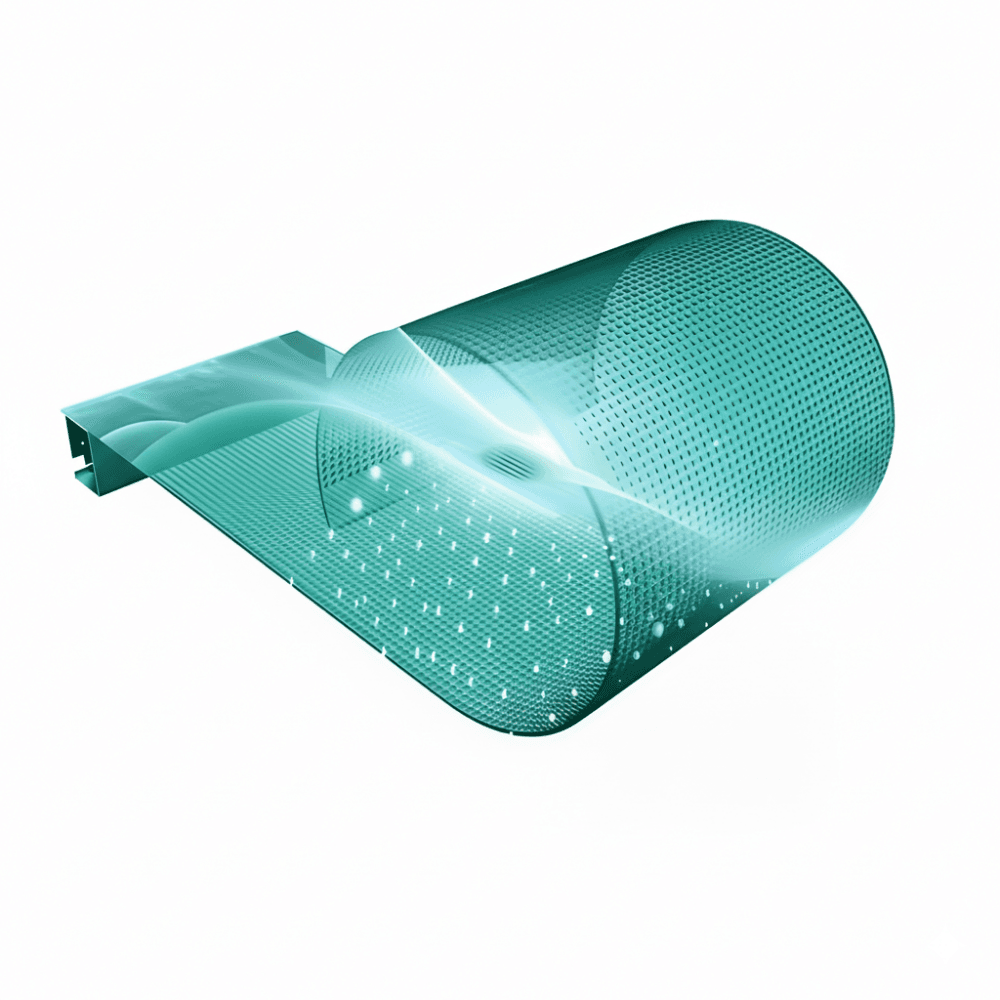
LED mesh is a wind-permeable LED matrix—think of it as “pixels on a grid,ngineering benefit is that the structure sees less wind drag and often less weight compared to tr.
Mesh is usually chosen for:
tall buildings, atriums, open façades
architectural outlines and large-format motion graphics
installations whust keep ventilation and permeability
LED glass is best understood as glass first, media second.
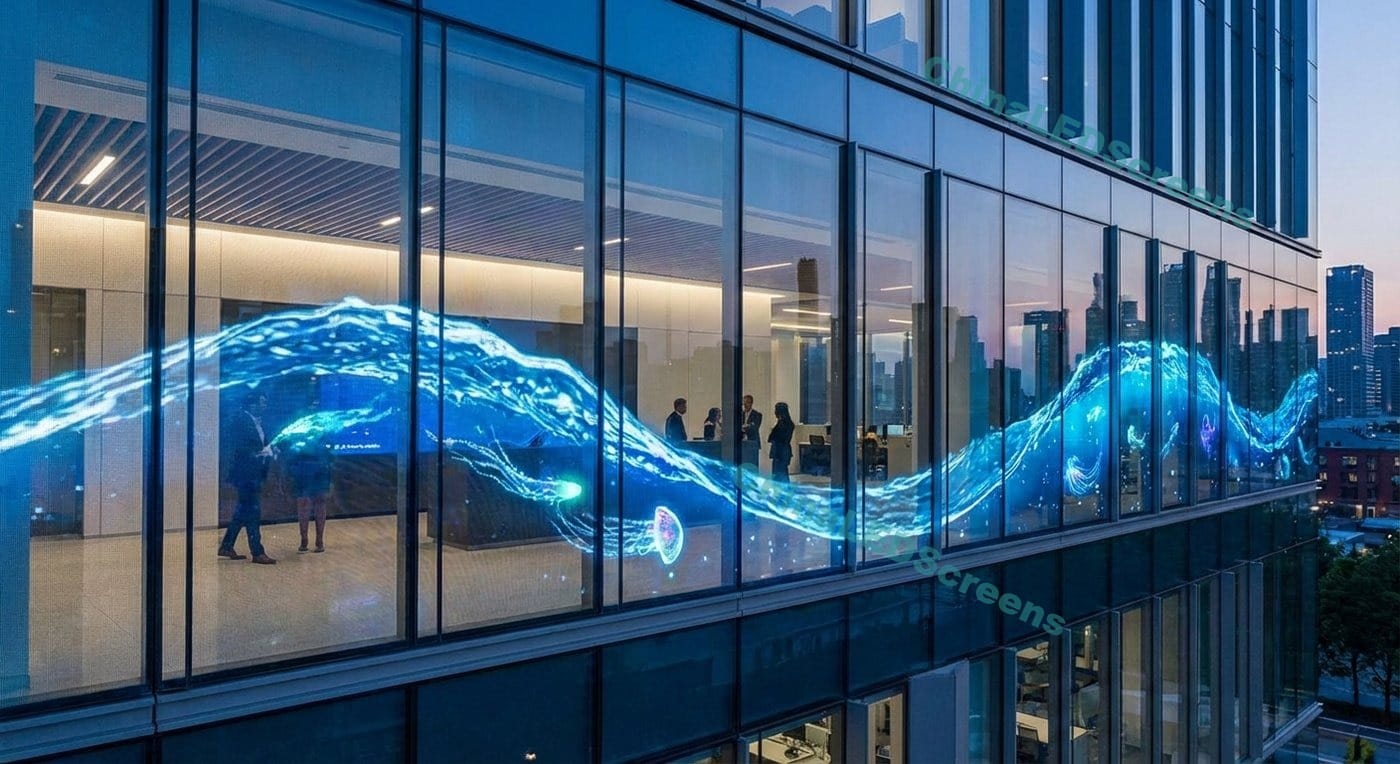
Instead of mounting a display onto glass, LED glass concepts embed media capability into laminated glass-like assemblies. That is why the project often needs façade/glass engineering coordination (glass make-up, interlayers, edge conditions, structural requirements).
Because “LED glass” lives ily has:
a premium “architectural finish”
stronger alignment with new builds / major refits
a longer coordination cycle—but potentially the cleanest final look
like any glass element—engineered as façade component
Content style
video + close-up branding + retail narratives
patterns, motion graphics, big typography
premium architectural content, brand statements
Serviceability
varies by routing + access
often modular nodes/strings
depends on glass/service design—plan early
Typical risk
messy cables/power boxes if rushed
legibility if pitch too large
coordination delays if façade team not engaged early
The most misunderstood metric: “transparency”
Buyers ask: “Is it 70% or 90% transparent?” Occupants experience something else: perceived openness.
Perceived openness is driven by:
how thick the vertical/horizontal “lines” look from your viewing distance
where power/data elements sit
reflections and black level on glass
content choice (busy content makes a transparent display feel “heavier”)
If you’re choosing between 50% vs 90% transparency, start with the human perception angle, not the number. (Transparent LED Screens Display)
Buyer checklist: specs that matter (and the traps)
1) Pixel pitch + viewing distance (the practical rule)
You don’t buy pitch for bragging rights. You buy it for legibility at the real viewing distance.
Storefront windows (close viewing): prioritize pitch that supports readable text and faces/logos without looking “striped.”
High-rise façades (far viewing): larger pitch can work because the city reads it as a moving pattern, not a phone screen.
Trap: choosing mesh for content that requires small text at 3–5 meters. Mesh can do it only if pitch supports it; otherwise it becomes “sparkly noise.”
2) Brightness in daylight vs night
Daylight performance is a combination of:
brightness (nits)
contrast against reflections
how open/transparent the structure is
content design (dark-heavy content disappears in reflections)
Practical guidance: If the glass is in direct sunlight, brightness requirements rise quickly—but your real constraint may be reflections and black level, not just nits.
3) Refresh rate + camera-friendliness
If the installation will be filmed (retail campaigns, launches, influencer content), you want a system that avoids banding/flicker artifacts. This is usually solved by:
higher refresh / better scanning and driver design
correct configuration (not “max brightness at any cost”)
4) Reliability: design for replacement, not perfection
All three solutions must be planned as a system you can service:
How do you replace a failed segment/module?
Where are spares stored and who can reach them?
What does maintenance require (lifts, scaffold, night work permits)?
Step 1: Start with daylight and visibility constraints
Architects care about view and daylight. A useful shared language is VLT (Visible Light Transmittance)—a standard measure of how much visible light passes through glazing.
This matters because your display can be “transparent” but still feel visually heavy if the structure pattern is dominant.
Step 2: Decide where this lives in the construction scope
A simple way to avoid schedule fights:
Transparent LED film usually lives in the AV/signage scope, with a light touch on façade coordination (surface, cable routing, power).
LED mesh often lives in a façade + signage hybrid scope (structure, brackets, wind, access).
LED glass lives in the glass/curtain wall scope (engineering, fabrication, approvals).
Step 3: Glass specifics (LED glass projects)
If you’re considering LED glass, you’ll hear terms like PVB and ionoplast/SGP interlayers. The reason they show up is stiffness and structural behavior in laminated safety glass contexts—ionoplast interlayers are generally stiffer than standard PVB, enabling different structural designs (project-dependent).
Buyer takeaway: LED glass is not “just a display.” It’s a façade component—treat it as such early.
Step 4: Submittals you should ask for (any of the three)
Request these before you lock budget:
elevation drawing with module layout and seams
power/data routing diagram (showing where boxes go)
structural load statement (weight per m² + mounting method)
access plan: install + service + cleaning
acceptance criteria: dead pixels, uniformity, brightness range, color calibration
Cost reality: what drives price (and what blows budgets later)
Buying by transparency percentage alone Fix: evaluate perceived openness + viewing distance + where boxes/cables land. (Transparent LED Screens Display)
Choosing mesh for text-heavy retail messaging Fix: either choose a tighter pitch or use film/glass for storefront storytelling.
Ignoring maintenance access Fix: write access into the spec: “module replacement without removing adjacent façade elements.”
Letting power boxes become an afterthought Fix: decide box locations in elevation drawings early (and hide them in mullion zones where possible).
FAQs
Which is easiest to retrofit onto existing glass? Transparenastest retrofit path because it minimizes structural changes.
Which is best for high-rise exteriors? LED mesh is commonly preferred because it’s wind-permeable and can reduce structural penalties versus solid cabinets.
Which looks most “architectural”? LED glass can deliver the cleanest integration when planned as part of the façade/glass scope.
Will these block daylight? They can preserve daylight well, but occupant experience depends on perceived openness and glazing properties. VLT is the shared daylight metric in façade discussions.
What should I send my architect/GC to start? A one-page brief with: area/elevations, day/night requirements, preferred option (film/mesh/glass), cable/power zones, and a maintenance access plan.