Talk To Our Expert, Get A Solution in 20 minutes
Share your LED screen needs. Our experts will provide solutions and a quick response.

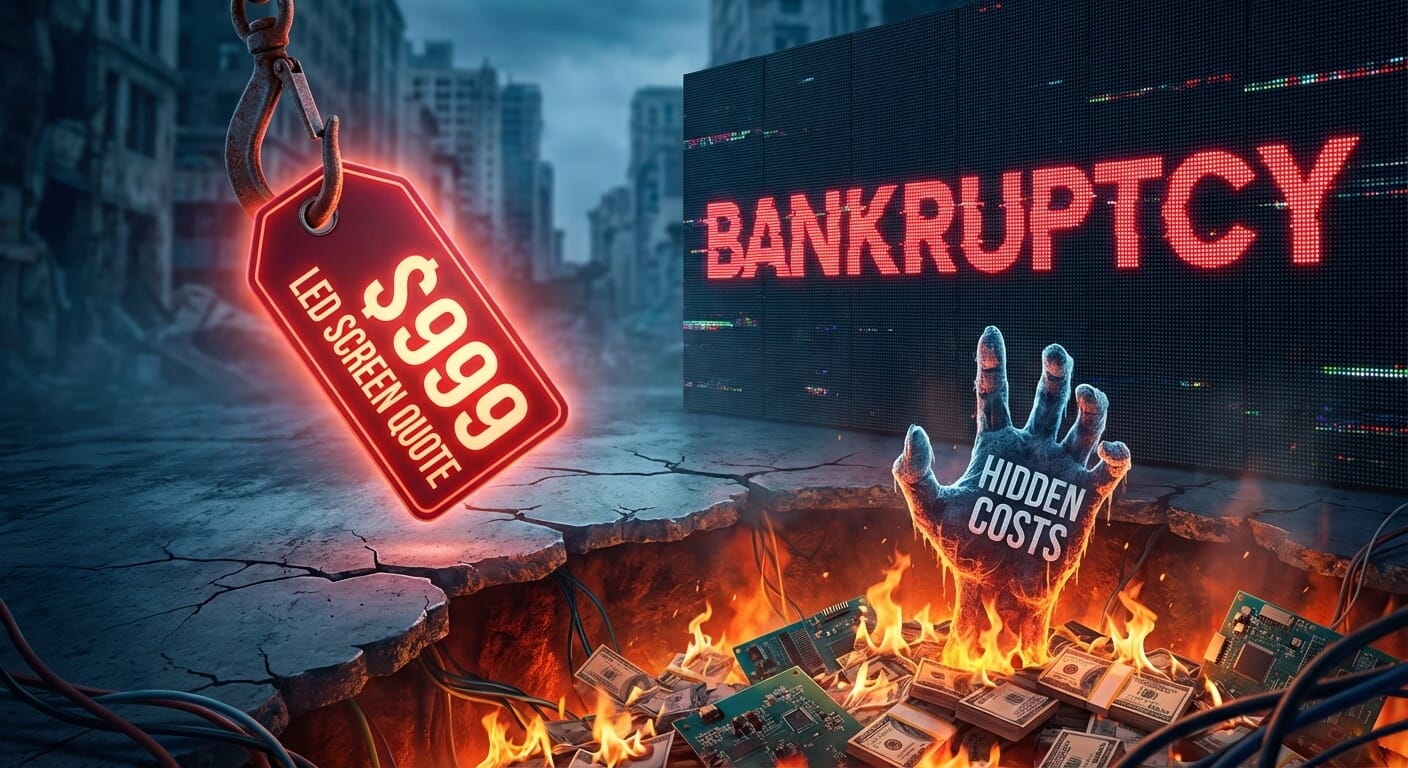
You’ve got the quote. I can see it from here.
It’s sitting on your desk, probably next to a cup of coffee that’s gone cold while you stare at the bottom line. The number looks good. Surprisingly good. That supplier in Shenzhen—or the local guy who swears he’s not just white-labeling the same Shenzhen gear (he is)—promised you a transparent video wall that will make your competitors weep, all for a price that fits neatly into this quarter’s budget.
Do yourself a favor. Throw it in the trash.
I’m serious. Crumple it up. That piece of paper isn’t a budget. It’s a ransom note.
I’ve been in this game long enough to know how the movie ends. You sign the check for the hardware. You feel like a genius negotiator. Then, six months later, you’re explaining to the Board of Directors why the “affordable” transparent LED screen has cost double the estimate and still isn’t turned on.
In the direct response world, we have a rule: If it sounds too good to be true, check the fine print. In the LED world, there is no fine print. There are just hidden costs waiting to mug you in a dark alley.
Here is the brutal truth about the Total Cost of Ownership (TCO) for transparent displays. This isn’t the brochure talk. This is the “3 a.m. panic attack” talk.
Most buyers look at the price per square meter and stop reading. That’s amateur hour. That’s like buying a Ferrari engine and forgetting you need a chassis, wheels, and a transmission to actually leave the driveway.
The quote lists the cabinets. Great. But how does the image get there? A high-resolution transparent wall eats bandwidth for breakfast. You aren’t just plugging in a HDMI cable. You’re buying sending boxes, video processors, and receiving cards that need to push 50 million pixels without stuttering.

This is the one that kills careers. Transparent LEDs aren’t like lightbulbs. You can’t just pop down to Home Depot when one burns out. LEDs have “bins”—batches of color. You must buy 3% to 5% spare modules upfront from the same batch.

Hardware is easy. We crate it, ship it, and it arrives. Putting it up? That’s where budgets go to die.
Marketing brochures love to say transparent screens are “lightweight.” And sure, compared to a concrete wall, they are. But a transparent LED glass screen still weighs 12kg to 15kg per square meter.
Glass curtain walls are divas. They were designed to hold glass and wind. That’s it. When you tell a structural engineer you want to hang two tons of electronics on the mullions, they don’t just say “cool.” They demand a study.
Are you installing this in a city with strong unions? New York? Chicago?
Here’s a physics lesson that hits your wallet: Transparency is expensive.
To make a screen see-through, we strip away 70% of the material. That means we have fewer pixels to do the work. To get the same brightness, we have to drive the remaining pixels like stolen cars.
A standard indoor screen runs at 600 nits. Boring. A window-facing transparent LED display needs to fight the sun. It needs 5,000 to 6,000 nits.
Where does that 900 Watts go? It turns into heat. If you put this inside a shop window, you’ve essentially built a giant radiator. Your AC unit now has to work overtime to keep your customers from sweating. That’s a hidden OPEX cost your LED salesman forgot to mention.
LEDs don’t burn out. They fade away. But they don’t do it gracefully.
Blue LEDs are the drama queens of the spectrum. They decay faster than red or green, especially when they get hot. And transparent screens get hot.
Depressed yet? Don’t be. I’m telling you this so you survive the purchase, not so you run away. Because here is the kicker: Transparent LED is one of the few expenses that can actually pay you back.
If you treat it like an asset, not a decoration, the math changes.
Stop asking “How much is the screen?” Start calculating this:
TCO = (Hardware + Spares + Installation + Structure) + 5 Years of (Electricity + HVAC + Content + Cleaning) – (Ad Revenue + Sales Uplift)
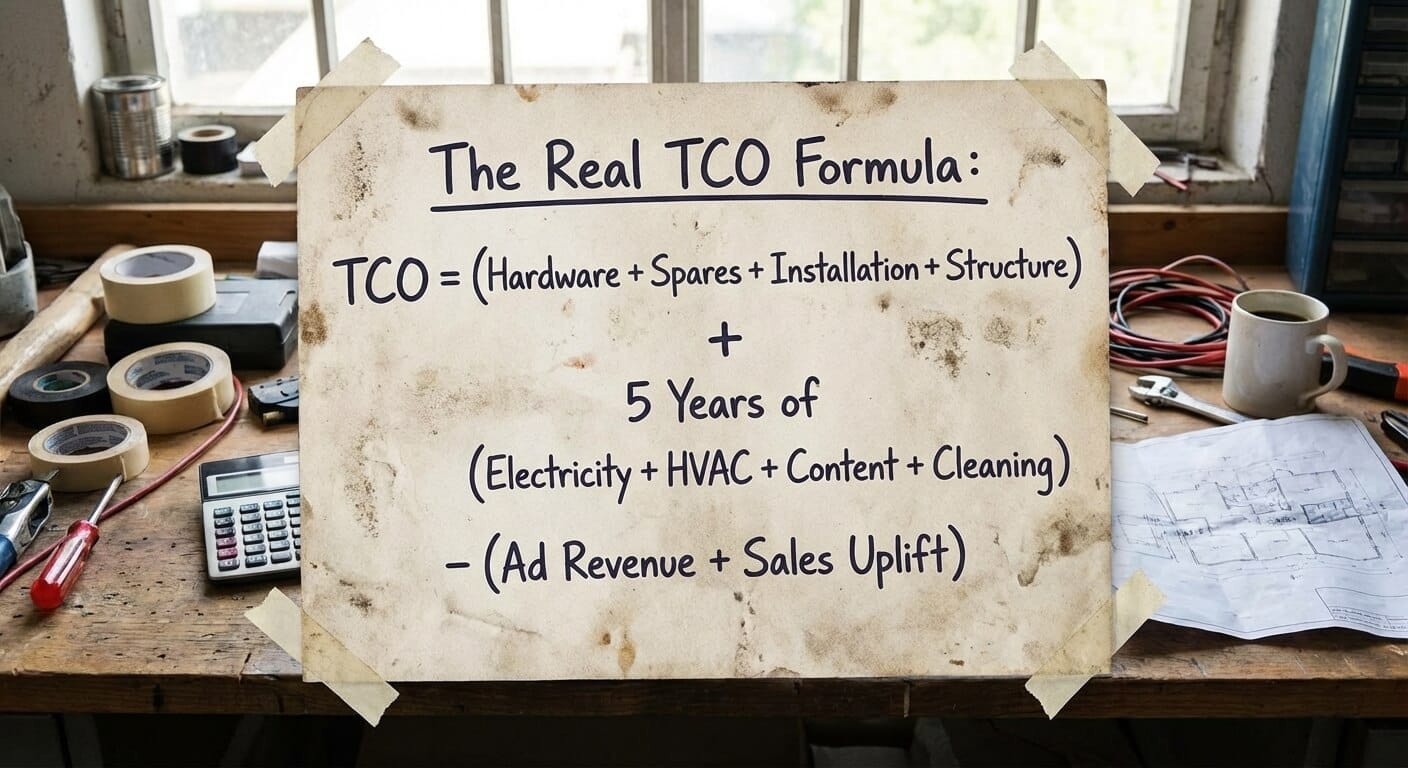
Stop asking “How much is the screen?”
Start calculating: Hardware + Installation + Spares + 5 Years of Energy + Cleaning.
If you buy the cheapest option on the table, you are buying a vampire that will suck your OPEX dry and die in three years. If you buy a premium system from a reputable manufacturer (like us), you pay a bit more upfront to save 40% on power and maintenance later.
Don’t be the guy who saves a dime to lose a dollar.
Ready to get a real quote—one that includes the truth? Drop a line to the engineering team at ChinaLEDScreens. We’ll help you do the math before you sign the check.