Talk To Our Expert, Get A Solution in 20 minutes
Share your LED screen needs. Our experts will provide solutions and a quick response.

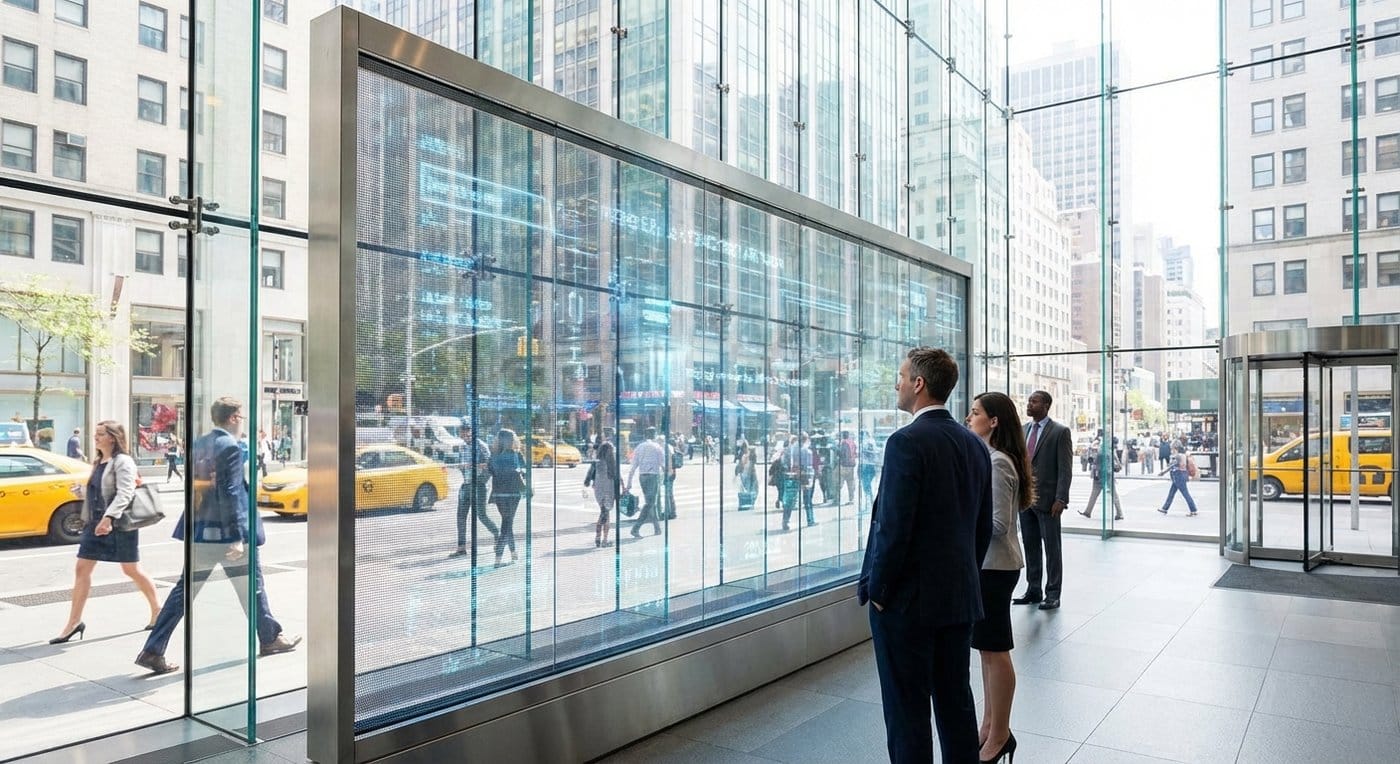
A transparent LED screen is one of the few display technologies that forces buyers to ask a question they almost never ask with conventional LED walls:
“Transparent… by which definition?” (Transparent LED Screens)
If you’re an AV integrator, architect, developer, or brand team planning a storefront window, glass balustrade, or curtain wall media façade, you’ll hear transparency described with confident, single-number claims—70%, 85%, even 90%+. The problem is that the word transparency gets used to describe different measurements, and those measurements don’t always track what humans mean when they say “see-through.” (Transparent LED Screens)
This guide breaks down the practical ceiling of “see-through,” the engineering tradeoffs behind it, and—most importantly—how to specify transparency so you don’t end up in a change-order fight after installation.
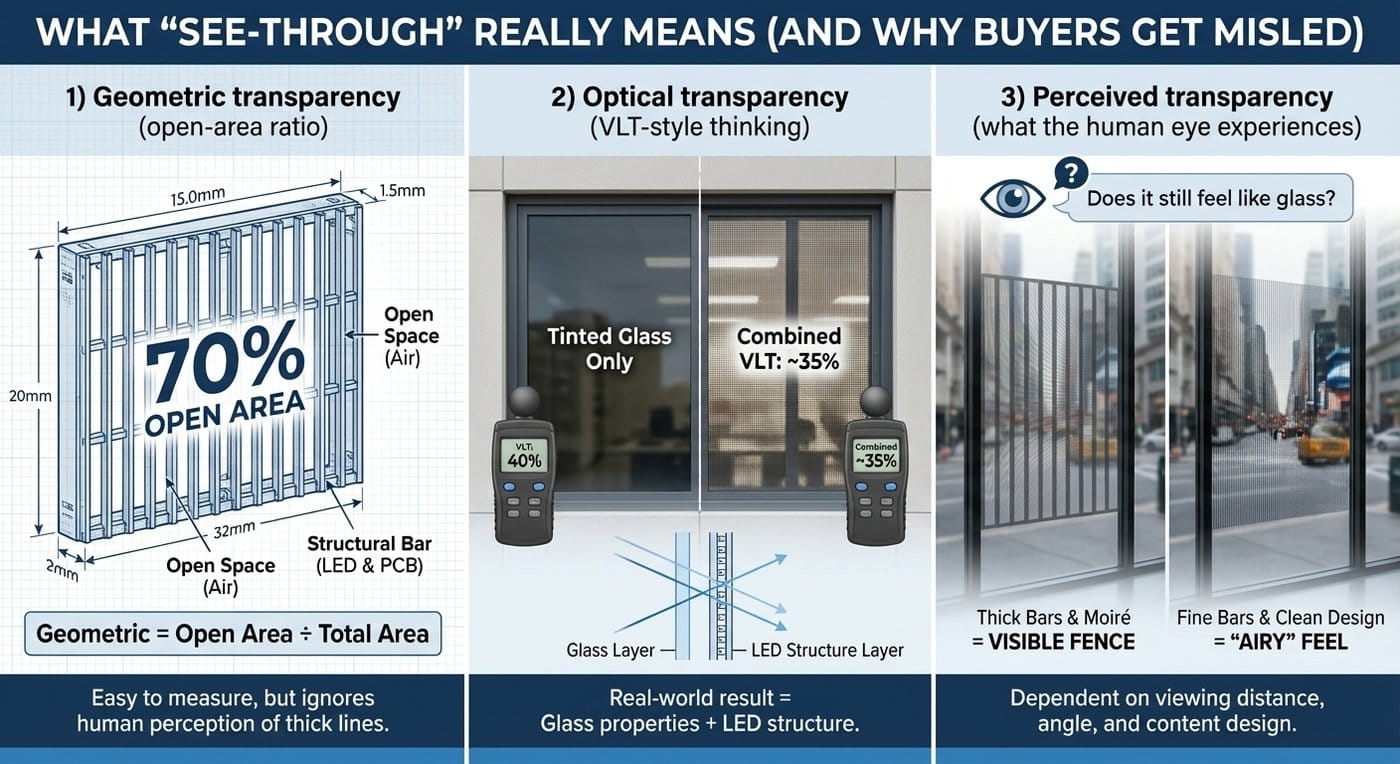
Industry discussions commonly separate transparency into three buckets: geometric, optical, and perceived. (Transparent LED Screens)
This is the most “engineering-friendly” definition:
Geometric transparency = open area ÷ total area (Transparent LED Screens)
If an LED is built from vertical bars (or a grille/mesh), you can measure how much of the surface is physically open—no LEDs, no PCB, no frame—and express that as a percentage.
Why it’s useful: it’s easy to compare structures, and it’s hard to manipulate if everyone uses the same boundary and counting method.
Why it can still mislead: humans don’t look at open area with calipers. Thick bars, bold mullion-like lines, glare, and moiré can feel less transparent even when the open-area ratio is high. (Transparent LED Screens)
In glass, “how much light passes through” is treated as an optical property. Glazing resources define visible light transmittance as transmitted visible light (commonly referenced in the 380–780 nm range), and standards like ISO 9050 specify methods for determining glazing light/solar characteristics.
Why it matters for transparent LED projects: your real-world “see-through” result is often a combination of:
If someone quotes “90% transparency” for the LED but your glazing is low-VT, the occupant will still feel the façade darkened—because the glass dominates optical transmission.
Perceived transparency is the client’s actual question:
“From normal distance, does it still feel like glass?” (Transparent LED Screens)
Perception is affected by:
This is why two products can both claim “70% transparency,” yet one looks airy and minimal while the other looks like a visible fence.
A transparent LED screen must still contain:
So the screen cannot become “nothing.” At best, it becomes a highly open structure that is less noticeable at distance. (Transparent LED Screens)
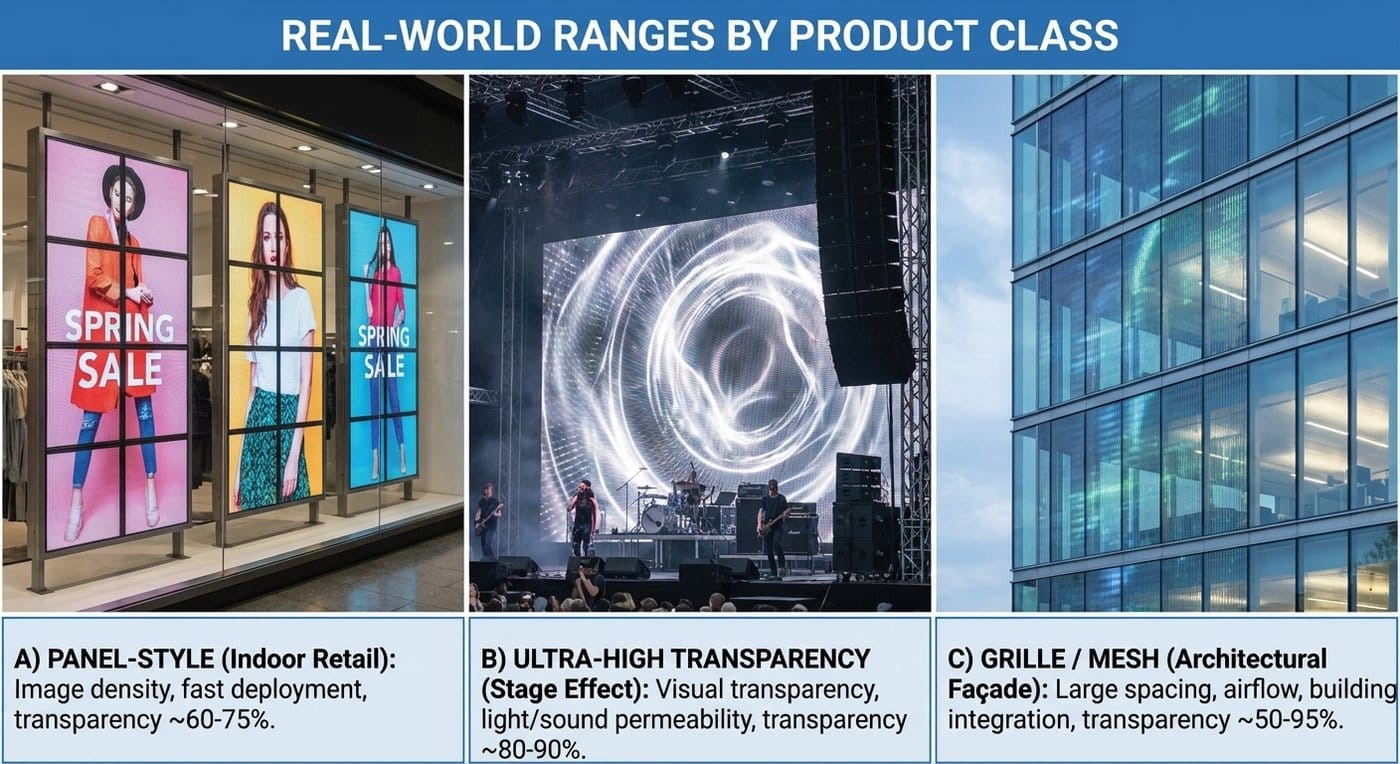
Many recognizable transparent panel systems publish transparency specs that are nowhere near 90%.
This is not a flaw—it’s a design choice: panels prioritize image density, uniformity, and a clean build for fast deployment.
At the upper edge, premium rental/stage designs may claim very high “visual transparency,” explicitly positioning it as improved light transmission and even sound permeability for stage use.
Takeaway: yes, “90%+” exists—but it tends to appear where viewing distances are larger, content is stylized, and “invisibility” is part of the creative language.
Market overviews commonly describe transparent/mesh systems spanning broad ranges (e.g., 30%–90%) and explain that spacing (and pixel pitch) heavily drives transparency.
This class is where you usually chase “maximum see-through” for buildings:
If you want higher transparency, you are removing “stuff” from the display surface. That inevitably changes performance.
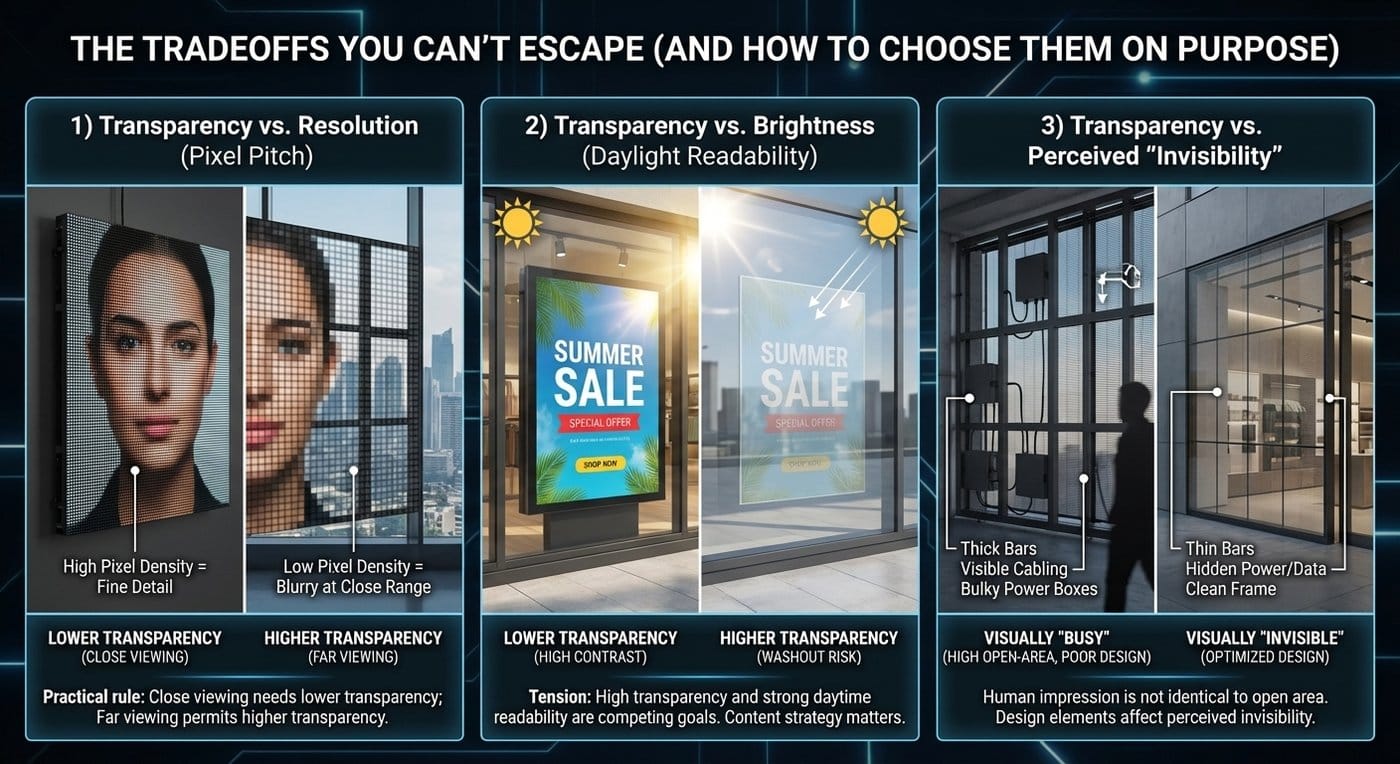
Pixel pitch is fundamentally tied to how many LEDs exist per square meter. If you increase spacing to gain openness, you reduce pixel density, which reduces fine detail at close viewing.
That’s why façade products can look stunning from across a plaza but underwhelming from two meters away—because they were never designed for close, high-detail reading.
Practical rule:
Transparent LED must compete with daylight and with reflections from glass. When the surface is open, you also lose the “solid black backing” that helps conventional LED walls maintain contrast.
This pushes buyers into a reality: high transparency and strong daytime readability are in tension, and content strategy becomes part of the spec. (Transparent LED Screens)
A high open-area ratio can still look visually “busy” if:
That’s why “visual transparency” is sometimes used in the industry—because the human impression is not identical to open area. (Transparent LED Screens)
If you only do one thing after reading this guide: force the vendor to commit to a transparency definition and test method.
“Supplier shall declare transparency as (1) geometric open-area ratio and (2) perceived transparency validated by an on-site mockup under defined viewing conditions.”
This keeps both the measurable geometry and the real-life experience aligned. (Transparent LED Screens)
Ask the supplier to provide:
Then compute:
Open-area ratio = (total area − occluded area) ÷ total area (Transparent LED Screens)
When stakeholders say “I don’t want to lose daylight,” they’re talking about light transmission, not LED geometry. Glazing references define visible transmittance concepts, and ISO 9050 provides standardized methods for glazing luminous/solar metrics.
So if you’re installing on a curtain wall:
This prevents the classic mistake: blaming the LED for a dim interior when the glass spec is the main limiter.
These are spec-framing ranges, not laws of physics—use them to sanity-check quotes and align expectations.
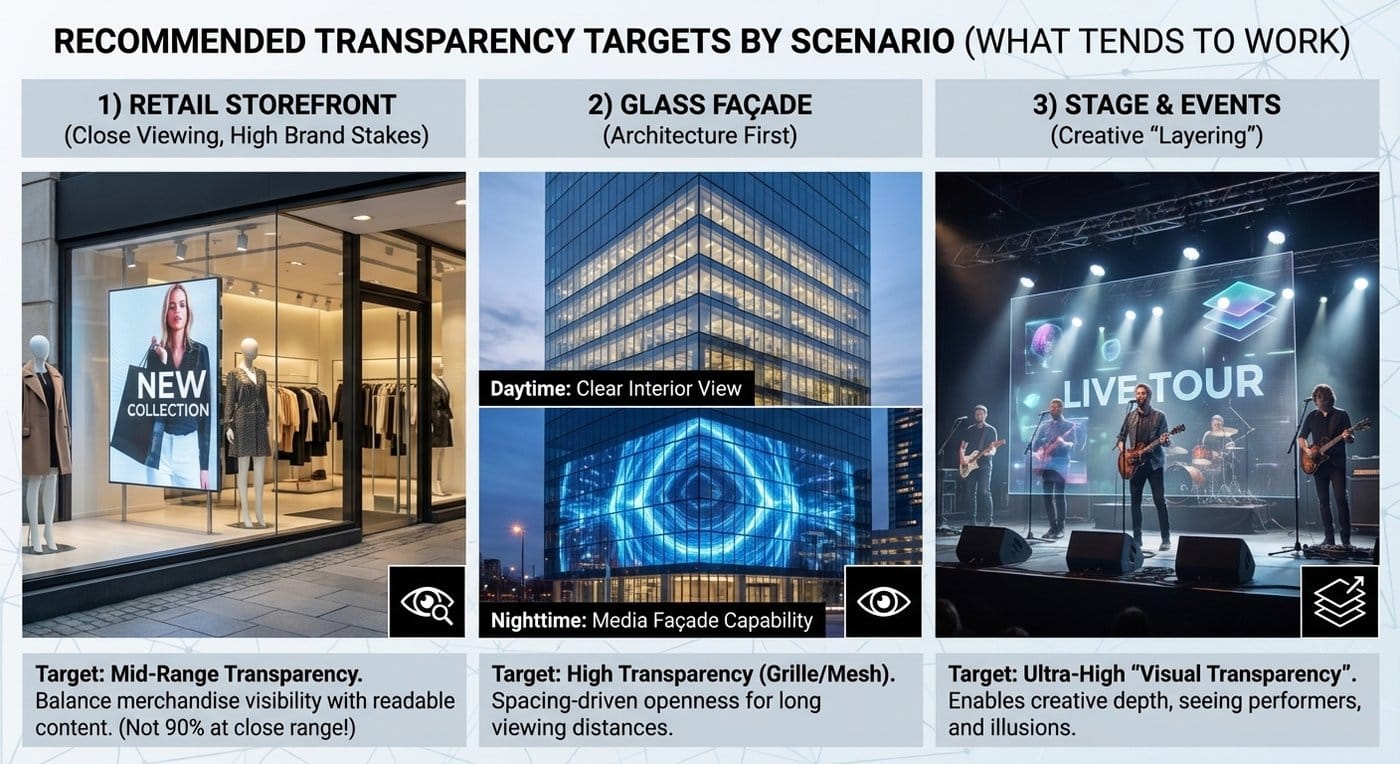
Target mindset: “Transparent enough to preserve merchandise visibility, dense enough to be readable in daylight.”
Many panel products published in the market sit around the mid ranges, because that’s where content looks premium at short distances.
If your client insists on “90% transparency” and expects sharp product videos at 1–2 m, treat that as a red flag: you’re being asked to violate the tradeoff triangle (transparency / resolution / daylight contrast). (Transparent LED Screens)
For façades, “see-through” is often about preserving the building’s daytime identity and interior view, while unlocking night-time media façade capability.
This is where grille/mesh systems commonly shine: spacing-driven openness and long viewing distances.
Stage transparent LED is about the illusion: performers behind video, depth layering, and sometimes even sound permeability. Trade announcements often frame ultra-high “visual transparency” as enabling these outcomes.
Perceived transparency is where projects succeed or fail, so test it.
This aligns with the idea that perception depends on distance, lines, and glare—not just an open-area percentage. (Transparent LED Screens)
At ChinaLEDScreens, we generally frame transparent solutions by what you’re optimizing: image density, architectural openness, or glass integration.
Start with transparent LED screens and use our transparent LED display guideto map pixel pitch + brightness + transparency tradeoffs to viewing distance.
Look at grille/mesh architecture patterns. Our LED grille screen guide is the right starting point when airflow + structure + long-distance viewing dominate the decision.
When stakeholders talk in glazing language (“daylight,” “VT,” “glass look”), compare:
Remember: glazing optical methods (ISO 9050 / EN 410 concepts) are your friend when the project is fundamentally a building-envelope decision.
Use Project Case Studies to align your stakeholders around “what see-through looks like” at real scale before you freeze the spec.
If someone asks, “How see-through can a transparent LED screen be?” the best answer is: