Talk To Our Expert, Get A Solution in 20 minutes
Share your LED screen needs. Our experts will provide solutions and a quick response.

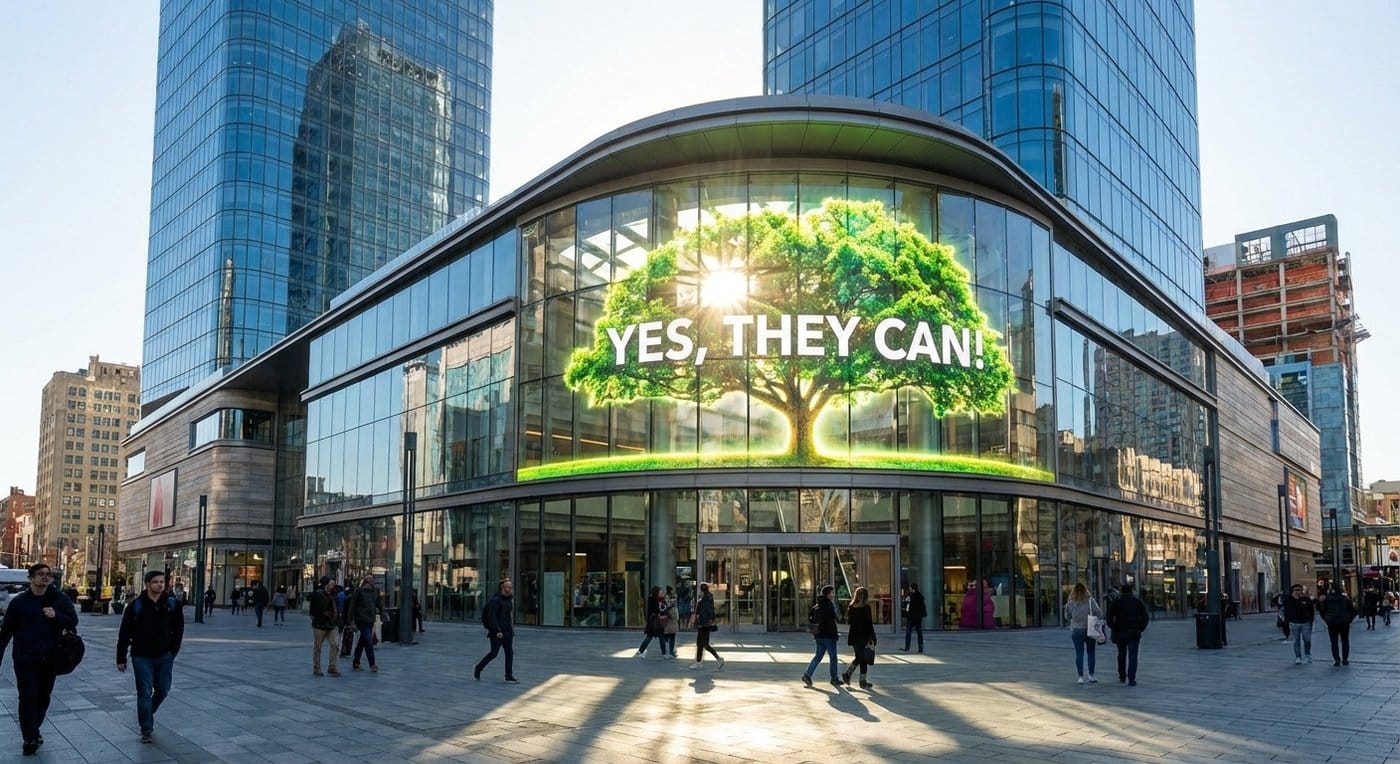
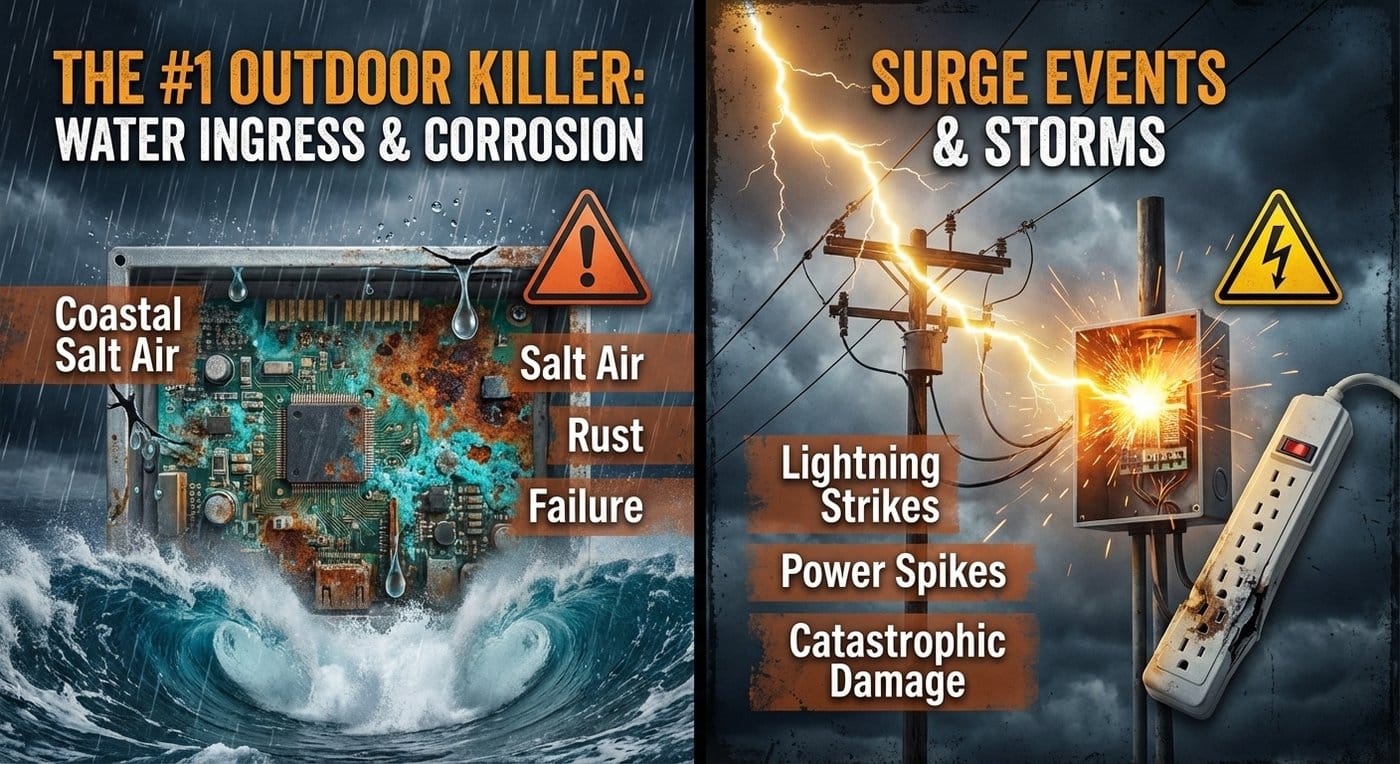
Transparent LED is one of those product categories where the honest answer is “yes—sometimes”. If you choose the right structure, seal the right interfaces, design for wind and heat, and verify performance with real test evidence, transparent LED can run outdoors for years. If you treat “outdoor” as a marketing checkbox, it can fail fast—often in ways that look like random pixel defects but are actually water ingress, corrosion, condensation, or surge damage. (國際電工委員會)
In this guide, we’ll break outdoor use into real-world exposure levels, map each transparent LED type to what it can survive, and give you an engineering checklist you can paste into a spec or tender.
Related references: We’ll link to your related pages for deeper product context: ChinaLEDScreens , Transparent LED Screens , Outdoor Mesh LED Display Screen (Waterproof) , Outdoor Transparent LED Grille LED Display , Technology & Quality , and Projects & Case Studies .
Most outdoor failures happen because stakeholders use “outdoor” as a single category. In practice, you have three tiers:
Your product choice and spec should match the tier—especially around ingress protection (IP), impact (IK), corrosion, and surge. (國際電工委員會)
If you’re designing a building façade or media curtain wall, mesh and grille structures are usually the most outdoor-friendly transparent LED family:
This is why many real-world outdoor “transparent LED” façades are functionally mesh/grille rather than glass-like film. If your project is a true exposed façade, start here: Outdoor Mesh LED Display Screen (Waterproof) and Outdoor Transparent LED Grille LED Display.
Rigid transparent cabinets can work outdoors—but only when the entire system is engineered for it (not just “waterproof modules”). Outdoor exposure demands enclosure-level protection defined by IEC IP ratings. (國際電工委員會)
If a supplier says “IP65 module” but can’t prove cabinet seams, doors, connectors, and cable glands are also sealed, your actual risk is still high.
Transparent LED film is often chosen for aesthetics, but direct outdoor exposure is tough: edges, adhesives, and driver interconnects are vulnerable to water ingress, UV degradation, and delamination. If film is used outdoors, it’s typically behind a protective layer (e.g., behind glass, within a sealed glazing assembly) or in “semi-outdoor” zones. UV weathering standards exist precisely because polymers and coatings change under UV exposure. (Atlas MTS)
LED glass can be outdoor-capable—but once you integrate electronics into glazing, you’re no longer just buying a screen. You’re dealing with building envelope performance, safety glass rules, thermal expansion, and long-term serviceability. Treat it like façade engineering, not AV procurement.
IEC 60529 is the basis for IP rating classification—how enclosures resist intrusion of dust and liquids.
In plain terms, many references describe IP65 as:
What people miss: IP is about the enclosure, not the LED chip. For outdoor transparent LED, common leak points are:
Actionable spec language (useful in tenders):
If your installation is near coastal spray or frequent wash-down, consider specifying enclosure expectations using NEMA types (e.g., Type 4/4X) as an additional framing tool—NEMA 4X addresses corrosion resistance concepts that matter in coastal zones.
If the display is reachable from pedestrians, you must plan for impact. IK ratings classify the degree of protection against mechanical impacts per IEC 62262 references.
Practical guidance:
Transparent LED has an inherent trade-off: higher transparency often means lower fill factor, so you need more luminance to be readable in daylight.
Outdoor LED signage commonly runs in very high brightness ranges; for example, outdoor billboard products can be specified around 6,000–10,000 nits depending on application.
Actionable guidance:
Outdoor failures often look like “random dead pixels,” but root cause can be heat stress:
What to specify:
Environmental test families like IEC 60068 are widely used as a reference set for temperature change and damp heat exposures.
For large outdoor façades, the governing risk is often structural, not electronic.
In the US, wind load design for building components and cladding is addressed within ASCE/SEI 7 (components & cladding provisions).
Why mesh/grille often wins: porous structures can reduce drag; studies on porous screens show drag coefficient trends that improve with higher porosity under certain conditions.
Actionable installation rules:
If you are within coastal influence, treat corrosion as a first-class requirement:
Salt spray testing is a common corrosion evaluation method; ASTM B117 is a widely referenced salt-fog practice.
UV also attacks plastics and coatings; ISO 4892 is a recognized framework for artificial weathering of plastics.
Actionable requirements:
Outdoor LED screens are surge targets: long cable runs, exposed structures, and nearby lightning events.
IEC surge immunity and surge protection device standards are commonly referenced for evaluating and specifying protection approaches.
In the US signage context, UL and NEC frameworks (e.g., UL 48 and NEC sign rules) are commonly referenced for electric sign safety expectations.
Actionable “ask the supplier” items:
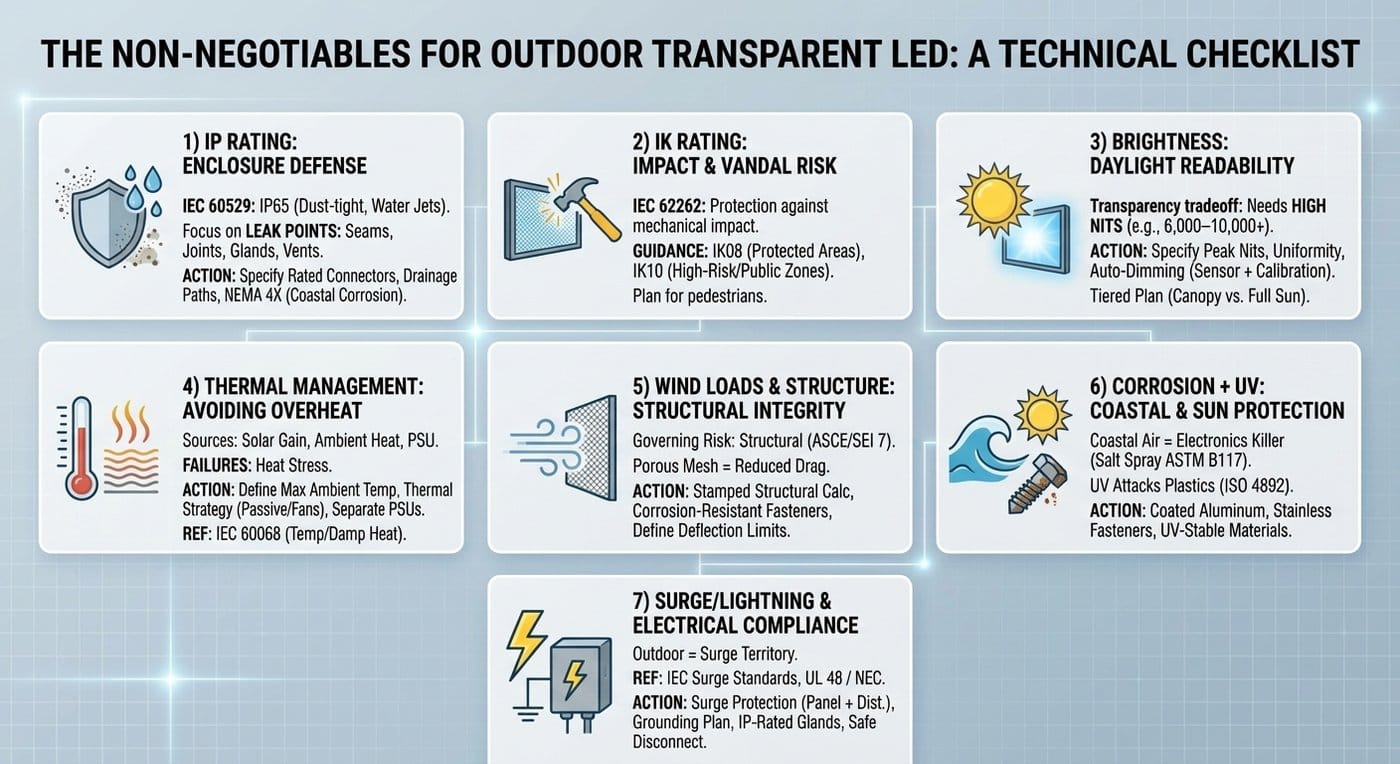
Here’s a procurement checklist you can copy into an RFQ:
If you want a quick place to anchor “how we build and verify quality” in your narrative, your own page helps: Technology & Quality.
Outdoor electronics fail when water finds a path and stays there. A good outdoor transparent LED design makes water leave:
These details matter as much as the headline IP rating because IP is only meaningful if the real leak paths are addressed.
Sealed cabinets need pressure equalization; poorly designed venting becomes a water entry point. Specify vent solutions appropriate for the exposure tier and make sure the vendor can explain how the vent maintains protection under wind-driven rain.
If you’re specifying for a fully exposed façade, start with mesh/grille transparency rather than film-like transparency. It’s usually the best balance of wind performance, cooling, serviceability, and durability.
If you’re under canopy or in semi-outdoor use, rigid transparent cabinets may work well—just ensure the spec is grounded in enclosure protection and verified sealing.
IP65 is a common target and is widely described as dust-tight and protected against water jets, but “enough” depends on exposure: wash-down, coastal wind-driven spray, and installation geometry can raise the bar.
Don’t assume. “Water jets” in IP65 contexts are a defined test concept, not a guarantee against real-world pressure-washing at close range; require the vendor to state cleaning limits and acceptable methods.
If pedestrians can reach it, yes—IK is how you translate “vandal resistance” into a measurable target.
In practice: water ingress + corrosion (especially coastal) and surge events after storms.