Talk To Our Expert, Get A Solution in 20 minutes
Share your LED screen needs. Our experts will provide solutions and a quick response.

If you’ve ever bought a normal LED wall, you already know the usual game: pixel pitch, brightness, refresh rate, and a quick check that the cabinet is serviceable.
Transparent LED flips the table—because you’re no longer buying “a screen.”
You’re buying a screen that must keep behaving like glass.
That single constraint changes everything. It’s why two suppliers can both sell you “80% transparency” and yet one looks like an elegant floating image, while the other looks like a visible fence that kills the storefront experience.
In this guide, we’ll treat transparency like an engineer would: as a system outcome that has to survive real daylight, real reflections, real viewing distances, and real installation constraints—not a marketing number.
Along the way, I’ll point you to the relevant internal references on ChinaLEDScreens for deeper spec sheets and examples, but the core value here is the decision framework. (Transparent LED Screens Display)
Before you debate 50% vs 90%, you need to define what “see-through” is protecting. In most projects, it’s one (or more) of these:
If you skip this step, the team will chase the biggest transparency number and accidentally destroy what the project is supposed to preserve: premium content readability.
Your own “good in practice” guidance for retail windows makes this explicit: you want enough openness to preserve visibility, but enough pixel density and brightness to still look like a real display. (Transparent LED Screens Display)
In the market, “transparency” may refer to:
If you don’t force clarity here, you can end up signing a PO for “90% transparency” and later discovering that only the LED strip surface (not the full installed system) was counted.
A transparent LED is visually “present” when:
That’s why the same nominal transparency can feel radically different between a clean install and a messy one. Your “Maintain 80% transparency” explainer frames “80%” as a deliberate optical-and-mechanical design approach—not a standalone truth. (Transparent LED Screens Display)
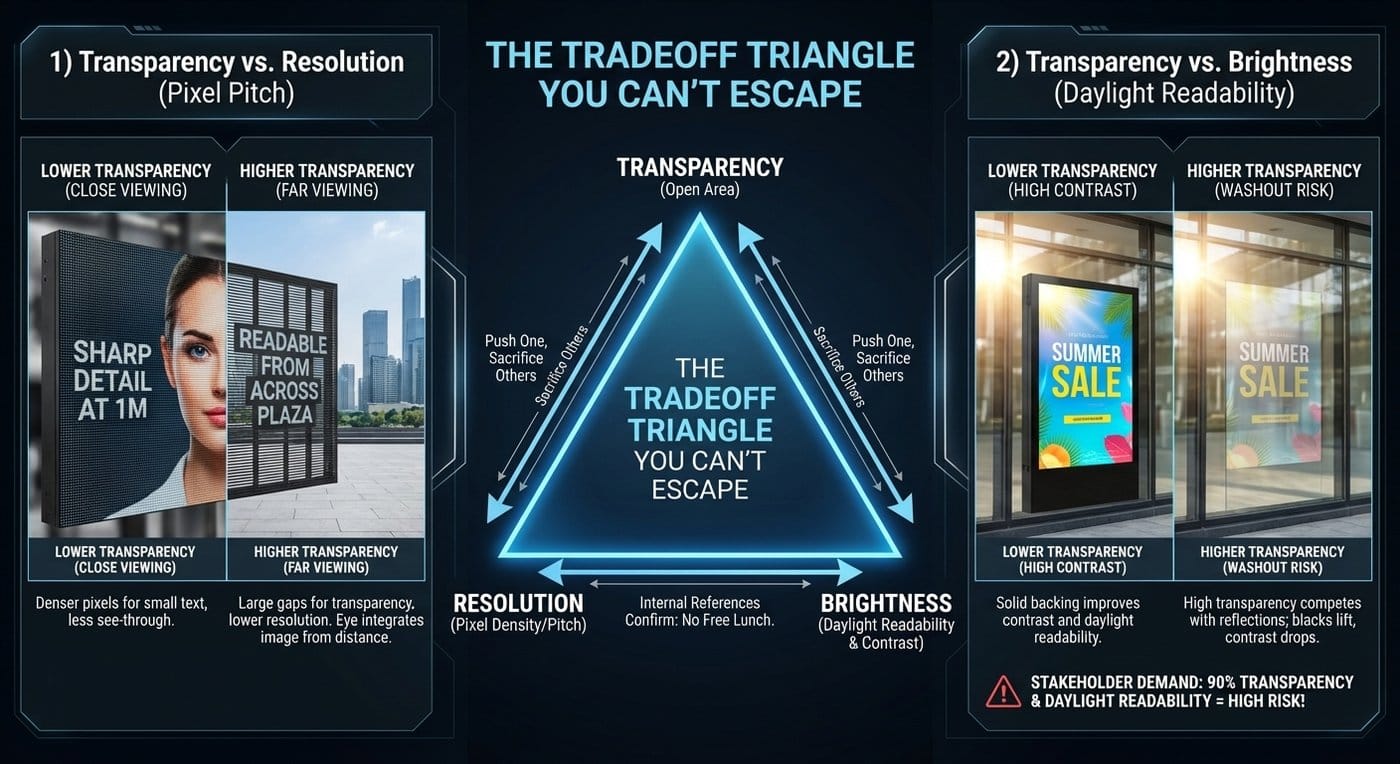
Transparent LED is governed by a triangle:
Transparency ↔ Brightness ↔ Resolution (pixel density)
Push one corner hard, and you usually give up something on one (or both) of the others. Your internal references call this out directly. (Transparent LED Screens Display)
Transparent LED needs gaps between pixels to remain see-through. Your own business guide states it plainly: transparent pixels “need gaps,” and it gives example pitches and use cases, including a warning that if your requirement is small text readability, transparent LED is the wrong tool. (Transparent LED Screens Display)
What this means in practice:
Glass is not a friendly display environment. Reflections lift your black level, and when blacks lift, bright pixels lose contrast even if the raw nits are high.
Your brightness guidance emphasizes this: on glass, the goal is not just high nits—it’s making “ON” pixels stand out above reflections while keeping “OFF” pixels truly dark. (Transparent LED Screens Display)
So if a stakeholder demands 90% transparency and strong daylight readability for street-facing glass, your risk goes up fast unless you control content, brightness strategy, and installation details.
Let’s say the project is a flagship retail window and the viewing distance is close. The brand wants product videos, faces, motion graphics, maybe even some readable text.
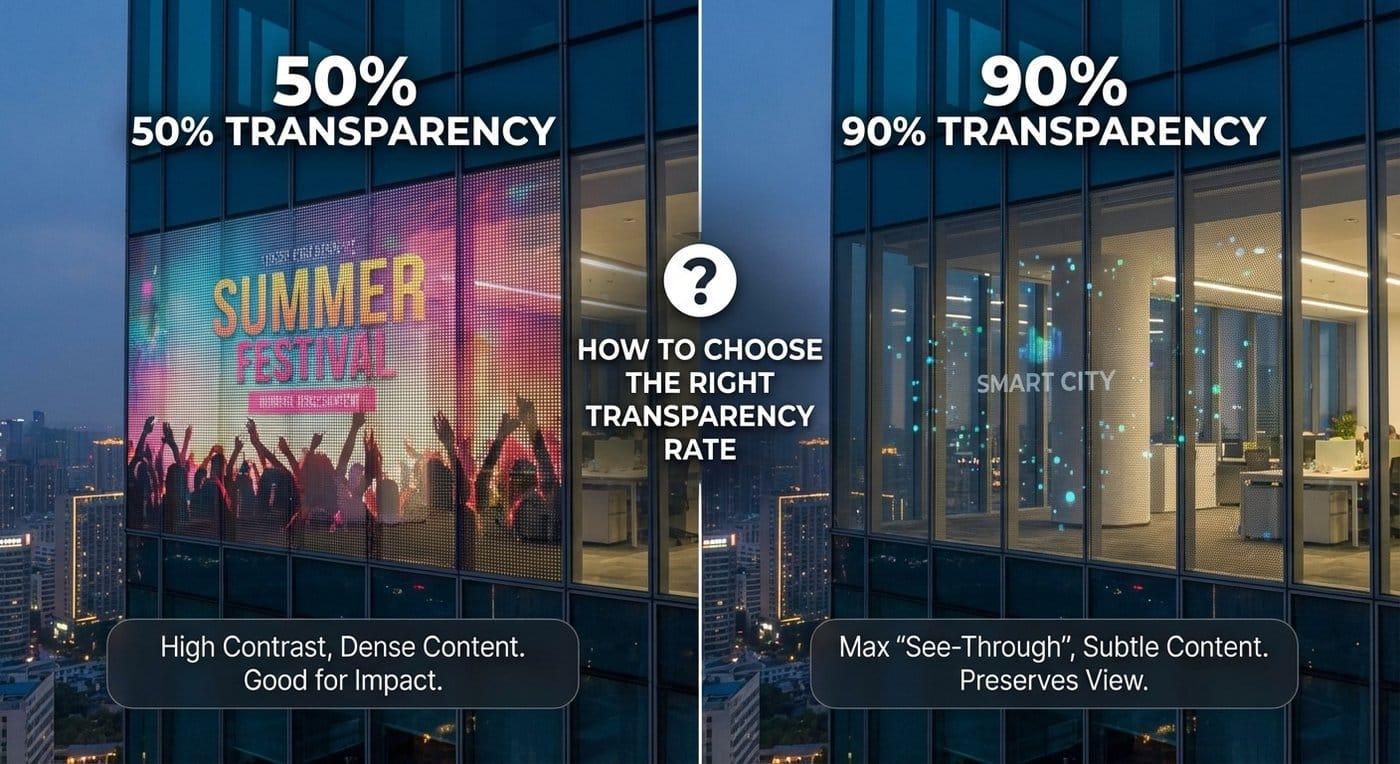
In that world, 50% transparency is not “worse.” It can be the responsible choice because it buys you:
This is why many retail-appropriate systems live in balanced ranges rather than chasing extreme openness. Your internal “good in practice” retail window range (~60–80% system transparency) is basically the market’s way of acknowledging that retail needs both glass visibility and real display performance. (Transparent LED Screens Display)
If the client expects:
they’re asking for a tough combination. The way you win is by choosing the right compromise on purpose, not by buying a brochure number.
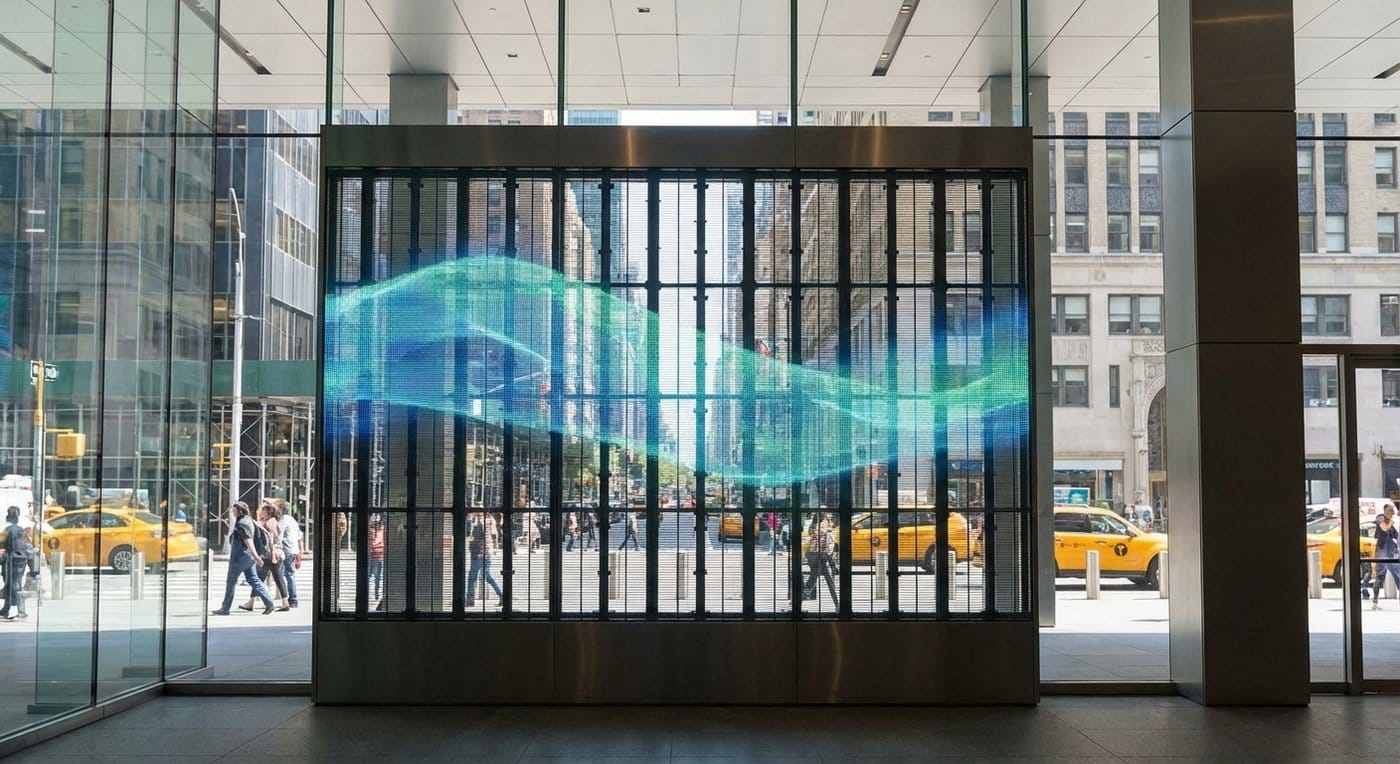
Ultra-high transparency is most realistic when:
If the real requirement is:
then you need to reset expectations. Transparent LED is a different class of tool. Even your transparent vs traditional guide includes a simple rule: if you need small text readability, don’t buy transparent LED—choose a traditional indoor screen. (Transparent LED Screens Display)
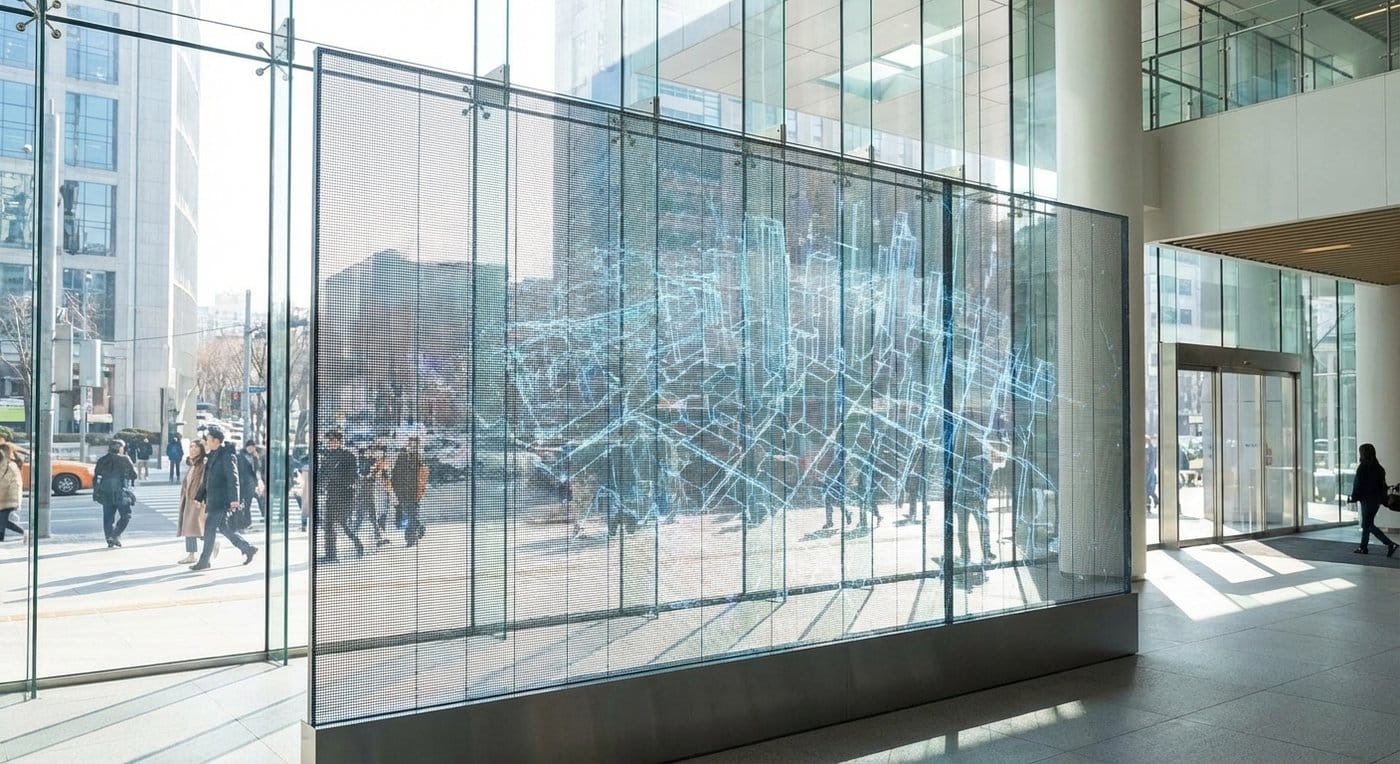
Here’s a grounded way to frame targets:
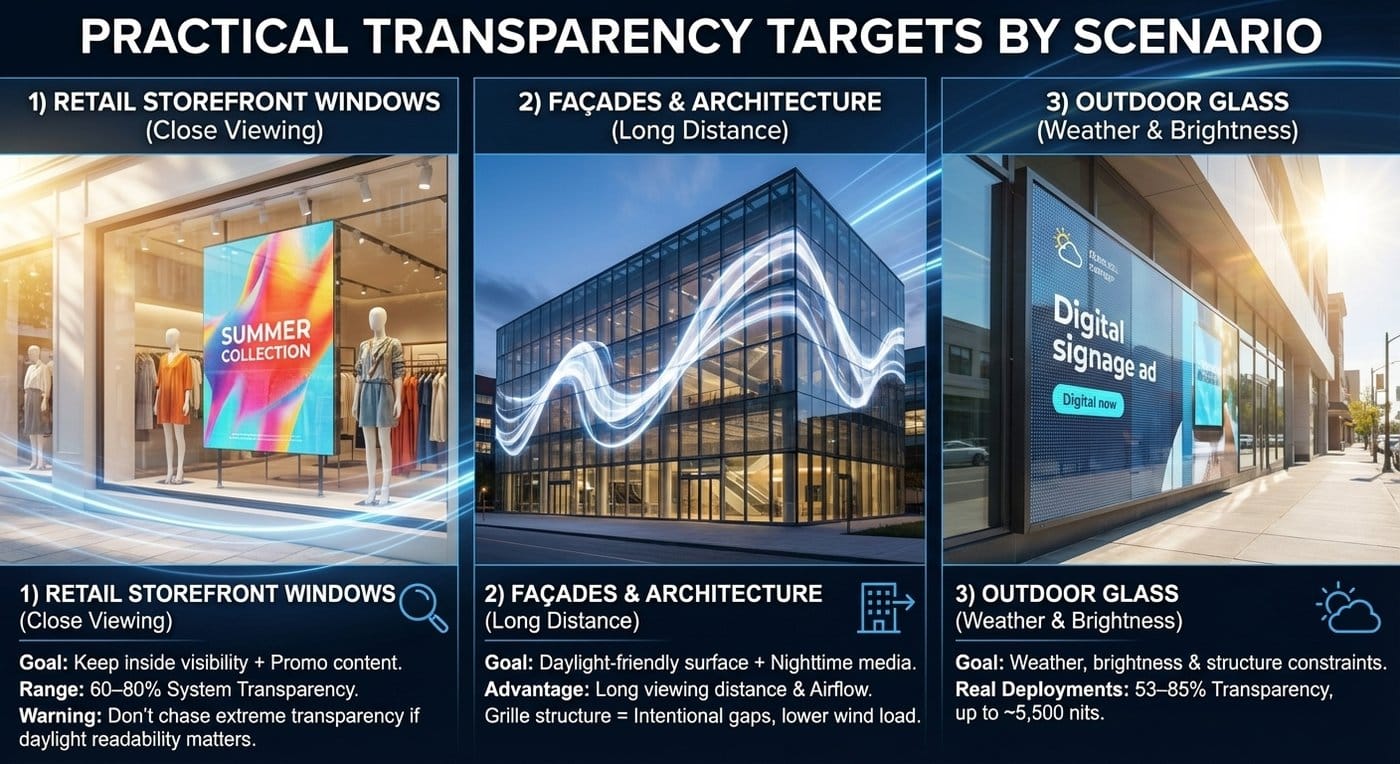
Goal: keep inside visibility while running promo content.
A practical starting range is ~60–80% system transparency, with a warning not to chase extreme transparency if daylight readability matters. (Transparent LED Screens Display)
When the client says “We want 90%,” translate it to: “You’re willing to trade image density and daylight contrast for openness—are you sure?”
For larger architecture, higher transparency can be more feasible because:
Your grille guide explains the basic logic: rigid strip modules with intentional gaps create airflow, lower façade pressure, and partial transparency—i.e., a daylight-friendly building surface. (Transparent LED Screens Display)
Outdoor transparent LED often lives inside bounded ranges because weather, brightness, and structure are real constraints. Your outdoor transparent LED page lists ~53–85% transparency with up to ~5,500 nits as an example of what’s being sold for real deployments. (Transparent LED Screens Display)
| Use case | What “see-through” must protect | Practical transparency direction | Why |
|---|---|---|---|
| Retail windows (close viewing) | Product visibility and readable promos | ~60–80% system transparency | Balances visibility with enough pixel density/brightness to look like a “real display.” Transparent LED Screens Display |
| Glass façade (long viewing) | Daytime building identity + openness | Higher transparency is viable | Distance lets the eye integrate; grille/strip gaps reduce wind load and keep the façade visually lighter. Transparent LED Screens Display |
| Outdoor glass installs | Readability vs sun + weather | Expect ranges like ~53–85% depending on design | Outdoor pages show transparency is often bounded by structure + brightness requirements. Transparent LED Screens Display |
| Transparency claim | What it usually implies | Best-fit scenarios | Common failure mode |
|---|---|---|---|
| ~50% | Denser LED surface (more “screen,” less “glass”) | Close viewing, premium video, stronger daytime presence | Feels “grid-like” if structure is bulky or content is poorly designed |
| ~60–80% | Balanced system design | Most retail windows + atriums | Buyers assume it will behave like a solid LED wall in full sun Transparent LED Screens Display+1 |
| ~90%+ | Extreme openness / minimal structure | Long viewing distances, stylized content, specific technologies | Legibility drops in daylight; spec disputes if the metric isn’t defined Transparent LED Screens Display+1 |
If you want to avoid disputes, you must convert transparency from a marketing claim into a contractable requirement.
Ask for the percentage after accounting for:
Force the supplier to declare:
Why? Because transparency is not independent—it’s coupled. Your “Maintain 80% transparency” explainer explicitly ties high transparency to design levers like pitch and structure, and it calls out the tradeoff triangle. (Transparent LED Screens Display)
If stakeholders care about “glass feel,” you need a mockup that tests:
Your internal guidance emphasizes that real-world examples and case studies matter because they reveal day vs night appearance and how wiring/mounting were handled. (Transparent LED Screens Display)
Vendor must provide:
If you want examples of how to frame these project inputs (location, glass size, viewing distance, indoor/outdoor, target brightness/transparency), your Project Case Studies page literally prompts for those parameters—use it as a template for your RFQ intake form. (Transparent LED Screens Display)
To keep your decision process consistent across stakeholders, here are the most relevant internal references: