Talk To Our Expert, Get A Solution in 20 minutes
Share your LED screen needs. Our experts will provide solutions and a quick response.

Note: I don’t have the
chinaledscreens.jsonfile available in this chat, so I’m selecting 5–7 internal links directly from chinaledscreens.com (including the homepage) and weaving them into the post.
If you sell transparent displays long enough, you’ll hear it in every other inquiry:
“We want an invisible screen.”
The tricky part is that customers aren’t describing a product category. They’re describing an emotional requirement (glass should still feel like glass) plus a bundle of technical expectations they don’t yet have words for.
This article decodes “invisible screen” the way engineers, integrators, architects, and buyers can actually act on—so your next RFQ doesn’t collapse into spec-sheet arguments, late-stage redesign, or “it looked different in the showroom.”
For context on who we are: ChinaLEDScreens (factory-direct since 2009) focuses on transparent LED screens, LED glass, LED film, flexible film, holographic, and mesh solutions. (ChinaLEDScreens homepage) (Transparent LED Screens Display)
Customers tend to compress five different needs into one phrase:
They want the façade to look like normal glass in daytime—no “grid,” no obvious circuitry, no distracting lines.
Translation: minimize visible structure (wires, traces, frame edges) and keep color neutrality.
They want content to appear like it’s hovering on glass, not sitting on a bulky cabinet.
Translation: thin profile + controlled reflections + content that preserves transparency.
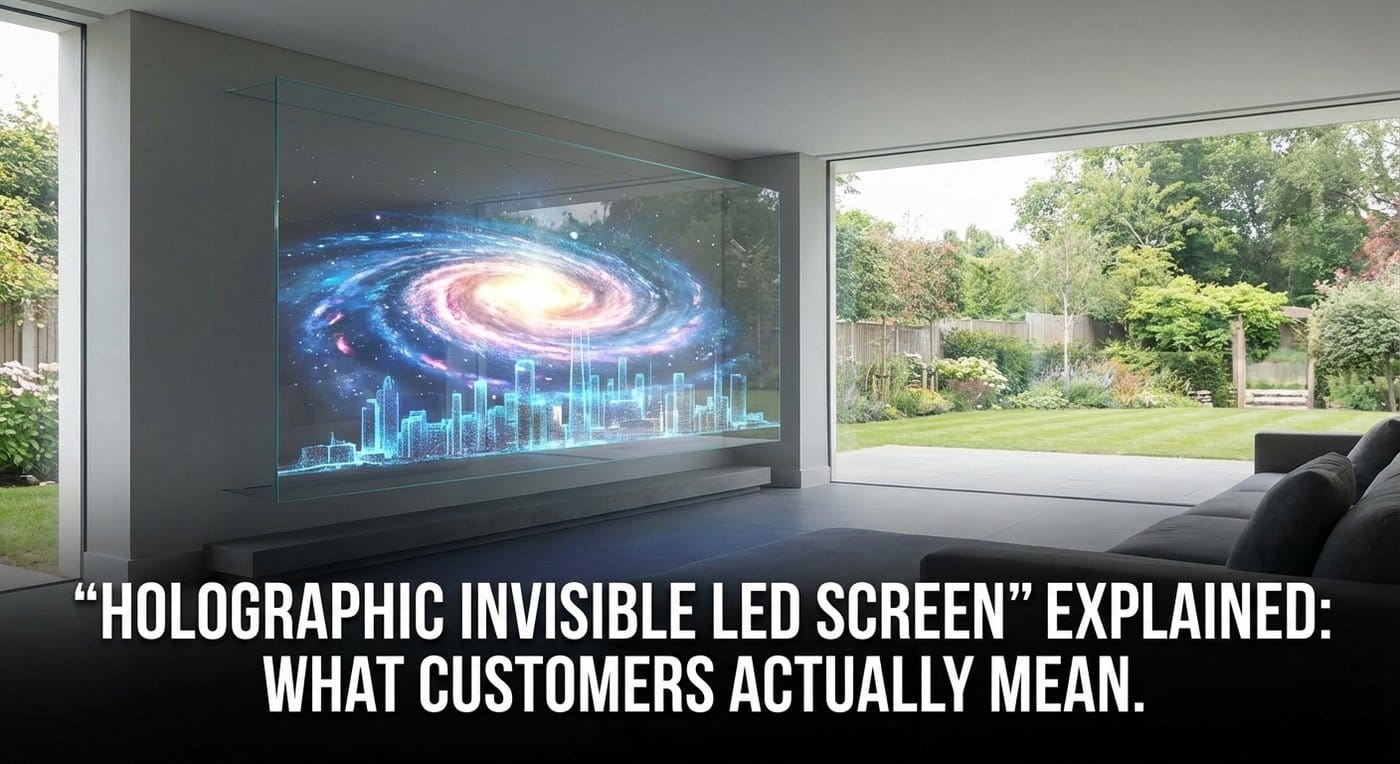
This is why “holographic” and “ultra-thin film” requests often show up alongside “invisible.” A representative example is a holographic-style screen marketed as frameless and ultra-thin. (Spectra holographic screen) (Transparent LED Screens Display)
Architects and agencies are thinking about renderings and real photography. If the frame, cables, or power boxes are visible, the concept dies.
Translation: conceal routing, specify edge conditions, and define where the controller/power lives before fabrication.
They expect it to look great at noon, at night, and with interior lights behind the glass.
Translation: “invisible” is often a contrast problem, not just a transparency problem.
They want the install to stay clean-looking over time, and maintenance to be predictable.
Translation: service model (module-swap vs layer-replace) matters as much as aesthetics.
A useful grounding reminder: an LED display is never “just a screen”—it’s modules/cabinets, power, control, structure, and calibration as a system. (What Is an LED Display Screen?) (Transparent LED Screens Display)
“Invisible” is usually a tug-of-war between three levers:
If you push one corner too hard (e.g., chase ultra-high transparency), you typically pay in another corner (contrast and perceived brightness). ChinaLEDScreens’ transparency guidance frames this as tiers and trade-offs rather than one magic percentage. (Transparency rate—what’s “good” in practice) (Transparent LED Screens Display)
Ask the customer (or decide internally):
Why this matters: a system can be “invisible” at 10 m and very visible at 2 m—even at the same pitch.
Example (glass-first integration): LED glass solutions often emphasize high visible transmittance and fine conductive traces designed to stay visually discreet. (JY Series LED glass) (Transparent LED Screens Display)
“Invisible” isn’t only hardware—it’s also what you choose to display.
If the customer wants the glass to feel transparent while playing content:
This is why “invisible” buyers often love showroom demos—and then struggle in a sunlit window with busy backgrounds.
Most “invisible screen” disappointment is actually a viewing distance mismatch:
If you need the category framework to prevent “wrong family” selection early, this comparison is built exactly for that decision conversation. (Transparent LED vs LED glass vs LED film) (Transparent LED Screens Display)
Two projects can use the same display and look totally different because of finishing:
If “invisible” is a must, treat finishing as a scoped deliverable—not an afterthought.
“Invisible” installations are often in high-visibility locations. That makes maintenance optics critical:
For a film category baseline, this guide frames what film is best at—and what to watch. (Guia de ecrãs de película LED) (Transparent LED Screens Display)
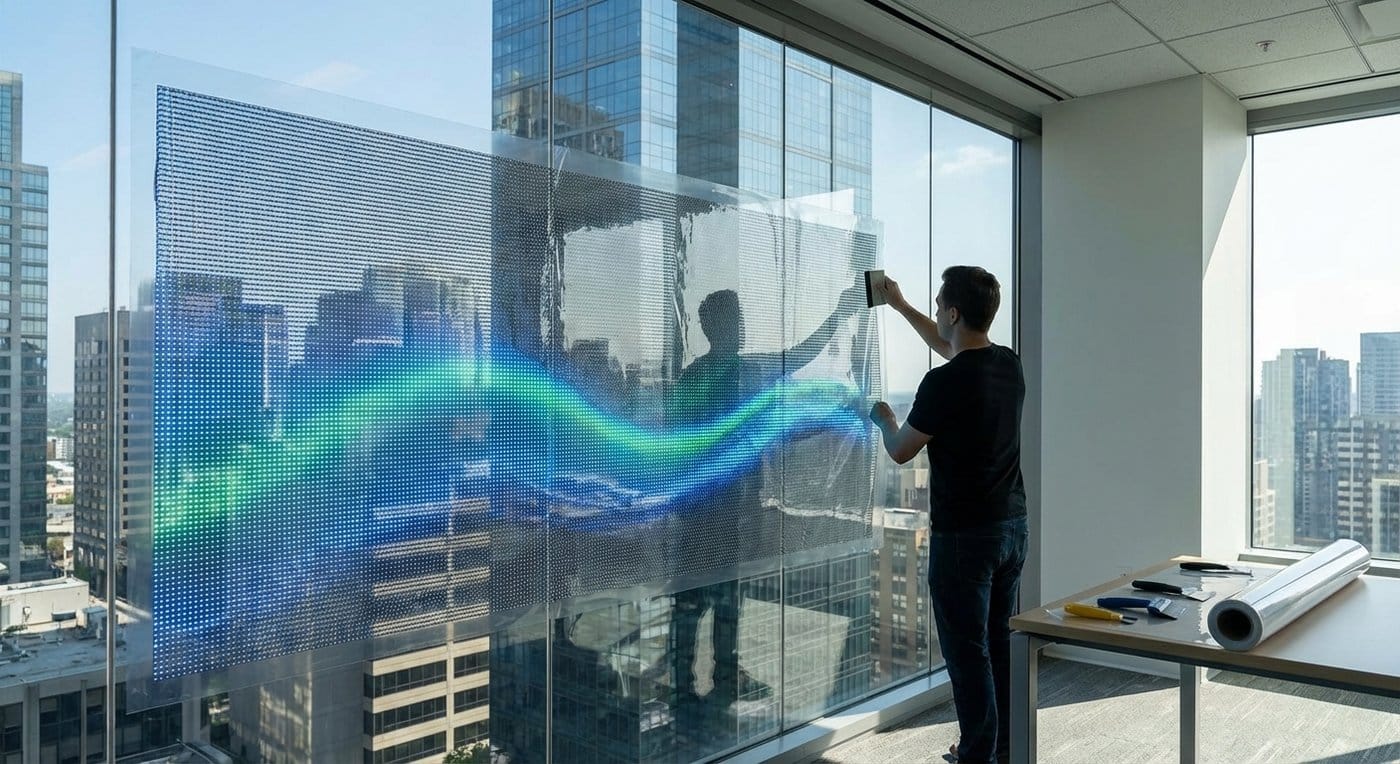
If the customer is reacting to bulky cabinets and wants glass to stay glass, self-adhesive flexible film is often what they’re imagining.
What it can deliver:
What you must manage:
A representative product-style reference is the RF-series self-adhesive flexible film concept (thin, lightweight, high transparency positioning). (RF Series flexible film) (Transparent LED Screens Display)
When the project owner is façade-driven (new build, premium lobby, glass package scope), LED glass is often the most “honest” match to “invisible”—because it’s designed to behave like a glass element.
What it can deliver:
What you must manage:
See an example positioning around visible transmittance and architectural integration. (JY Series LED glass) (Transparent LED Screens Display)
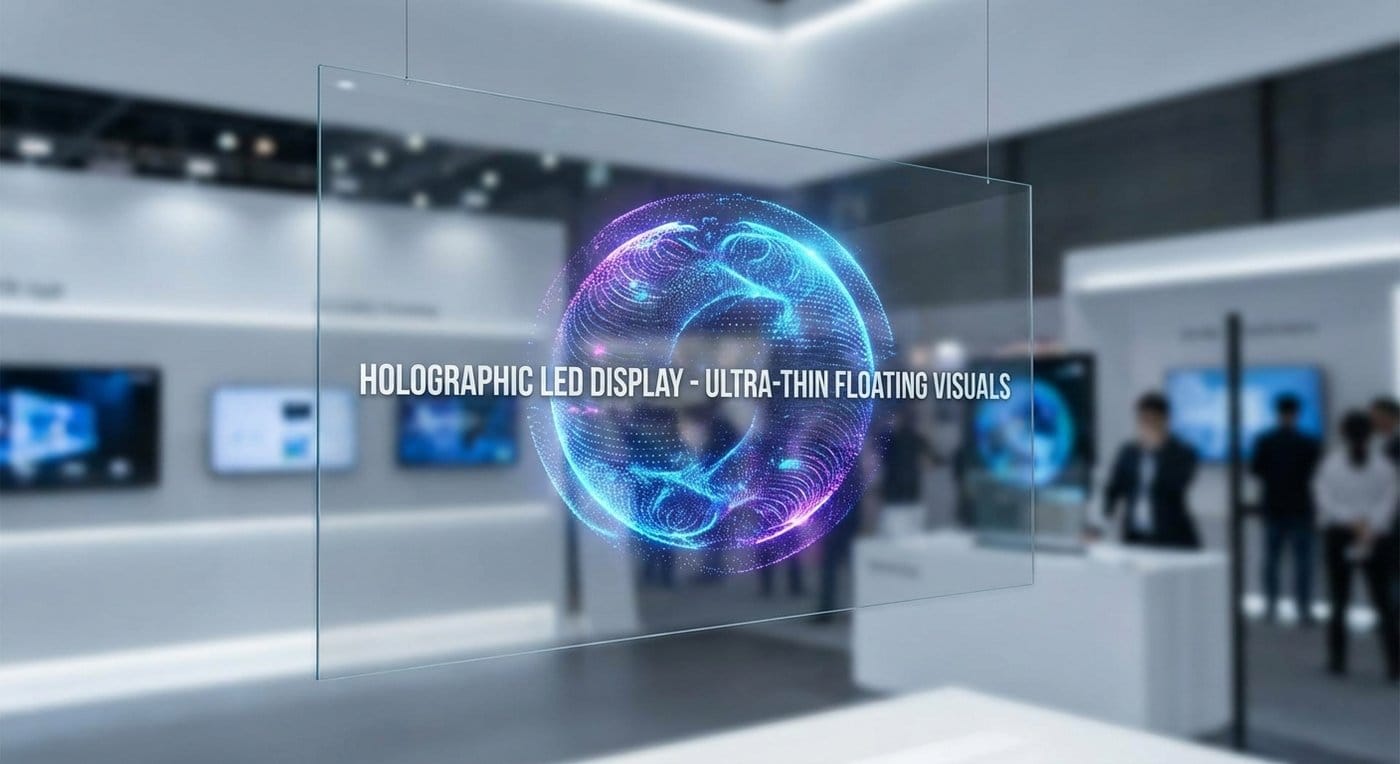
Some buyers say “invisible” but actually mean: “I want the content to look like it’s floating.” That’s a different intent from “I want no visible structure at 2 meters.”
Holographic-style screens are often sold as ultra-thin and high-transparency, optimized for that floating impression. (Spectra holographic screen) (Transparent LED Screens Display)
If the customer’s real pain is maintenance risk (retail chains, airports, public venues), framed modular transparent screens may look “less invisible” up close—but they win on predictable service and lifecycle control.
If you need a clean definition of “transparent LED screens” vs other families for stakeholders, this overview helps align terminology. (What Is Transparent LED?) (Transparent LED Screens Display)
Have the customer score what they mean from 1–5:
Then choose the family that wins their scorecard—not the one that wins a brochure.
If a customer says “invisible,” paste this into your RFQ:
It sounds strict—but it prevents expensive expectation gaps later.
“Invisible screen” isn’t a single product. It’s a bundle of priorities—glass authenticity, floating visuals, minimal hardware, real-world readability, and manageable service.
When you translate that phrase into measurable requirements, the correct solution usually becomes obvious (film vs glass vs holographic vs modular). And the project becomes predictable.
If you want the fastest path: start with the ChinaLEDScreens portfolio hub, then route the inquiry to the correct family from there. (ChinaLEDScreens homepage) (Transparent LED Screens Display)