Talk To Our Expert, Get A Solution in 20 minutes
Share your LED screen needs. Our experts will provide solutions and a quick response.

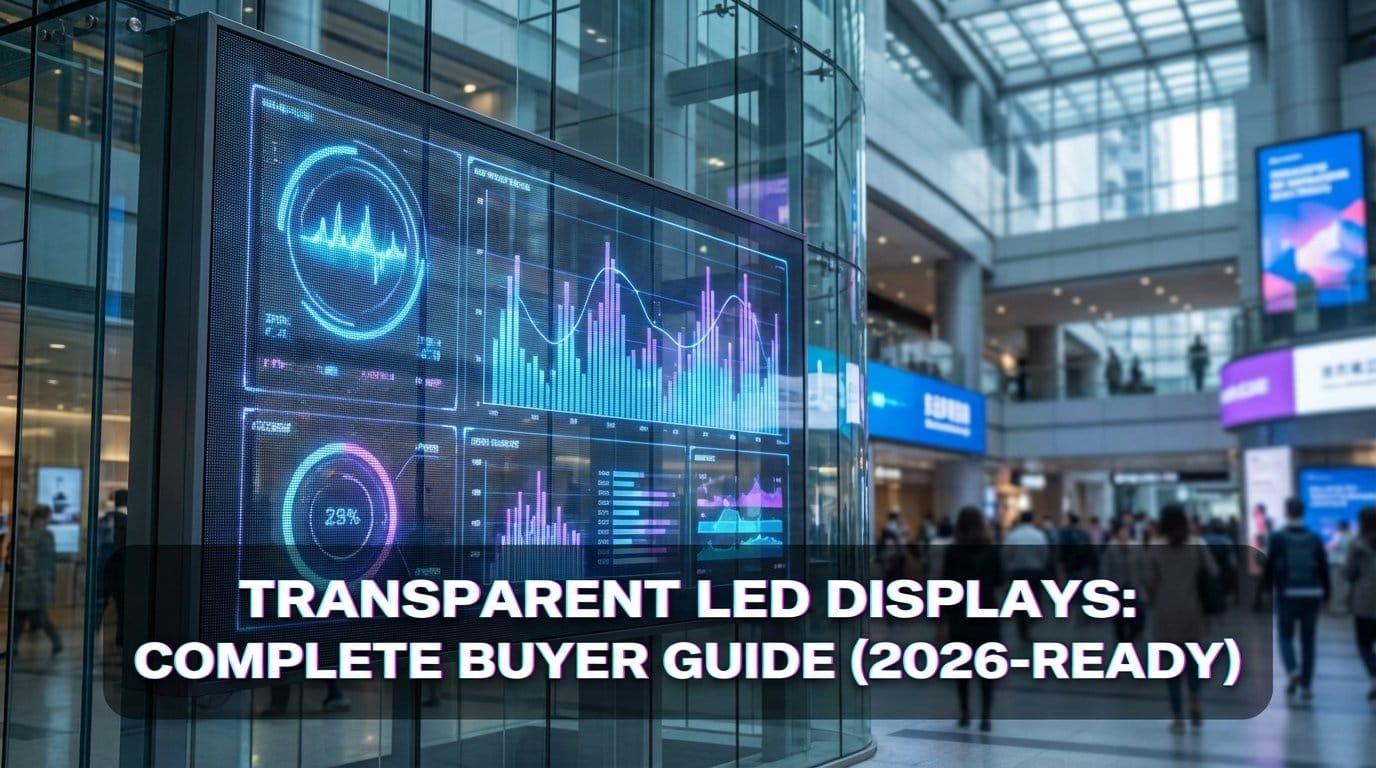
Transparent LED is not “a screen you stick on glass.” In 2026 projects, it’s a building-facing display system that must satisfy optics, structure, power/control, compliance, and long-term maintenance. The most common failure isn’t a dead pixel—it’s a bad spec: wrong brightness strategy for daylight, unrealistic transparency expectations, poor service access, or missing compliance items that delay handover.
If you’re sourcing factory-direct, start from the full portfolio and capability baseline at ChinaLEDScreens.
A transparent LED display overlays digital content while keeping visibility through the surface—especially valuable for retail windows and architectural glass. But the core trade-off never goes away: you’re always balancing brightness, clarity, and transparency.
Engineer’s framing: transparent LED isn’t one product. It’s a system:
When any one of those is weak, the result looks “fine” on day one—and becomes a headache by month six.
The buyer guide breaks the tech stack into three practical layers:
The base is usually optically clear glass or plastic, chosen to maximize light transmission and preserve the “see-through” effect.
Power has to reach pixels without turning the display into a visible grid. That’s why transparent conductors like ITO or silver nanowires are used.
Transparent transistors function as pixel switches, controlling on/off behavior to form images with precise control.
The guide highlights a key distinction: front-lit has become mainstream and generally improves image quality and visibility, while edge-lit offers different visual effects and installation flexibility.
Buyer takeaway: don’t accept “it’s transparent LED” as a complete description. Ask which design approach and why it fits your viewing and brightness requirements.
Before you write specs like pixel pitch, brightness, and IP rating, lock the product family. Transparent LED is not one technology—it’s a set of architectures optimized for different constraints: structure vs. glass aesthetics, wind load vs. optical cleanliness, serviceability vs. invisibility.
Here’s the practical category map I use in meetings (architect + integrator + buyer). Once you choose the category, your RFQ becomes simpler because you’re no longer comparing incompatible solutions.
A safe starting point—when you need scalable systems with strong daylight performance and predictable maintenance—is Transparent LED Screens.
What it is (short intro): Classic modular transparent LED built from cabinets/tiles. This is the “workhorse” category for most commercial projects because it balances brightness, structure, and serviceability.
Why buyers choose it:
Best for: retail windows, building façades, and projects needing modular service and a strong brightness strategy.
RFQ focus points:
What it is (short intro): A glass-first solution where the display is integrated into glass structures. “Electro-optic glass” is often discussed in premium architecture because it keeps the look closer to real glass.
Why buyers choose it:
Best for: premium architectural integration where the glass appearance is non-negotiable.
RFQ focus points:
If your design intent is “media glass,” evaluate LED Glass Screens early—because it changes structural coordination.
What it is (short intro): Ultra-thin transparent display film applied on or close to glass, designed to keep sightlines and reduce visual obstruction compared with cabinet systems.
Why buyers choose it:
Best for: thin-profile glass installs where minimal visual obstruction matters.
RFQ focus points:
Use LED film screens guide to align pitch/brightness expectations with real use cases and budget logic.
What it is (short intro): A flexible, often self-adhesive film display designed for curved glass, columns, irregular surfaces, or projects where you need the display to follow architecture rather than fight it.
Why buyers choose it:
Best for: curved glass and unconventional surfaces where geometry dominates.
RFQ focus points:
Reference self-adhesive LED film selection guide when geometry, installation constraints, and aesthetics are your primary drivers.
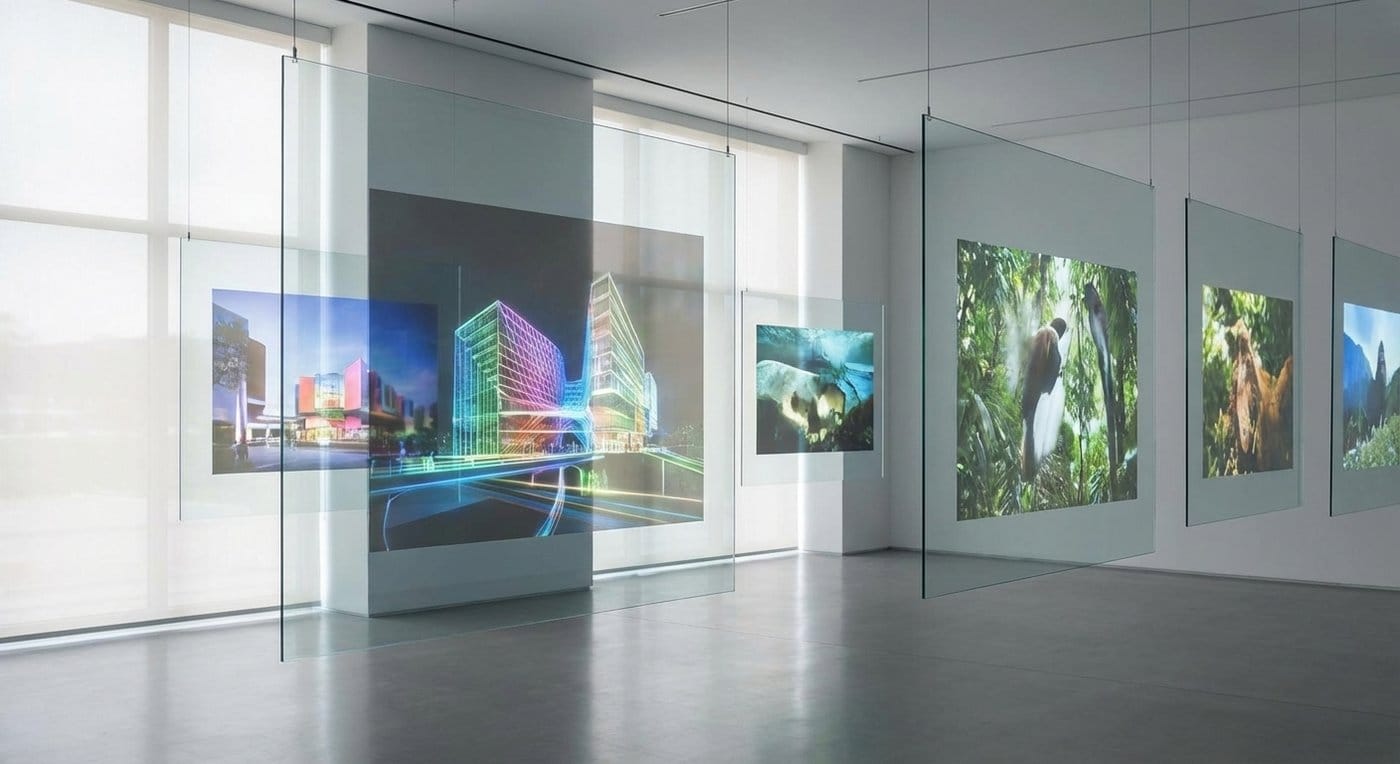
What it is (short intro): A “floating image” style display that prioritizes visual spectacle—often used as a premium storytelling layer rather than a traditional information display.
Why buyers choose it:
Best for: premium floating visuals in showrooms, events, and flagship storytelling (usually controlled light and viewing angles).
RFQ focus points:
Explore Holographic LED Screens when your KPI is impact and experiential design more than pure daylight legibility.
What it is (short intro): A façade-oriented architecture where the display is built as an open mesh/curtain—designed to tolerate wind and reduce structural load while still delivering large-scale visuals.
Why buyers choose it:
Best for: large outdoor façades where airflow, wind-load management, and long viewing distances dominate.
RFQ focus points:
For deeper comparison and procurement logic, use mesh LED curtain display buying guide.
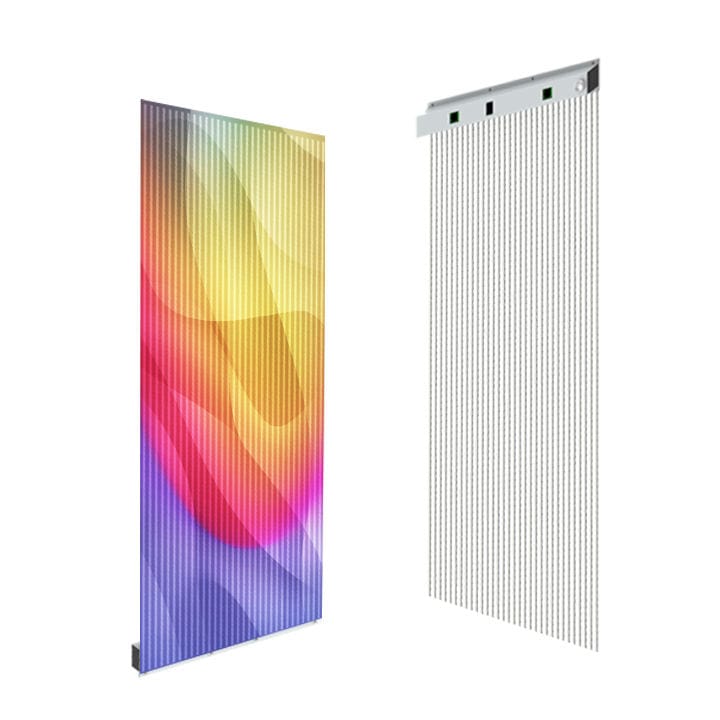
What it is (short intro): A strip-based “louver-like” transparent display format. Think of it as a middle ground between traditional transparent cabinets and mesh—often chosen for façade projects that need robustness and high transparency.
Why buyers choose it:
Best for: façade installations needing strip structure, strong wind tolerance, and high transparency.
RFQ focus points:
What it is (short intro): A linear “pixel media” format used to draw outlines, contours, and architectural lines. It’s not meant to be a high-resolution video surface; it’s meant to make buildings look alive.
Why buyers choose it:
Best for: building outlines and media lines rather than full-surface transparent video.
RFQ focus points:
Use LED video light strip pixel media guide when the objective is architectural line lighting—not a transparent window canvas.
If you want, paste your project scenario (window vs façade vs interior glass, viewing distance, sunlight condition, and whether the client cares more about “invisible hardware” or “maximum brightness”), and I’ll turn it into a category + RFQ spec template in one page.
This is where most buyers accidentally create apples-to-oranges quotes. Use measurable ranges.
The guide notes most transparent LED films fall roughly 70%–95% transparency. Higher transparency improves openness—but can reduce perceived “vibrancy” because there’s less emissive area.
What to specify
Pixel pitch for transparent LED films can range from P6 to P30 in the guide. Smaller pitch improves detail, but usually raises cost and increases power density and thermal demands.
What to specify
If you want a deeper film-specific breakdown, use LED film screens guide as your internal baseline when building the RFQ.
Indoor models are often cited at 4,000–5,000 cd/m² with ~75% transparency, while outdoor versions run higher brightness to fight ambient light.
What to specify
For outdoor use, the guide recommends evaluating resistance to rain, wind, and UV, and looking for weatherproof housing and scratch resistance.
If you have harsh outdoor sites (high wind, high UV, high altitude), prioritize structural reinforcement, UV protection, thermal management, and modular serviceability.
The guide explicitly calls out TCO: maintenance, energy consumption, and compliance costs—beyond initial purchase price.
What to ask for
For U.S. market deployment, the guide flags the need to comply with UL safety standards and FCC regulations for EMI, and to consider local zoning laws and building codes that affect installation.
How pros de-risk this

Transparent LED displays are increasingly used across retail, stage design, and architectural glass façades. Those environments share one truth: integration matters more than the LED spec sheet.
You need a service plan that matches the site:
Transparent displays “fail” when content is designed like a solid wall. For best results:
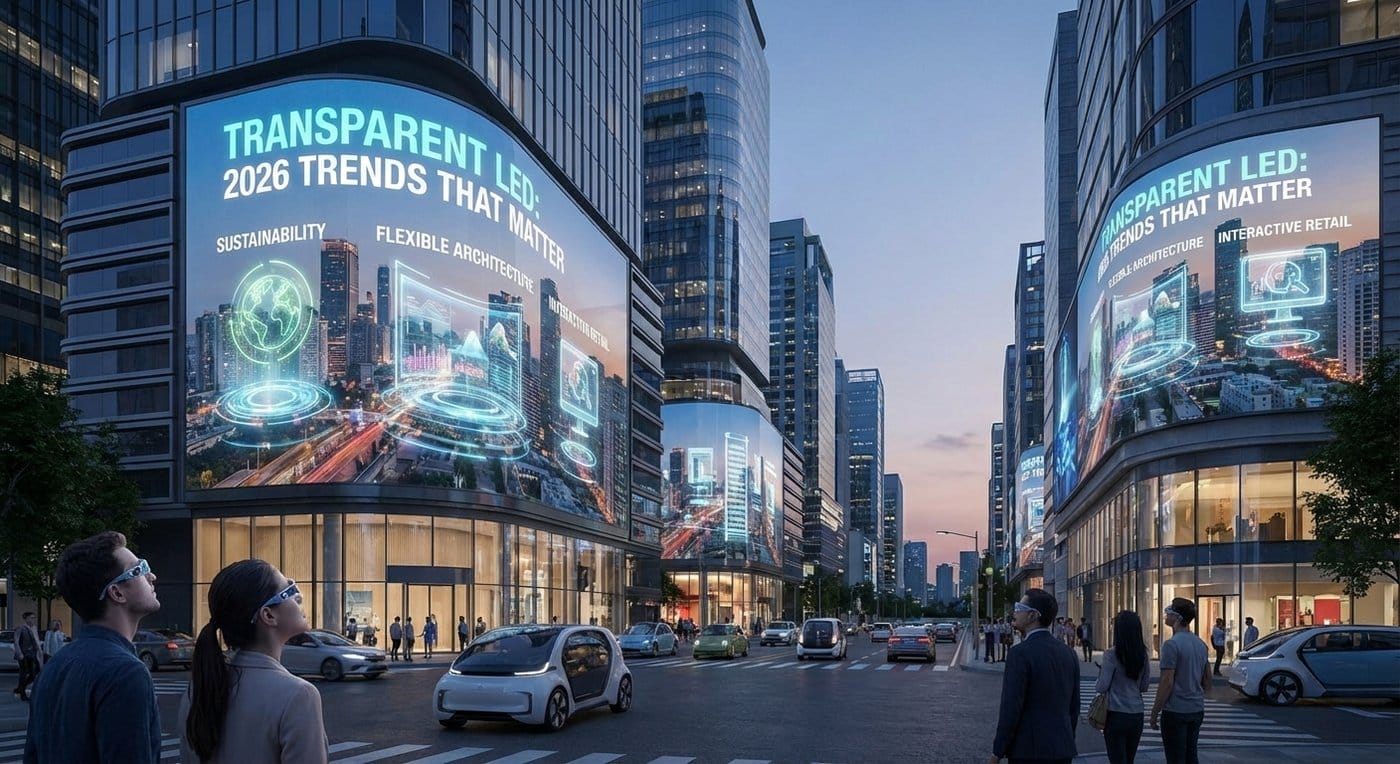
The guide forecasts “smart LED systems” becoming default by 2026 with IoT integration, plus AI-enabled dynamic content management and interactivity.
Buyer advice: even if you don’t need advanced AI features today, demand the fundamentals: remote status, alerts, temperature monitoring, and controlled brightness behavior.
The guide highlights growth across retail, architecture, museums, and events.
Transparent LED can create dynamic storefront displays that attract attention while maintaining visibility into the store—often improving engagement and sales behavior.
These displays are designed for lightweight, high-transparency formats suitable for architectural glass walls and commercial settings.
They can overlay digital information onto physical artifacts, creating interactive experiences that “bring exhibits to life.”
Transparent LED backdrops enhance stage design without blocking performers—high visual impact with better sightlines.
What actually changes buying decisions
What to ignore