Talk To Our Expert, Get A Solution in 20 minutes
Share your LED screen needs. Our experts will provide solutions and a quick response.

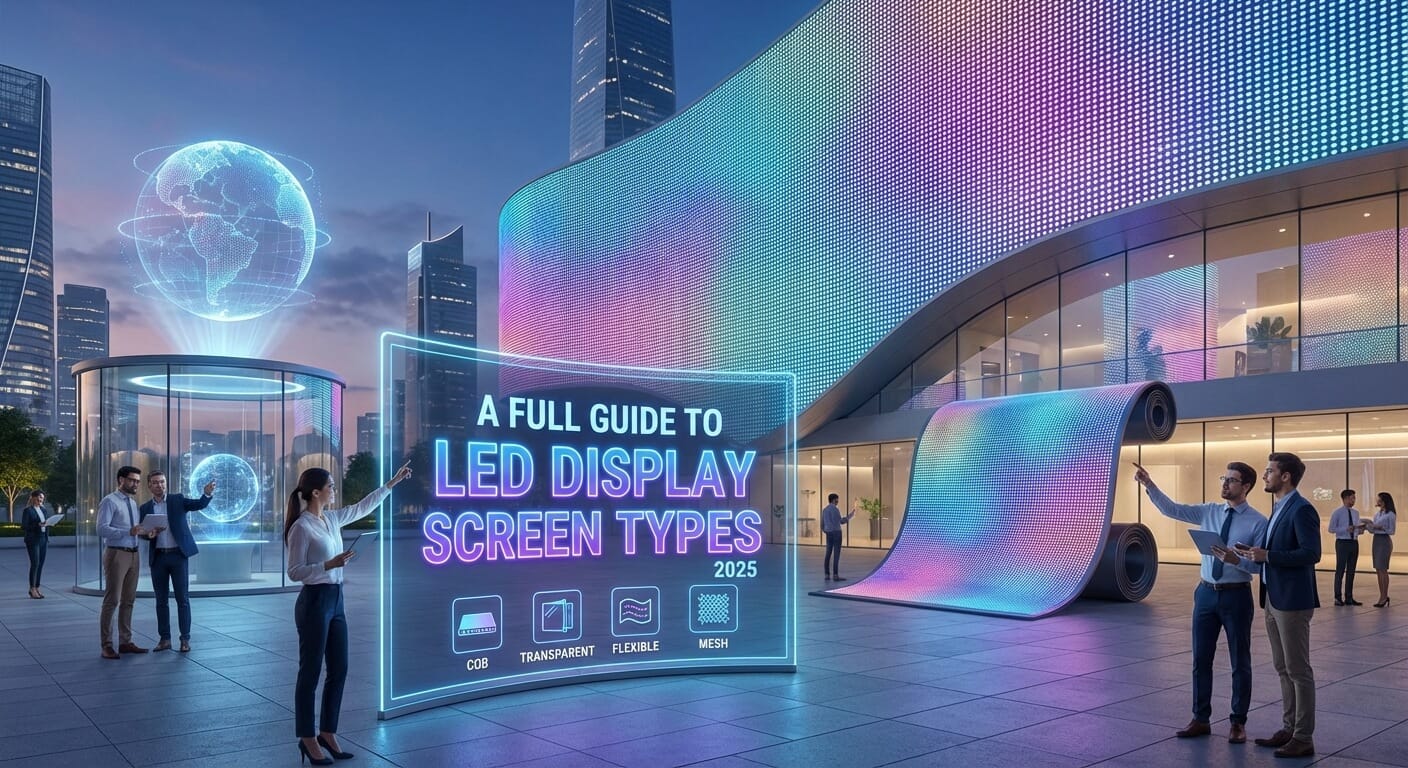
If you’ve ever searched “LED screen types,” you’ve probably noticed most guides mix application categories (indoor/outdoor), form factors (curved/sphere/cube), and LED packaging (SMD/COB/GOB) into one long list. That’s why buyers end up comparing the wrong things.
In 2025, the cleanest way to choose an LED display is to classify it layer by layer:
This guide follows that exact logic—and when you want deeper product-specific references, you’ll see internal links to ChinaLEDScreens pages (from your chinaledscreens.json mapping).
An LED screen (LED display) is a modular display system made of LED pixels mounted on circuit boards (modules), assembled into cabinets/frames, then driven by power and control electronics to create a large image.
Two important points professionals care about:
If you’re new to ChinaLEDScreens, start here: ChinaLEDScreens.
SMD is the most common LED pixel form in mainstream LED displays. The LED package is mounted onto the PCB surface (via SMT), and each pixel is formed by RGB emitters.
Why SMD is still everywhere in 2025
Watch-outs
DIP LEDs are the classic “through-hole lamp” style—high brightness and rugged, historically common in outdoor signage.
Where DIP still makes sense
Trade-offs
GOB is a protection method: a transparent resin/epoxy layer is applied over the LED module surface to fill gaps and improve impact resistance. (ViewSonic)
Why people choose GOB
Trade-offs
COB mounts LED chips directly onto the board (then encapsulates them), creating a more integrated pixel surface. It’s widely adopted in fine-pitch indoor walls because it can improve uniformity and robustness.
Why COB is trending in 2025
MiP (MicroLED in Package) is an advanced packaging approach often described as MicroLED packaged into a surface-mount format—pushing high resolution and yield/repair considerations for next-gen fine pitch. (theledstudio.co.uk)
Why MiP is gaining attention
This section translates the technologies above into buyer-facing display “types.”
Best for: simple outdoor signage, long-distance visibility, rugged brightness-focused installs. Not ideal for: high-resolution near-view applications.
Best for: the broadest range—indoor video walls, outdoor DOOH, rental stage walls (depending on cabinet design). Best practice: evaluate it with the whole system: cabinet flatness, calibration, sealing, and power design.
Best for: rentals, high-traffic public areas, interactive spaces where bumps and cleaning are real risks. Buying tip: request details on coating material, repair method, and uniformity control.
Best for: premium indoor fine pitch, corporate/showroom walls, control room “always on” installations. Buying tip: ask about calibration workflow, module replacement strategy, and uniformity across batches.
Best for: next-gen fine pitch projects aiming for very high pixel density and advanced packaging benefits. (theledstudio.co.uk) Buying tip: focus on serviceability (pixel repair approach), yield consistency, and supplier support maturity.
Single color (often red/green/amber/white). Typical uses: simple information boards, basic industrial signage, queue systems.
Two colors (commonly red+green). Typical uses: directional signs, simple messaging where emphasis matters.
RGB full-color video capability. Typical uses: video walls, DOOH billboards, retail storytelling, stage backdrops, architectural media.
In 2025, most commercial “LED screens” people talk about are full-color.
Core priorities
Core priorities
Pro tip: outdoor failure is often not “LED quality,” but system design: sealing, drainage, connectors, and thermal margins.
Designed for long-term operation in one location.
Typical features
Built for repeated assembly/disassembly.
Typical features
2025 rental trend: more projects demand “camera-friendly” performance for filming and live streaming. For virtual production and broadcast, high refresh (often cited around 7680Hz) helps reduce camera scan artifacts. (The Broadcast Bridge)
Pixel pitch is the distance between pixel centers (mm). Smaller pitch = higher resolution at close viewing distances.
A practical selection mindset:
Two common mistakes
Shape is usually the final layer after you’ve locked environment + structure + pitch.
Best for experiential retail, exhibitions, and multi-angle storytelling.
Used for iconic centerpieces and immersive art installations.
Common in branding zones, ceilings, and architectural highlights.
Improves immersion, reduces “panel look,” and looks premium in lobbies/showrooms.
Corner storytelling for retail and stage design—useful for wraparound content.
Enables creative surfaces and complex shapes; evaluate it carefully for long-term reliability and service approach.
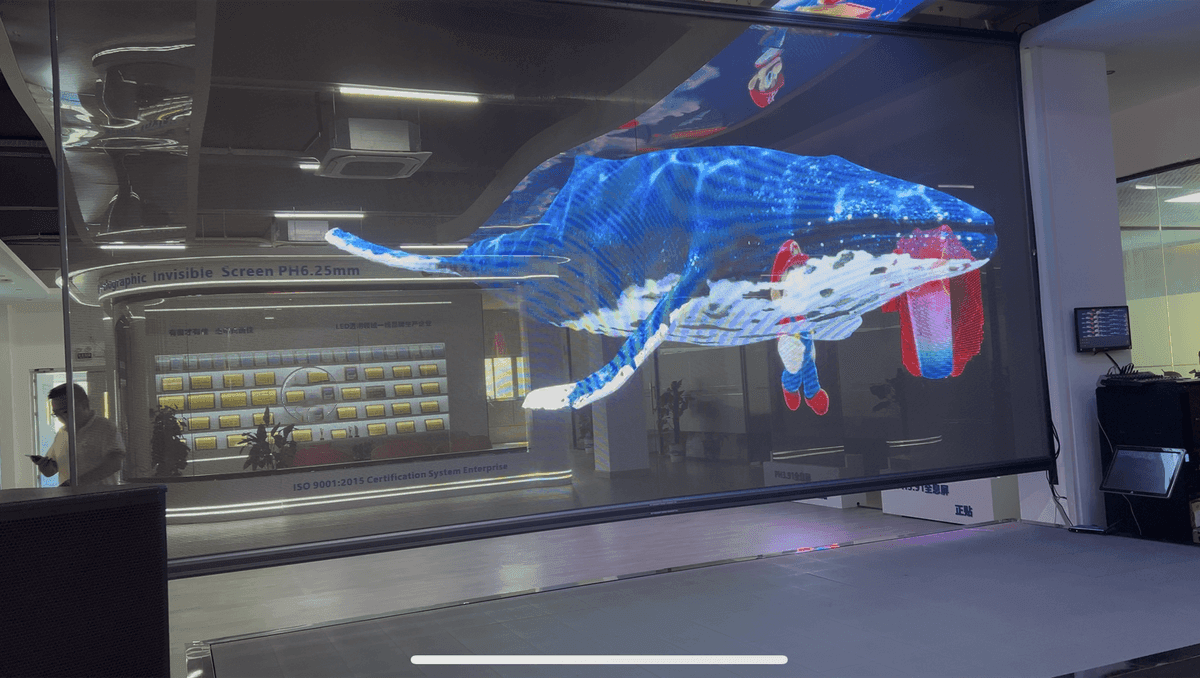
As we move further into 2025, the demand for “digital architecture” has surpassed the demand for simple black boxes. Architects and designers now require displays that integrate seamlessly with glass facades, allowing natural light to enter the building while projecting dynamic content to the outside. This category has fractured into several specialized technologies, each with unique structural properties and use cases.

The industry standard for retail windows. These screens are built using rigid light bars (usually aluminum) arranged horizontally to create a louver effect.
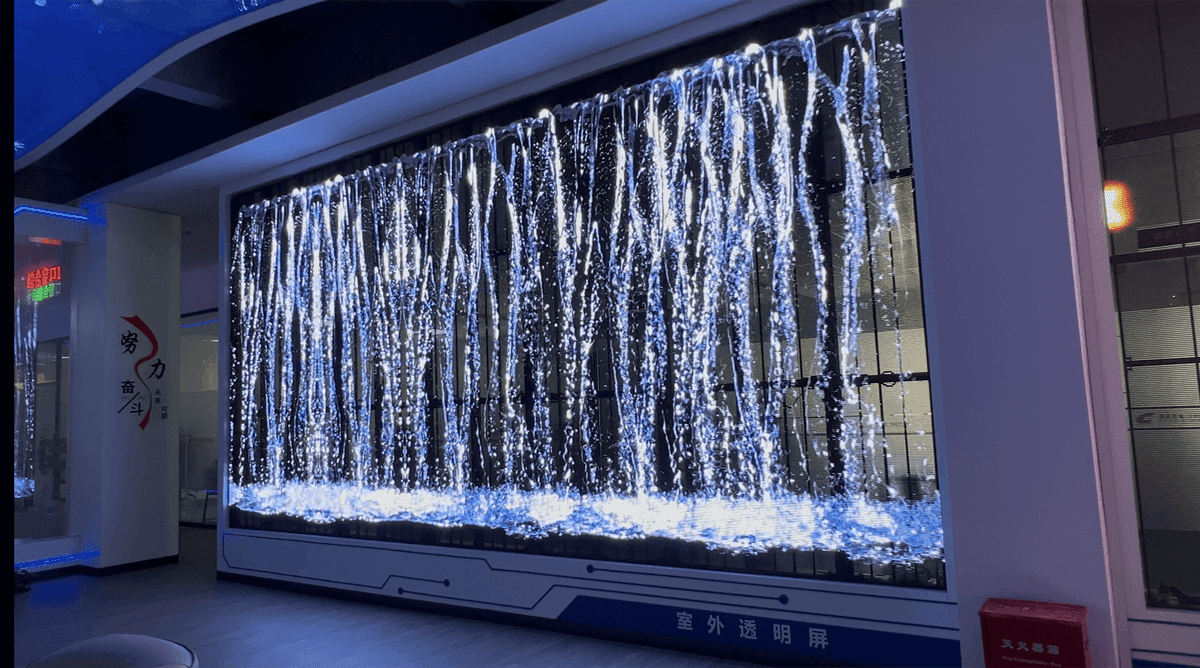
Unlike screens that are attached to glass, this technology embeds the LEDs inside the glass. It is a construction material first and a display second.
A retrofit revolution. This technology utilizes a specific adhesive PCB substrate that is ultra-thin and invisible.
Taking the film concept further, these screens use flexible polyimide materials and often utilize COB (Chip on Board) technology for greater durability and tighter pixel pitches.
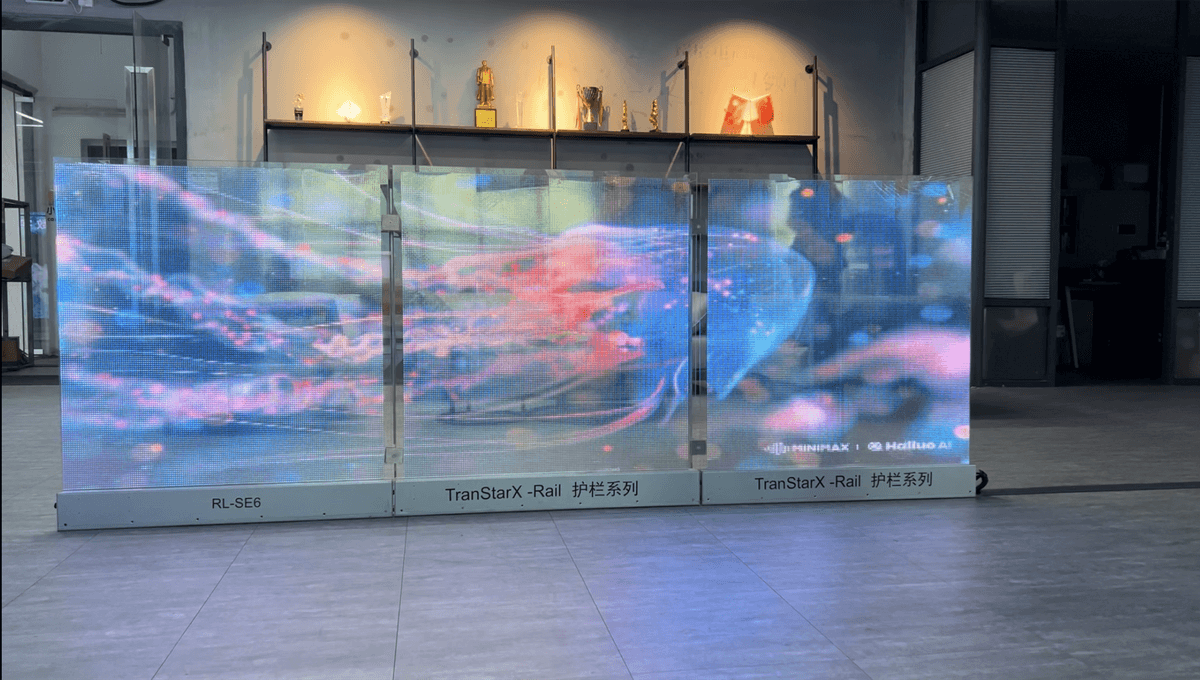
Also known as “invisible PCB” screens, these utilize advanced manufacturing to reduce the width of the PCB traces to near-invisibility (often less than 2mm).
The solution for massive scale. Mesh screens are flexible curtains of pixel dots held together by steel wire or durable plastic framing.
Often confused with mesh, Grille screens are rigid strip curtains designed for permanent outdoor installation.
The minimalistic approach to media facades. Instead of a dense screen, these are individual linear pixel bars spaced widely apart.
Key Advantage: Architectural accentuation. LED video light strips turn the building’s existing lines (mullions, ridges) into video elements, emphasizing the architecture rather than covering it up.
Structure: Individual rigid or flexible LED bars.
Application: Building contour lighting, bridge highlighting, and low-resolution media facades.
A portable, plug-and-play format popular for retail campaigns, showroom messaging, and events where fast deployment matters.
Designed for walk-on durability and interactive experiences; evaluate load rating, surface protection, and slip resistance.
In 2025, “LED display types” only becomes clear when you separate technology (SMD/DIP/COB/GOB/MiP), application structure (fixed vs rental), environment (indoor vs outdoor), and visual requirements (pitch + shape). Once you classify your project correctly, the “best type” usually becomes obvious—and your RFQ becomes much easier for suppliers to quote accurately.
If your project involves glass, façades, or transparent architectural media, ChinaLEDScreens can support you with factory-direct engineering, strict QC, and OEM/ODM-ready documentation. Start with the transparent family above—or visit ChinaLEDScreens.