Parla con il nostro esperto, ottieni una soluzione in 20 minuti
Condividi le tue esigenze in fatto di schermi LED. I nostri esperti ti forniranno soluzioni e una risposta rapida.

Uno LED display screen (direct-view LED) is a modular display built from many small LED pixels that emit light directly—no backlight. In real projects, it’s never “just a screen.” It’s a system: modules + cabinets + power + control + structure + calibration. If any one link is weak, you’ll see it as seams, color shift, flicker, or premature failures.
This 2025 guide gives engineers, AV integrators, agencies, architects/GCs, and B2B buyers a systematic knowledge base for specifying, integrating, and purchasing LED displays—without bias toward any single niche.
Every pixel is made of RGB sub-pixels (red/green/blue). Driver ICs regulate current and use PWM (pulse-width modulation) to control brightness thousands of times per second. A controller/processor converts your input signals into data for receiving cards, which drive each module.
Two important implications:
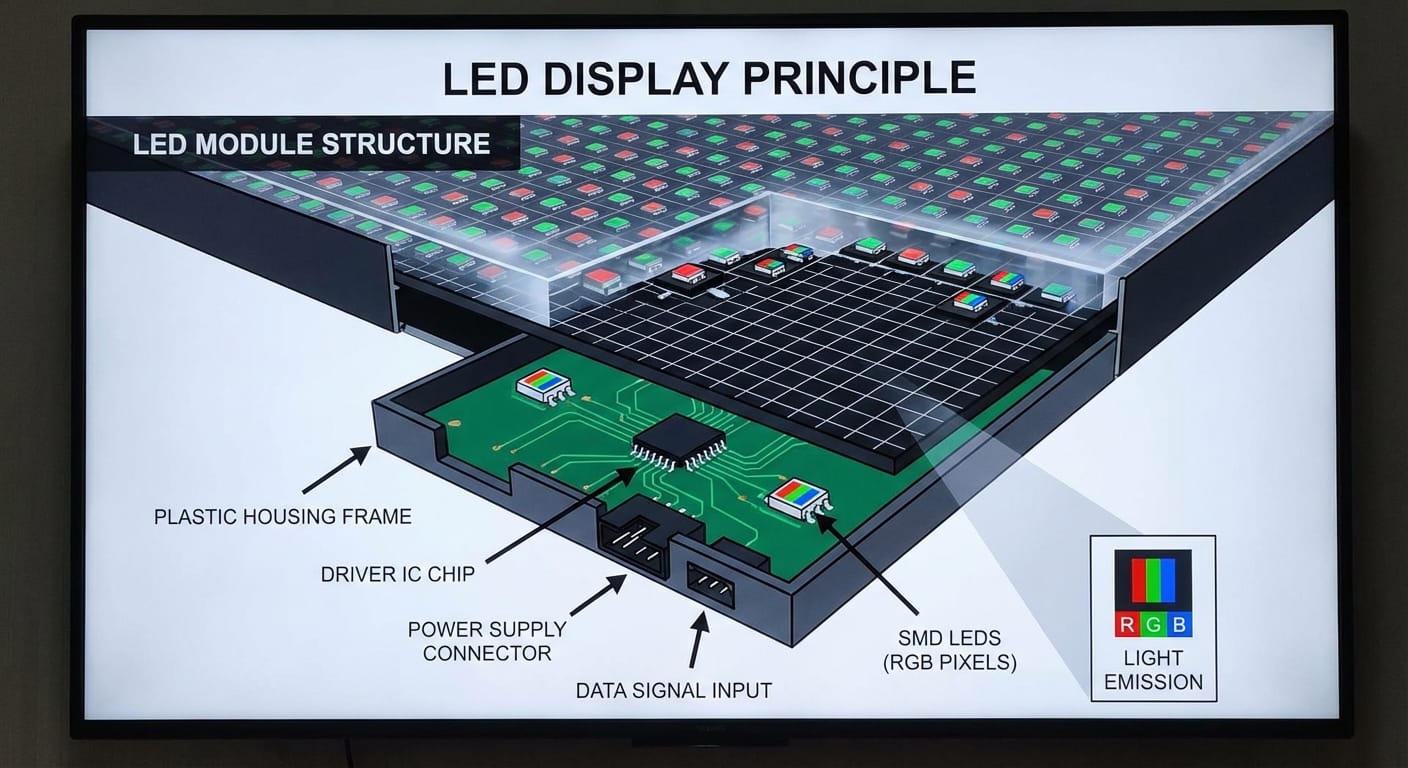
An LED display is not just a monitor; it is a modular system.
For architects and construction firms, understanding this modularity is key. It means LED screens can be built to any aspect ratio or size, untethered by the 16:9 constraints of consumer televisions.
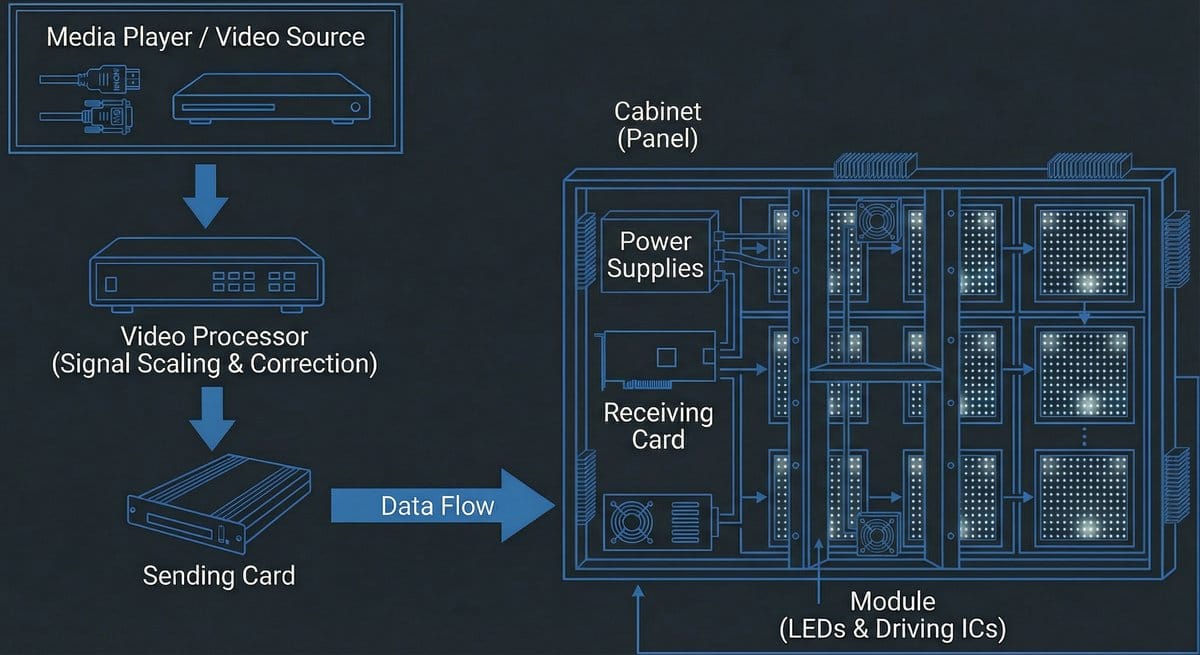
Modules carry LEDs, driver ICs, scan circuitry, and connectors. Their design impacts pixel geometry, thermal behavior, protection (ESD/coating), and the quality of low-brightness grayscale.
Cabinets keep modules flat and aligned. Flatness is not cosmetic—micro-warps change viewing angles, which changes perceived color and creates seam shadows. On a big wall, cabinet precision often decides whether a display looks “premium.”
LED loads change with content. A well-designed power system (quality PSU, correct distribution, clean grounding) prevents flicker, banding, and intermittent faults—especially over long cable runs.
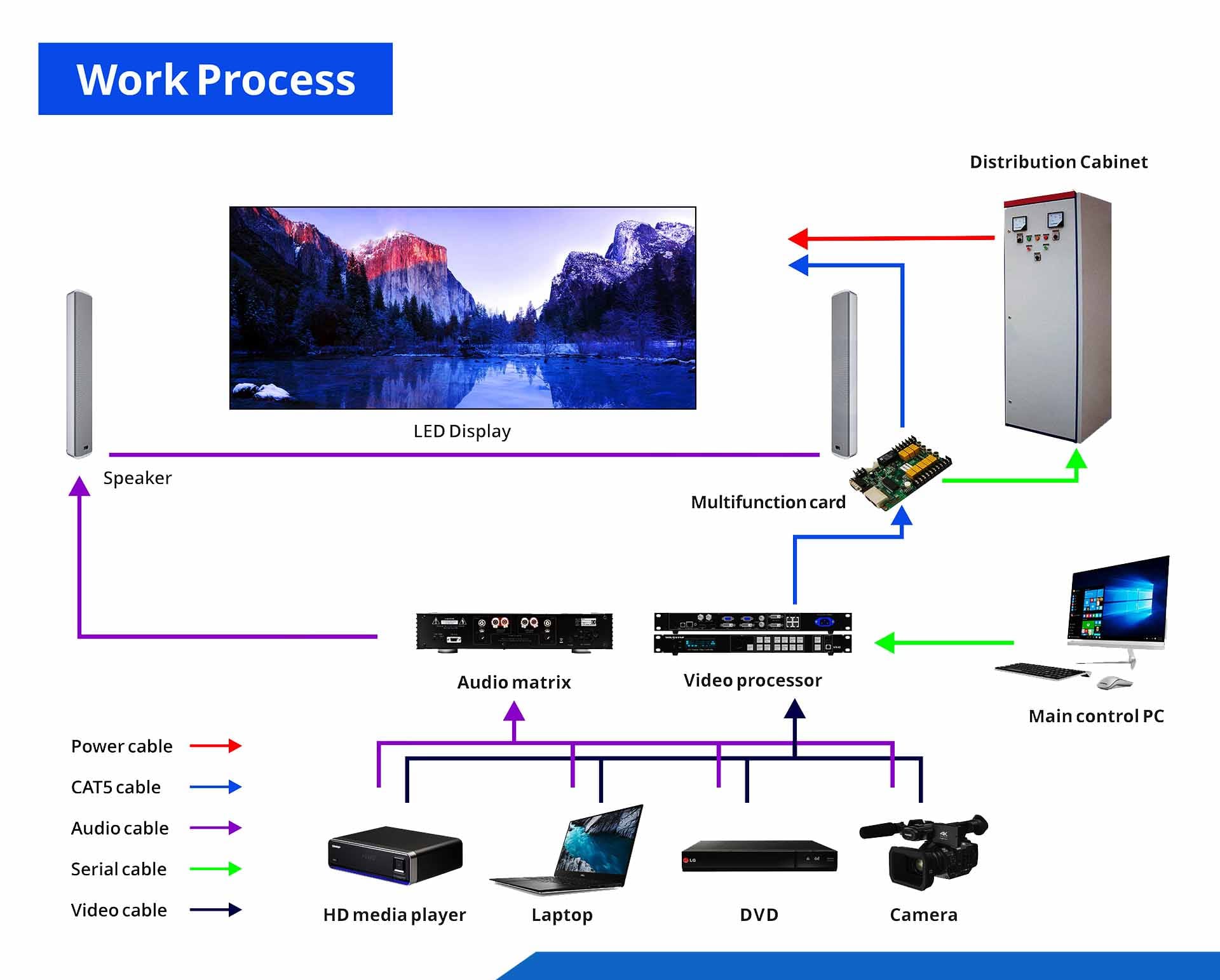
Typical chain: Source → processor → sending → receiving → modules. Broadcast/rental workflows may need genlock, low latency, 10-bit processing, and redundancy. Fixed signage may prioritize stability and remote monitoring.
Even good LEDs vary. Calibration aligns brightness and color across modules/cabinets and stabilizes gamma/grayscale. Skipping or rushing calibration is one of the fastest ways to make a capable wall look cheap.
The manufacturing method of the LED package dictates the screen’s durability, viewing angle, contrast, and repairability. In 2025, integrators must navigate five distinct technologies to choose the right panel for the environment.
Read More details about LED display packaging technologies->SMD vs. COB vs. GOB vs. MIP vs. DIP: qual è il packaging LED migliore per il vostro progetto di display?
LED display screens offer a multitude of advantages that make them a preferred choice for both indoor and outdoor visual communication needs. Their inherent qualities provide users with enhanced functionality, energy efficiency, and superior performance compared to traditional display technologies.
LED display screens are designed to have a remarkably long lifespan, typically ranging from 25,000 to 50,000 hours, with high-quality models reaching up to 100,000 hours. This longevity significantly outperforms traditional lighting options, which often require more frequent replacements. Consequently, LED displays reduce maintenance costs and waste, providing a more sustainable option for continuous use, especially in hard-to-reach locations.
One of the most significant advantages of LED display screens is their exceptional energy efficiency. Unlike older technologies that rely on backlighting systems, such as fluorescent lamps, LED screens emit light directly from tiny light-emitting diodes. This direct emission reduces energy consumption considerably, often leading to electricity savings of up to 90% compared to traditional incandescent bulbs and 50-60% compared to compact fluorescent lamps (CFLs). As a result, businesses benefit from lower electricity bills and a reduced carbon footprint, making LED technology an environmentally friendly choice.
The image quality offered by LED screens is another compelling advantage. With tightly packed pixels, LED displays deliver ultra-sharp, high-resolution images and vibrant colors. Their ability to produce high contrast ratios and wide viewing angles enhances the viewing experience, making LED displays ideal for engaging audiences in various settings, from retail environments to large public events. Moreover, the technology supports local dimming, allowing specific areas of the screen to dynamically adjust brightness, which improves overall contrast and color accuracy.
LED screens are highly versatile and can be customized to meet specific needs. Innovations in manufacturing and material design have led to the creation of flexible and ultra-thin displays, as well as options for curved and transparent screens. This adaptability not only enhances aesthetic appeal but also opens up new possibilities for creative installations, allowing businesses to effectively capture attention and deliver compelling visual experiences.
While the initial investment for LED technology may be higher, the long-term cost savings are substantial. Businesses often see a complete return on investment (ROI) within a few years due to the significant reduction in energy costs and the durability of the displays. For instance, one nightclub reported a 40% reduction in power usage with their new LED display, which helped attract more patrons while simultaneously lowering operational costs.
LED display screens have become integral to various sectors, owing to their versatility and dynamic capabilities. These displays are employed across a multitude of environments, enhancing visual communication and engagement in both indoor and outdoor settings.
One of the primary applications of LED displays is in the realm of advertising. Businesses utilize LED screens in commercial centers, storefronts, and outdoor locations to showcase advertisements, promotions, and event notifications, effectively capturing the attention of potential customers. Programmatic digital out-of-home (pDOOH) advertising allows brands to dynamically change content based on real-time factors such as weather, location, and consumer behavior, optimizing the impact of their advertisements.
LED displays serve a critical role in transportation guidance, providing essential information in places such as airports, train stations, and subways. These screens display timely updates, including arrival and departure times, delays, and other relevant travel information, ensuring that passengers remain informed and oriented. The ability to rotate content also allows for efficient communication of important details to tourists and commuters alike.
In the entertainment industry, LED display screens are widely used to enhance the visual experience at concerts, sports events, and live performances. These displays provide vivid colors and high-definition visuals, enriching stage scenes and creating an immersive atmosphere for audiences. Ultra-high-definition (UHD) displays, including 8K and MicroLED technologies, further enhance spectator experiences by providing detailed close-ups, live replays, and player statistics in sports venues.
LED displays are increasingly employed for internal communication within organizations. They replace traditional paper notice boards, allowing administrations to share information instantly and efficiently. Schools, colleges, and businesses can update schedules, events, and important announcements with just a few clicks. This adaptability makes digital signage an effective tool for engaging employees and visitors alike, promoting a more connected environment.
The rise of interactive LED displays has opened new avenues for engagement in various sectors. From retail environments to theme parks, interactive displays allow users to engage with content in real-time, enhancing the overall experience. For instance, in sports stadiums, interactive displays can shift from providing team information to wayfinding, making them a versatile tool for enhancing visitor experiences.
Cities are increasingly adopting LED displays as part of their smart city initiatives. These screens provide critical information, such as wayfinding, public safety alerts, and updates on community events. By improving urban communication, LED displays help streamline city operations and keep residents informed about local happenings.
As we look toward 2025, several key trends and innovations are poised to reshape the LED display landscape, driven by advancements in technology and a growing focus on sustainability. This section explores emerging developments in LED technology, highlighting the features that will define the next generation of displays.
Artificial Intelligence (AI) integration is set to revolutionize LED technology by introducing real-time interactivity and responsiveness to displays. AI-enabled LED screens can adapt content dynamically based on audience demographics and environmental factors, providing a personalized viewing experience that enhances engagement. This capability is especially valuable in retail settings, where businesses can tailor promotions and information to meet the specific needs of customers, thus transforming passive viewing into an interactive journey.
Transparent LED displays are gaining popularity in retail, advertising, and exhibition spaces, allowing for engaging content without obstructing the view of products or artifacts behind them. This trend is particularly evident in the use of transparent displays on store windows, where they can showcase dynamic content while maintaining visibility. In the corporate sector, these displays are being integrated into architectural designs, offering modern aesthetics combined with functional benefits, thus redefining digital content presentation.
The demand for ultra-fine pixel pitch technology is expected to rise significantly in 2025, delivering stunning visual clarity even from close viewing distances. This advancement is particularly important for indoor LED panels, where resolution quality continues to improve, enhancing the overall viewing experience for audiences.
With increasing awareness of environmental issues, LED manufacturers are focusing on sustainability as a core component of their innovations. LED displays are inherently more energy-efficient than traditional technologies, boasting lower power consumption and a longer lifespan. Additionally, manufacturers are now exploring materials innovation by utilizing recycled and reclaimed materials in the production of LED products, contributing to a circular economy and reducing waste.
LED excels when you need very large size, high ambient light, long duty cycles, or forme creative. LCD/OLED can be more cost-effective for smaller, close-view applications; projection can still win for temporary or ultra-large, low-brightness environments.
A simple rule: choose the technology that makes your total system easiest (image + structure + service + workflow), not the one with the flashiest brochure.
Smaller pitch = higher resolution per area. But pitch must match the closest typical viewing distance and your content. Over-spec pitch wastes budget; under-spec pitch shows pixel structure and moiré.
Brightness must match ambient light. The pro question is: What brightness can the screen hold continuously without thermal throttling or unstable color? Also validate uniformity (center vs edge) and power budget at bright scenes.
For events and broadcast, confirm refresh rate, scan design, PWM frequency, and real shutter test results. These affect flicker, rolling-shutter artifacts, and banding.
Marketing “HDR” claims don’t guarantee good shadows. What matters is stable low-brightness performance, consistent gamma, and solid calibration.
Contrast depends heavily on surface design and reflections. Two screens with similar LEDs can look very different under downlights or sunlight spill.
Outdoor/coastal projects need corrosion strategy, sealing design, operating temperature range, and service access planning—not just an IP number.
Decide early: front service vs rear service, spare parts plan, and whether calibration data follows modules after replacement.
Retail, lobbies, showrooms, auditoriums, control rooms. Priorities: flatness, uniformity, low noise, long-term stability, and predictable service.
Fast rigging and repeatability matter. Priorities: lightweight cabinets, strong corner protection, quick locks, and a processor chain that behaves on camera.
Priorities: brightness, weather resistance, wind/structure, corrosion management, safe maintenance access, and remote monitoring.
Curves, columns, transparent surfaces, special visual effects. Priorities: mechanical integration, safety, and content design.
Define content type, viewing distances, ambient light, target resolution/aspect ratio, service access constraints, and local electrical/structural requirements.
Serious projects require layout drawings (pixel map), elevations, power/signal routing, structure details, and O&M manuals. This is where factory discipline and engineering support matter most.
The most reliable screens are built like industrial products: component screening, burn-in/aging, documented tests, and controlled calibration. ChinaLEDScreens outlines its approach to binning, aging, and calibration here: Tecnologia e qualità. (Schermi LED trasparenti)
Commissioning includes electrical verification, signal checks, calibration, processor configuration, redundancy tests (if used), and handover training—not just powering on.
For a reference on supplier-side engineering deliverables (CAD/BIM docs, OEM/ODM workflows, warranty planning), see: Servizi. (Schermi LED trasparenti)
When sourcing displays or issuing tenders, focus on these metrics:
| Scenario | What viewers do | Top specs to prioritize (in order) |
|---|---|---|
| Control room / boardroom (close-view) | Read small text for long hours | Pixel pitch, cabinet flatness/seams, low-brightness grayscale, refresh/PWM, color uniformity & calibration |
| Retail / lobby / showroom (mid-view) | Mixed distance + brand visuals | Brightness & anti-glare, contrast (black surface), pixel pitch, color accuracy, reliability/serviceability |
| Stage / audience (far-view) | Watch motion content | Brightness, refresh/motion handling, pixel pitch (not overkill), rigging & safety, fast service |
| Broadcast / on-camera | Cameras see artifacts first | Refresh + PWM + scan, grayscale, processor pipeline, moiré control, camera test proof |
| Outdoor billboard / roadside | Sunlight + weather | Sustained brightness, IP rating, thermal/corrosion design, power distribution, remote monitoring |
| Architectural / glass / “see-through” | Must preserve sightlines | Transparency vs brightness tradeoff, structure integration, daylight readability, service access, safety compliance |
Most LED deployments are classic video walls, rental stages, and outdoor signage. But when a project involves glass—storefronts, atriums, curtain walls, partitions—transparent and lightweight formats can solve problems solid panels can’t:
These are specialized formats, but they still follow the same fundamentals above: geometry, power, control, calibration, and serviceability.
Treat LED as a system, not a commodity. When requirements, engineering, manufacturing QA, and commissioning are aligned, an LED screen becomes a reliable asset—not a maintenance headache.
Explore the full ChinaLEDScreens portfolio and contact options here: Schermi LED cinesi. (Schermi LED trasparenti)